
A Variant of Asymmetric Propeller with Equilateral Triangles
Loading the math board and drawing, please wait…
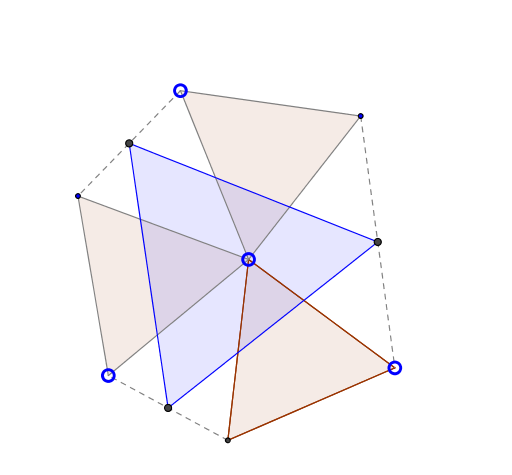
This example demonstrates an asymmetric propeller composed of equal-sized equilateral triangles. Core math concepts include equilateral triangles, rotation, angles, and matrix transformations. Construction highlights involve commands like Circle, Polygon, Point, Rotate, Ray, Intersect, Line, and Segment in GeoGebra. Suitable for high school and above students to explore geometric transformations and polygon combinations.
GeoGebra Commands & Parameters
Circle(A, Distance[A, B]) → hPolygon(B, A, 3) → poly5, p_1, q_1, r_1, NPolygon(A, B, C) → poly1, c, a, bPoint(h) → DRotate(D, (-Angle[A, B, C]), A) → D'Ray(A, D') → fCircle(A, Distance[A, B]) → dIntersect(d, f, 1) → EPolygon(A, D, E) → poly2, e, a_1, d_1Point(h) → FRotate(F, (-Angle[B, C, A]), A) → F'Ray(A, F') → gIntersect(h, g, 1) → GPolygon(G, A, F) → poly3, f_1, g_1, a_2Line(G, c) → iLine(B, f_1) → jLine(C, e) → kLine(D, b) → lLine(E, g_1) → mLine(F, d_1) → nIntersect(m, n) → HIntersect(i, j) → ISegment(G, I) → pSegment(I, B) → qSegment(F, H) → sSegment(H, E) → tIntersect(k, l) → JSegment(C, J) → rSegment(J, D) → h_1Segment(I, A) → i_1Segment(A, H) → j_1Segment(A, J) → k_1Segment(G, B) → l_1Segment(C, D) → m_1Segment(F, E) → n_1Polygon(K, M, L) → poly4, l_2, k_2, m_2