
A Variant of Asymmetric Propeller: Similar Triangles in Rotation
Loading the math board and drawing, please wait…
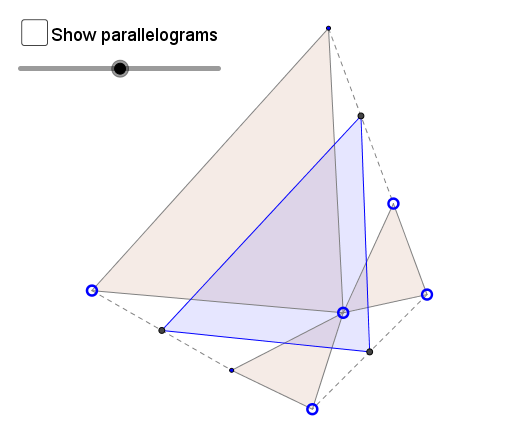
① This example illustrates a variant of the asymmetric propeller, a geometric configuration where three similar triangles are rotated around a central point, producing a visually striking pattern. ② Core mathematical concepts include similar triangles, rotation transformations, polygon construction, and the interplay of points, lines, and circles. ③ The construction employs GeoGebra commands such as Polygon, Rotate, Ray, Circle, Intersect, Line, and Segment to build multiple polygons (poly1, poly2, poly3) and associated points (D, E, F, G, etc.), with additional elements like Histogram and Prism possibly for data representation. ④ It is suitable for middle and high school geometry lessons, dynamic geometry demonstrations, or as an artistic exploration of symmetry and transformation, helping students visualize how similarity and rotation interact.
GeoGebra Commands & Parameters
Polygon(A, B, C) → poly1, c, a, bRotate(D, (-Angle[A, B, C]), A) → D'Ray(A, D') → fCircle(A, (Distance[A, D] * Distance[A, B] / Distance[B, C])) → dIntersect(d, f, 1) → EPolygon(A, D, E) → poly2, e, a_1, d_1Rotate(F, (-Angle[B, C, A]), A) → F'Ray(A, F') → gCircle(A, (Distance[A, F] * Distance[B, C] / Distance[A, C])) → hIntersect(h, g, 1) → GPolygon(G, A, F) → poly3, f_1, g_1, a_2Line(G, c) → iLine(B, f_1) → jLine(C, e) → kLine(D, b) → lLine(E, g_1) → mLine(F, d_1) → nIntersect(m, n) → HIntersect(i, j) → ISegment(G, I) → pSegment(I, B) → qSegment(F, H) → sSegment(H, E) → tIntersect(k, l) → JSegment(C, J) → rSegment(J, D) → h_1Segment(I, A) → i_1Segment(A, H) → j_1Segment(A, J) → k_1Segment(G, B) → l_1Segment(C, D) → m_1Segment(F, E) → n_1Polygon(K, M, L) → poly4, l_2, k_2, m_2