
A Variant of Asymmetric Propeller with Varying Equilateral Triangles
Loading the math board and drawing, please wait…
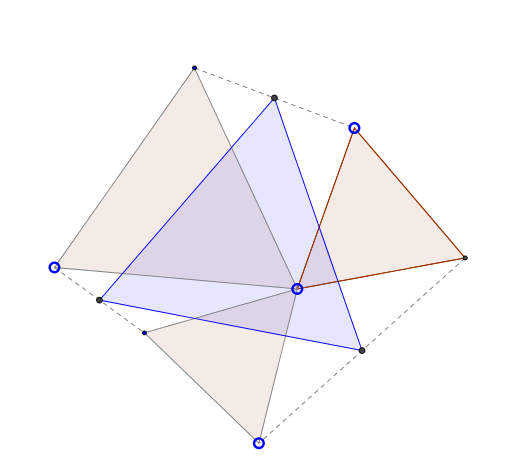
This example demonstrates an asymmetric propeller pattern constructed from equilateral triangles of varying sizes. It involves core mathematical concepts such as equilateral triangles, stochastic processes, exponential functions, conditional probability, random experiments, LCM, and GCD. The construction utilizes GeoGebra commands like Polygon, Rotate, Ray, Circle, Intersect, Line, and Segment. It is suitable for high school mathematics education, showcasing the integration of geometric transformations and probability statistics.
GeoGebra Commands & Parameters
Polygon(B, A, 3) → poly5, p_1, q_1, r_1, NPolygon(A, B, C) → poly1, c, a, bRotate(D, (-Angle[A, B, C]), A) → D'Ray(A, D') → fCircle(A, (Distance[A, D] * Distance[A, B] / Distance[B, C])) → dIntersect(d, f, 1) → EPolygon(A, D, E) → poly2, e, a_1, d_1Rotate(F, (-Angle[B, C, A]), A) → F'Ray(A, F') → gCircle(A, (Distance[A, F] * Distance[B, C] / Distance[A, C])) → hIntersect(h, g, 1) → GPolygon(G, A, F) → poly3, f_1, g_1, a_2Line(G, c) → iLine(B, f_1) → jLine(C, e) → kLine(D, b) → lLine(E, g_1) → mLine(F, d_1) → nIntersect(m, n) → HIntersect(i, j) → ISegment(G, I) → pSegment(I, B) → qSegment(F, H) → sSegment(H, E) → tIntersect(k, l) → JSegment(C, J) → rSegment(J, D) → h_1Segment(I, A) → i_1Segment(A, H) → j_1Segment(A, J) → k_1Segment(G, B) → l_1Segment(C, D) → m_1Segment(F, E) → n_1Polygon(K, M, L) → poly4, l_2, k_2, m_2