
A Booklet on Axial Symmetry: Exploring Mirror Transformations
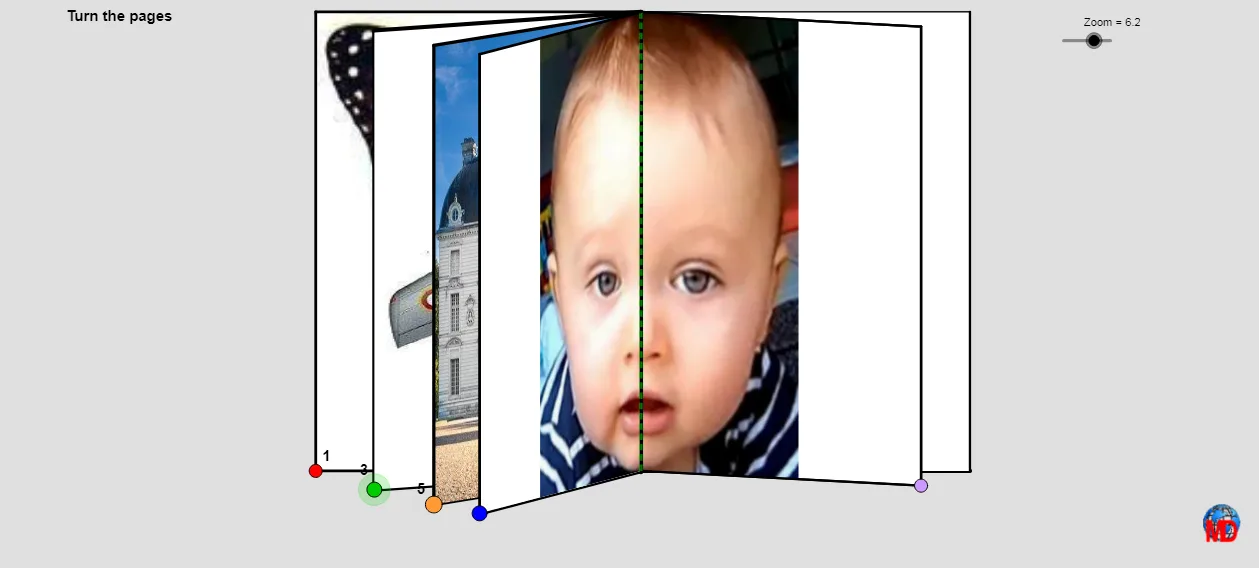
Loading the math board and drawing, please wait…
① This interactive booklet demonstrates axial symmetry (mirror symmetry) by showing how geometric figures are reflected across a line of symmetry, making the transformation visually intuitive. ② Core mathematical concepts include axial symmetry, symmetric points, reflection, midpoints, perpendicular lines, and properties of symmetric figures, along with basic elements like circles, ellipses, polygons, and vectors. ③ Construction highlights: Based on the construction summary, the example uses GeoGebra commands such as Midpoint, Mirror, CircleArc, Point, Line, OrthogonalLine, Vector, Translate, Arc, Polygon, Distance, Intersect, Circle, Segment, Sequence, PointIn, and Rotate. It creates multiple symmetric points (e.g., J', L'_1, J'') and reflected shapes, using auxiliary lines, circles, and arcs to build the symmetric structure. ④ Suitable for middle school geometry lessons (e.g., axial symmetry units) or math clubs, this resource helps students intuitively grasp symmetry transformations, explore properties hands-on, and serves as a reference for teachers creating interactive materials.
GeoGebra Commands & Parameters
Midpoint(A, B) → CMidpoint(E, C) → FMidpoint(E, F) → JMidpoint(J, E) → L_2Mirror(J, E) → J'Mirror(L_2, J') → L'_1Mirror(J', L'_1) → J''CircleArc(J'', A, B) → cPoint(c) → HCircleArc(J'', H, B) → f_1Line(A, B) → bOrthogonalLine(C, b) → aMidpoint(F, C) → G_2OrthogonalLine(I, b) → dLine(H, a) → eMidpoint(J, E) → KVector(C, E) → uTranslate(J', u) → J''_1Translate(A, u) → A'Translate(B, u) → B'_1Arc(Translate[Circle[J', A], u], A', B'_1) → c'Midpoint(J', L'_1) → M_2Translate(H, u) → NPolygon(C, H, N, E) → poly1, c_1, h, n, e_1Distance(A, H) → aaLine(E, b) → fIntersect(f, d) → OPolygon(E, O, I, C) → poly3, e_3, o, i, c_3Midpoint(I, C) → PMirror(B, P) → B'Line(B', o) → gLine(B, o) → jCircle(I, B) → kIntersect(d, o) → QIntersect(k, d) → R, SCircle(O, B'_1) → pIntersect(p, o) → T,Line(T, f) → lLine(S, b) → mIntersect(l, g) → UIntersect(m, g) → VIntersect(m, j) → WMidpoint(O, V) → ZMidpoint(U, I) → B_1Midpoint(G_2, V) → D_1Line(D_1, c_1) → qIntersect(q, h) → E_1Midpoint(K, J) → G_1Line(G_1, q) → sLine(G_1, n) → rIntersect(r, h) → F_1Point(f_1) → GTranslate(G, u) → I_1Polygon(E, I_1, G, C) → poly5, e_5, i_1, h_2, c_5Midpoint(I_1, G) → J_1Midpoint(T, I) → K_1Midpoint(K_1, I) → L_1Midpoint(G_2, L_1) → M_1Segment(C, I) → g_1Segment(C, G) → j_1Segment(C, I) → b_1CircleArc(J'', G, B) → k_1Point(k_1) → LTranslate(L, u) → L'Polygon(E, L', L, C) → poly6, l_1, m_1, n_1, p_1CircleArc(J'', L, B) → q_1Point(q_1) → MTranslate(M, u) → M'Polygon(E, M', M, C) → poly7, r_1, s_1, t_1, a_2Distance(A, G) → bbMidpoint(M', M) → N_1Polygon(N, E, C, H) → poly8, b_2, d_2, f_2, g_2Midpoint(I_1, G) → H_1Midpoint(e_1) → O_1Midpoint(E, O_1) → P_1Line(P_1, l_1) → a_1Intersect(a_1, m_1) → Q_1Midpoint(M, C) → R_1Midpoint(M, R_1) → S_1Midpoint(S_1, R_1) → T_1Midpoint(S_1, T_1) → U_1Midpoint(p_1) → V_1Midpoint(M', E) → W_1Midpoint(M', W_1) → Z_1Midpoint(Z_1, W_1) → A_2Midpoint(Z_1, A_2) → B_2Point(p_1) → D_2Intersect(p_1, l_1) → E_2Polygon(D_2, E_2, O, I) → poly2, d_1, e_2, o_1, i_2Midpoint(D_2, I) → C_2Midpoint(C_2, I) → F_2Midpoint(C_2, F_2) → H_2Segment(O, I) → h_1Segment(E_2, O) → c_2Midpoint(C_2, H_2) → I_2Point(q_1) → J_2Segment(J_2, C) → j_2Polygon(E, K_2, J_2, C) → q1, e_4, k_2, l_2, c_4Midpoint(j_2) → N_2Midpoint(N_2, J_2) → O_2Midpoint(O_2, N_2) → P_2Midpoint(P_2, N_2) → Q_2Segment(K_2, J_2) → m_2Intersect(e_4, c_4) → R_2Segment(R_2, K_2) → n_2Polygon(R_2, K_2, J_2, C) → q2, r_2, p_2, q_2, c_6Sequence(Segment[Element[Marque, i], Element[Marque, i + 1]], i, 1, Length[Marque]) → TraitPointIn(poly2) → S_2Mirror(Trait, a_2) → Trait'Rotate(Trait', 2, a_2) → Trait''
AI Drawing Prompt Reference
Draw an axial symmetric figure with points A, B, C, E, J, L1, J', L1', and J''. First, find the midpoint C of A and B, then find the midpoint F of E and C, followed by the midpoint J of E and F, and the midpoint L2 of J and E. Mirror J over E to get J', mirror L2 and J' to get L1', and mirror J' and L1' to get J''. Draw a circular arc c with J'' as the center and A and B as endpoints, and take point H on c. Draw a circular arc f1 with J'' and H, draw the line b through A and B, draw the perpendicular line a from C to b, find the midpoint G2 of F and C, draw the perpendicular line d from I to b, draw the line e from H to a, find the midpoint K of J and E, draw the vector u from C to E, translate J' by u to get J''1, translate A and B by u to get A' and B'1, draw a circular arc c' with Translate[Circle[J', A], u] as the center and A' and B'1 as endpoints, find the midpoint M2 of J' and L1', translate H by u to get N, draw the polygon poly1 with C, H, N, and E, find the distance aa from A to H, draw the line f through E and b, find the intersection O of f and d, draw the polygon poly3 with E, O, I, and C, find the midpoint P of I and C, mirror B over P to get B', draw the line g from B' to o, draw the line j from B to o, draw the circle k with I as the center and B as the radius, find the intersection Q of d and o, find the intersection R and S of k and d, draw the circle p with o as the center and B'1 as the radius, find the intersection T of p and o, draw the line l from T to f, draw the line m from S to b, find the intersection U of l and g, find the intersection V of m and g, find the intersection W of m and j, find the midpoint Z of V and O, find the midpoint B1 of V and U, find the midpoint D1 of V and G2, draw the line q from D1 to c1, find the intersection E1 of q and h, find the midpoint G1 of K and J.
The prompt above was compiled from the original drawing commands and is for reference only.