
60-Degree Sector Surprise!
Loading the math board and drawing, please wait…
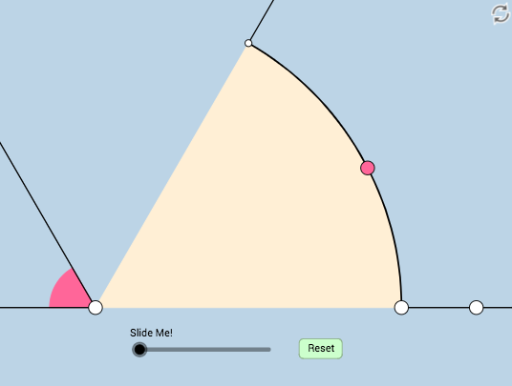
This dynamic illustration demonstrates a special phenomenon found inside any 60-degree sector of a circle using GeoGebra commands such as rotation, mirroring, and circle arcs. Suitable for high school geometry and trigonometry studies.
GeoGebra Commands & Parameters
Ray(A, B) → jPoint(j) → DSegment(A, D) → r_1Line(A, B) → fRotate(B, π / 3, A) → B'Angle(B, A, B') → αRotate(B', π / 3, A) → B''Angle(B', A, B'') → βRay(A, B'') → gRay(A, B') → hPoint(h) → CMirror(B, A) → B'_1Segment(C, D) → iRay(A, B'_1) → kSegment(A, D) → lSegment(A, C) → mCircle(A, (0.15 * r_1)) → cIntersect(c, k, 1) → EIntersect(c, g) → F,CircleSector(A, F, E) → dRotate(d, If[0 < a ≤ 1, ((-a) * π / 3), ((-π)) / 3], A) → d'Rotate(d', If[2 < a ≤ 3, ((-(a - 2)) * π / 3), ((-π)) / 3], A) → d''Line(A, C) → nOrthogonalLine(D, n) → pIntersect(n, p) → JLine(A, D) → qOrthogonalLine(C, q) → rIntersect(r, q) → HLine(A, C) → n_1Circle(C, 1) → e_1Intersect(e_1, n_1, 2) → NCircle(A, 1) → p_1Intersect(p_1, n_1) → O, PRay(A, D) → s_1Circle(D, 1) → t_1Intersect(t_1, s_1) → Q, RLine(A, C) → q_1Circle(A, D) → c_1Intersect(c_1, q_1) → U, VCircleArc(A, D, V) → ePoint(e) → GRay(D, B) → sMidpoint(A, D) → IDilate(A, If[3 < a ≤ 4, 4 - a, 0], I) → A'Circle(V, 1) → tMidpoint(A, V) → KMidpoint(G, V) → LMidpoint(D, G) → SDistance(I, S) → distanceISDistance(S, L) → distanceSLDistance(L, K) → distanceLKDistance(K, I) → distanceKIIntersect(t, q_1, 2) → TRay(V, T) → bDilate(A, If[3 < a ≤ 4, 4 - a, 0], K) → A'_1Segment(A, A') → f_1Segment(A, A'_1) → g_1Rotate(A, If[4 < a ≤ 5, ((-(a - 4)) * π), (-π)], I) → A'_2Rotate(A', If[4 < a ≤ 5, ((-(a - 4)) * π), (-π)], I) → A''Segment(A'_2, A'') → h_1Rotate(A, If[4 < a ≤ 5, ((-(a - 4)) * π), (-π)], K) → A'_3Rotate(A'_1, If[4 < a ≤ 5, ((-(a - 4)) * π), (-π)], K) → WSegment(A'_3, W) → i_1Dilate(G, If[5 < a ≤ 6, 6 - a, 0], S) → G'Dilate(G, If[5 < a ≤ 6, 6 - a, 0], L) → G'_1Segment(G, G') → a_1Segment(G, G'_1) → b_1Dilate(L, If[6 < a ≤ 7, 7 - a, 0], V) → L'Dilate(S, If[6 < a ≤ 7, 7 - a, 0], D) → S'Segment(L, L') → d_1Segment(S, S') → f_2Rotate(G, If[7 < a ≤ 8, ((a - 7) * π), π], S) → G'_2Rotate(G', If[7 < a ≤ 8, ((a - 7) * π), π], S) → G''Segment(G'_2, G'') → j_1Rotate(G, If[7 < a ≤ 8, ((a - 7) * π), π], L) → G'_3Rotate(G'_1, If[7 < a ≤ 8, ((a - 7) * π), π], L) → ZSegment(G'_3, Z) → k_1Dilate(I, If[8 < a ≤ 9, 9 - a, 0], S) → I'Segment(I, I') → l_1Angle(S, I, K) → γRotate(I, If[9 < a ≤ 10, ((a - 9) * γ), γ], I) → I'_1Rotate(I', If[9 < a ≤ 10, ((a - 9) * γ), γ], I) → I''Segment(I'_1, I'') → m_1Dilate(I, If[10 < a ≤ 11, 11 - a, 0], K) → I'_2Vector(I, I'_2) → uTranslate(I, u) → I'_3Translate(I', u) → I''_1Segment(I'_3, I''_1) → g_2Dilate(K, If[11 < a ≤ 12, 12 - a, 0], L) → K'Vector(K, K') → vTranslate(I'_1, v) → MTranslate(I'', v) → I'''Segment(M, I''') → h_2CircleSector(A, D, V) → c_2Polygon(I, S, L, K) → poly1, i_2, s_2, l_2, k_2