
3D Parametric Curve from Three Planes
Loading the math board and drawing, please wait…
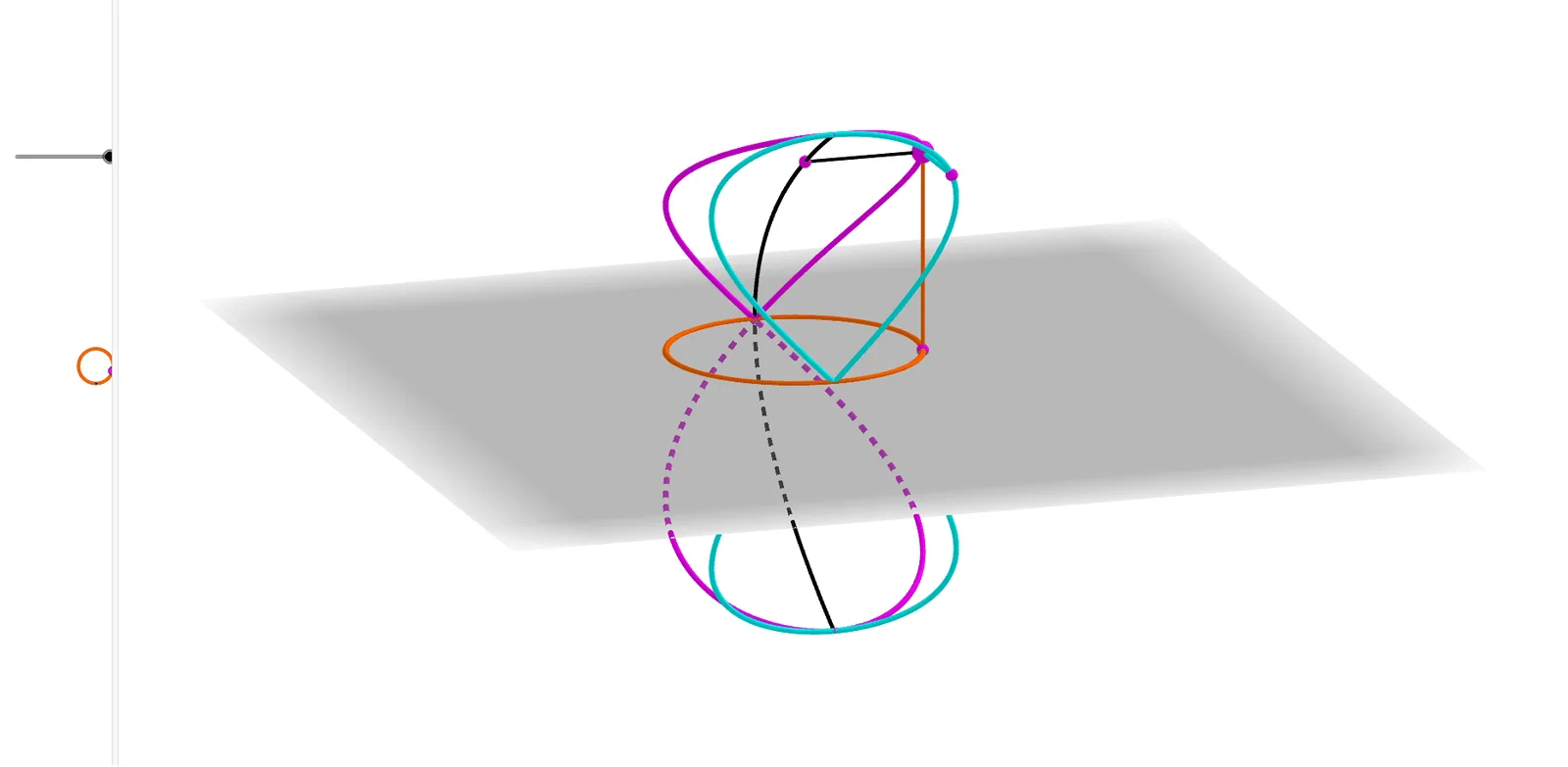
This example demonstrates constructing a 3D parametric curve from three planes. Key mathematical concepts include parametric equations, plane geometry, and spatial curves. Construction involves GeoGebra commands like CurveCartesian, OrthogonalLine, and Intersect. Suitable for high school students or college freshmen learning spatial geometry and parametric curve drawing.
GeoGebra Commands & Parameters
CurveCartesian((0, (sin(t) * sin(t)), cos(t)), t, 0, (2 * π)) → cyzCurveCartesian(((sin(t) * cos(t)), (sin(t) * sin(t)), cos(t)), t, 0, (2 * π)) → cxyzCurveCartesian(((sin(t) * cos(t)), 0, cos(t)), t, 0, (2 * π)) → cxzCurveCartesian(((sin(t) * cos(t)), (sin(t) * sin(t)), 0), t, 0, (2 * π)) → cxyOrthogonalLine(B, a) → fOrthogonalLine(B, b) → gOrthogonalLine(B, c) → hIntersect(f, a) → CIntersect(h, c) → EIntersect(g, b) → DSegment(B, E) → iSegment(B, D) → jSegment(B, C) → k
AI Drawing Prompt Reference
Draw a 3D parametric curve formed by the intersection of three planes. The curve is defined by parametric equations on each plane. Construct the curves on the three planes first, then use perpendicular lines to intersect with the planes to find intersection points. Finally, connect these points to form the spatial curve. Ensure the curve maintains continuity in 3D space and preserves the geometric relationships between the planes.
The prompt above was compiled from the original drawing commands and is for reference only.