
3 Squares Problem: Angles and Similarity Transformations in a Unit Circle
Loading the math board and drawing, please wait…
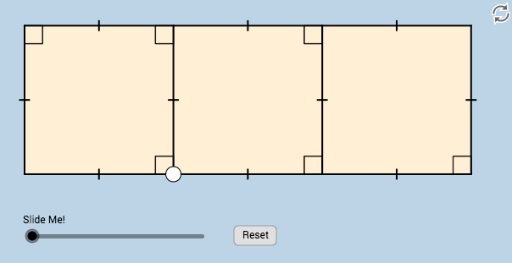
① This example demonstrates the construction of three interrelated squares inscribed in a unit circle, exploring their angle relationships and similarity transformations. ② Core mathematical concepts include squares, unit circle, angles, similarity transformations (dilation and rotation), and the analogical use of median value in geometric contexts. ③ Construction highlights: using GeoGebra commands such as Polygon, Circle, Intersect, Angle, Dilate, Rotate, Translate, and CircleArc to build the figure; objects include multiple points, segments, polygons, and angle variables α, β, γ, δ. ④ Suitable for high school to early college geometry instruction, useful for understanding similarity transformations, properties of cyclic polygons, and dynamic geometry exploration.
GeoGebra Commands & Parameters
Polygon(A, B, 4) → poly1, f, g, h, i, C, DPolygon(B, E, 4) → poly2, j, k, l, m, G, HPolygon(E, F, 4) → poly3, n, p, q, r, I, JSegment(A, B) → sSegment(B, C) → tSegment(C, D) → bSegment(D, A) → cSegment(C, G) → dSegment(G, E) → eSegment(E, B) → f_1Segment(G, I) → g_1Segment(I, F) → h_1Segment(F, E) → i_1Angle(C, B, A) → αAngle(D, C, B) → βAngle(A, D, C) → γAngle(C, G, E) → δAngle(G, E, B) → εAngle(I, F, E) → ζCircle(A, (0.25 * b)) → c_1Circle(B, (0.25 * b)) → d_1Circle(E, (0.25 * b)) → e_1Segment(E, I) → j_1Segment(B, I) → k_1Segment(A, I) → l_1Intersect(c_1, l_1, 1) → KIntersect(c_1, s, 1) → LIntersect(d_1, k_1, 1) → MIntersect(d_1, f_1, 1) → NIntersect(e_1, j_1, 1) → OIntersect(e_1, i_1, 1) → PIntersect(e_1, e, 1) → QCircleSector(B, N, M) → p_1CircleSector(A, L, K) → q_1Dilate(A, If[0 < o ≤ 1, 1 - o, 0], I) → A'Segment(A, A') → m_1Dilate(I, If[1 < o ≤ 2, 2 - o, 0], B) → I'Segment(I, I') → n_1Dilate(E, If[2 < o ≤ 3, 3 - o, 0], I) → E'Segment(E, E') → s_1CircleSector(E, O, Q) → r_1Rotate(r_1, If[4 < o ≤ 5, ((-(o - 4)) * π / 4), ((-π)) / 4], E) → t_1Line(B, s_1) → a_1Intersect(a_1, m_1) → SAngle(N, B, S) → ηRotate(p_1, If[5 < o ≤ 6, ((o - 5) * η), η], B) → c_2Dilate(B, If[6 < o ≤ 7, 7 - o, 0], E) → B'Vector(B, B') → uTranslate(c_2, u) → d_2CircleArc(B, N, M) → e_2Line(A, s_1) → b_1Angle(M, B, S) → θAngle(L, A, K) → ιRotate(q_1, If[7 < o ≤ 8, ((o - 7) * (π / 2 - θ)), π / 2 - θ], A) → f_2Dilate(A, If[8 < o ≤ 9, 9 - o, 0], E) → A'_1Vector(A, A'_1) → vTranslate(f_2, v) → g_2CircleArc(A, L, K) → h_2
AI Drawing Prompt Reference
Draw a unit circle containing three interconnected squares arranged sequentially, each sharing a side with the next. Start with the first square, then construct the second square on one of its sides, and the third square on a side of the second. Connect adjacent vertices of the squares with line segments, and label the interior angles. From each square's vertex, draw small circles with radius equal to one quarter of the first square's side length; these circles intersect the connecting lines at new points. Use circular arcs to connect these intersection points, forming sector regions. Finally, apply dilation and rotation transformations to certain sectors and segments, controlled by a slider parameter, to illustrate angle relationships and similarity transformations.
The prompt above was compiled from the original drawing commands and is for reference only.