
3.1 Fundamental Theorem of Calculus: Tracking Bank Account Balance
Loading the math board and drawing, please wait…
In collections
TFM: Introducción al Cálculo Infinitesimal (1º Bachillerato)
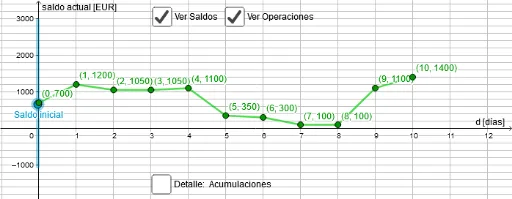
This example demonstrates the Fundamental Theorem of Calculus by tracking a bank account balance. Key mathematical concepts include integration and differentiation. Using GeoGebra commands such as Point, PolyLine, and Segment, a dynamic graph of the changing bank account balance is constructed. Suitable for high school mathematics education and learning.
GeoGebra Commands & Parameters
Point({1, var1}) → AV1Point({2, var2}) → AV2Point({3, var3}) → AV3Point({4, var4}) → AV4Point({5, var5}) → AV5Point({6, var6}) → AV6Point({7, var7}) → AV7Point({8, var8}) → AV8Point({9, var9}) → AV9Point({10, var10}) → AV10PolyLine(A0, A1, A10, A2, A3, A4, A5, A6, A7, A8, A9) → gPoint({1, y(A0)}) → AUX1Segment(A0, AUX1) → V1ASegment(AUX1, A1) → V1BPoint({2, y(A1)}) → AUX2Segment(A1, AUX2) → V2ASegment(AUX2, A2) → V2BPoint({3, y(A2)}) → AUX3Point({4, y(A3)}) → AUX4Point({5, y(A4)}) → AUX5Point({6, y(A5)}) → AUX6Point({7, y(A6)}) → AUX7Point({8, y(A7)}) → AUX8Point({9, y(A8)}) → AUX9Point({10, y(A9)}) → AUX10Segment(A2, AUX3) → V3ASegment(AUX3, A3) → V3BSegment(AUX4, A4) → V4BSegment(A3, AUX4) → V4ASegment(A4, AUX5) → V5ASegment(AUX5, A5) → V5BSegment(A5, AUX6) → V6ASegment(AUX6, A6) → V6BSegment(A6, AUX7) → V7ASegment(AUX7, A7) → V7BSegment(A7, AUX8) → V8ASegment(AUX8, A8) → V8BSegment(A8, AUX9) → V9ASegment(AUX9, A9) → V9BSegment(A9, AUX10) → V10ASegment(AUX10, A10) → V10BPoint({0, 0}) → P0Point({1, 0}) → P1Point({2, 0}) → P2Point({3, 0}) → P3Point({4, 0}) → P4Point({5, 0}) → P5Point({6, 0}) → P6Point({7, 0}) → P7Point({8, 0}) → P8Point({9, 0}) → P9Point({10, 0}) → P10Point({0, y(AV1)}) → PB0Point({1, y(AV2)}) → PB1Polygon(P0, PB0, AV1, P1) → ACU1, p0, pb0, av1, p1Point({2, y(AV3)}) → PB2Point({3, y(AV4)}) → PB3Point({4, y(AV5)}) → PB4Point({5, y(AV6)}) → PB5Point({6, y(AV7)}) → PB6Point({7, y(AV8)}) → PB7Point({8, y(AV9)}) → PB8Point({9, y(AV10)}) → PB9PolyLine(AV0, PB0, AV5, PB5, AV6, PB6, AV7, PB7, AV8, PB8, AV9, PB9, AV1, AV10, P10, PB1, AV2, PB2, AV3, PB3, AV4, PB4) → fPolygon(P1, PB1, AV2, P2) → ACU2, h, pb1, av2, p2Polygon(P2, PB2, AV3, P3) → ACU3, i, j, k, lPolygon(P3, PB3, AV4, P4) → ACU4, p3, pb3, av4, p4Polygon(P4, PB4, AV5, P5) → ACU5, m, pb4, av5, p5Polygon(P5, PB5, AV6, P6) → ACU6, n, pb5, av6, p6Polygon(P6, PB6, AV7, P7) → ACU7, p, pb6, av7, p7Polygon(P7, PB7, AV8, P8) → ACU8, q, pb7, av8, p8Polygon(P8, PB8, AV9, P9) → ACU9, r, pb8, av9, p9Polygon(P9, PB9, AV10, P10) → ACU10, s, pb9, av10, p10Segment(AV3, P3) → av3
AI Drawing Prompt Reference
Draw a dynamic graph showing the change in a bank account balance over time. First, create 10 points representing the balance at different times, then connect these points with a polyline. Next, draw vertical lines from each point to the x-axis to represent the change in balance for each time period. Finally, connect the endpoints of these vertical lines with segments to form a step-like graph, illustrating the change in balance over time.
The prompt above was compiled from the original drawing commands and is for reference only.