
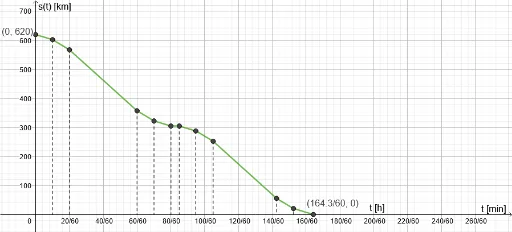
High Speed Train Trip as Piecewise Linear Function
Loading the math board and drawing, please wait…
In collections
TFM: Introducción al Cálculo Infinitesimal (1º Bachillerato)
This example demonstrates the kinematics of a high-speed train trip using piecewise linear functions. It covers key concepts such as piecewise functions and linear functions. Using GeoGebra commands like Intersect, Segment, and OrthogonalLine, the construction of piecewise linear functions is illustrated. Suitable for high school mathematics education and learning.
GeoGebra Commands & Parameters
Intersect(f1, xAxis, (164.28191428571427, 0)) → AIntersect(f1, yAxis, (0, 620)) → BSegment(C, D) → gOrthogonalLine(C, g) → hOrthogonalLine(D, g) → iIntersect(f1, i, (20, 567.50035)) → JIntersect(f1, h, (10, 602.5)) → KOrthogonalLine(E, g) → jOrthogonalLine(F, g) → kOrthogonalLine(C, xAxis) → lOrthogonalLine(G, g) → mOrthogonalLine(H, g) → nOrthogonalLine(C, xAxis) → pOrthogonalLine(N, g) → qOrthogonalLine(L, g) → rOrthogonalLine(M, g) → sOrthogonalLine(I, g) → tIntersect(f1, t, (152.5, 20.62368749999996)) → OIntersect(f1, s, (142.5, 55.628675000000044)) → PIntersect(f1, r, (105, 252.5)) → QIntersect(f1, q, (95, f1(95))) → RIntersect(f1, n, (85, 304.9937)) → SIntersect(f1, m, (80, 304.99649999999997)) → TIntersect(f1, k, (70, 322.49895000000004)) → UIntersect(f1, j, (60, 357.50104999999996)) → VSegment(K, C) → eSegment(J, D) → f_1Segment(V, E) → g_1Segment(U, F) → h_1Segment(S, H) → i_1Segment(T, G) → j_1Segment(R, N) → k_1Segment(Q, L) → l_1Segment(P, M) → m_1Segment(I, O) → n_1Point(f11) → ZPoint(f11) → A_1
AI Drawing Prompt Reference
Draw a diagram of a high-speed train trip using piecewise linear functions. Start by plotting a curve representing speed changes, then construct a series of perpendicular lines and segments based on intersections with the x-axis and y-axis. Highlight the formation of piecewise linear functions through these constructions, including multiple line segments, perpendiculars, and intersection points, forming various triangles and trapezoids to illustrate different stages of the train's motion.
The prompt above was compiled from the original drawing commands and is for reference only.