
2D Vector Addition: Tail-to-Tip Method
Loading the math board and drawing, please wait…
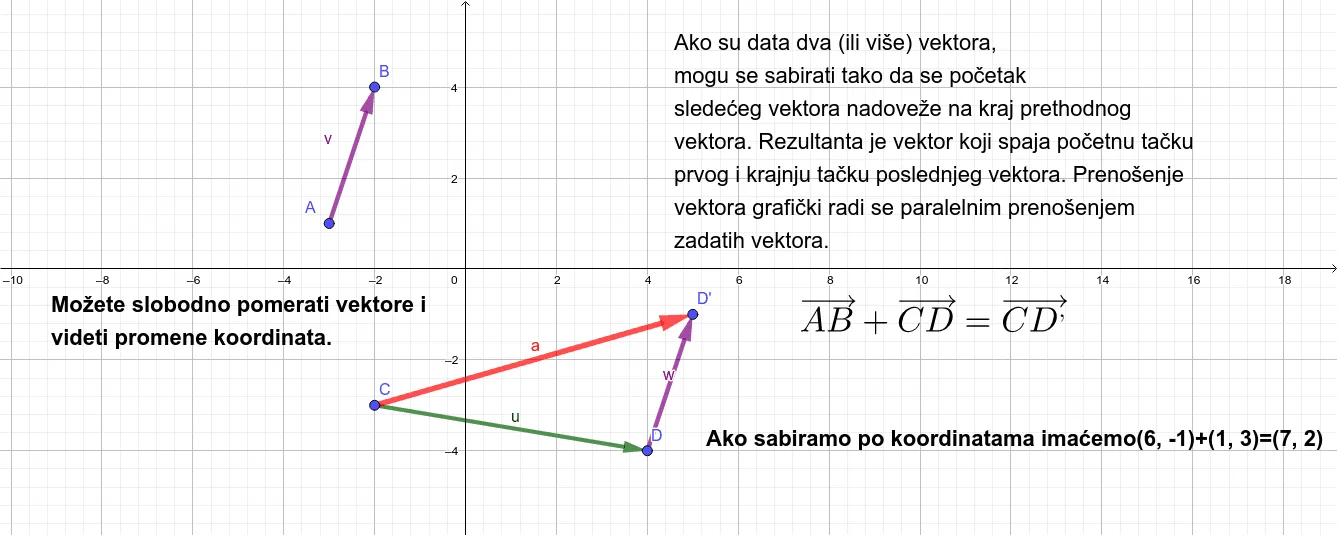
This GeoGebra example demonstrates the tail-to-tip method for adding two two-dimensional vectors, visually illustrating the geometric meaning of vector addition. Core concepts include vector representation, translation transformations, and the commutative property of vector addition. Construction utilizes the Vector and Translate commands along with points A, B, u, v, and text objects to dynamically construct and display the sum vector. Suitable for middle school and high school mathematics, it helps students grasp the geometric essence of vector operations and serves as an interactive tool for classroom teaching and self-study.
GeoGebra Commands & Parameters
Vector(C, D) → uVector(A, B) → vTranslate(D, v) → D'Vector(D, D') → wVector(C, D') → a
AI Drawing Prompt Reference
Draw a diagram illustrating the tail-to-tip method for adding two 2D vectors. Start with two vectors: one from a point to another, and a second from a third point to a fourth. Translate the second vector so its tail coincides with the tip of the first, keeping its direction and length. Then draw a segment from the tail of the first vector to the tip of the translated second vector; this segment represents the sum vector. Label all vectors with arrows and mark key points to clearly show the geometric addition process.
The prompt above was compiled from the original drawing commands and is for reference only.