
2010 AP Calculus AB Form B Problem 1b: Volume Problem
Loading the math board and drawing, please wait…
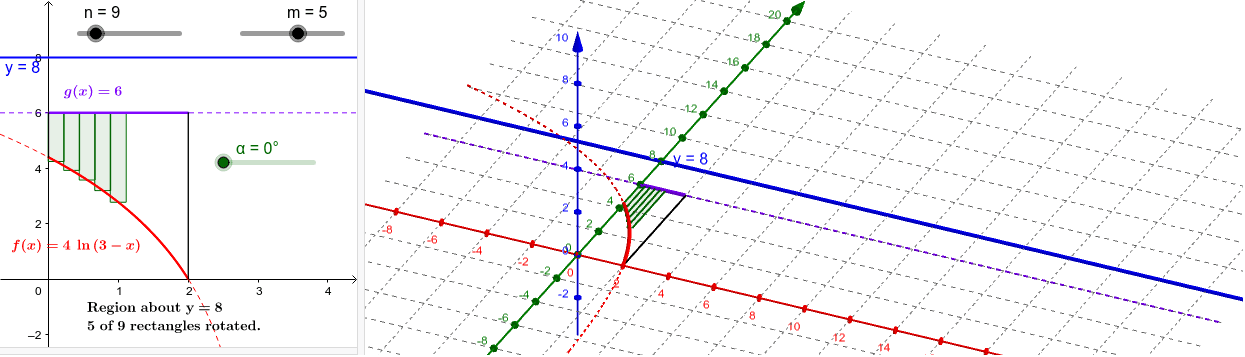
This example demonstrates the volume problem from the 2010 AP Calculus AB Form B, Problem 1b. Key mathematical concepts include integration and solid geometry. Using GeoGebra commands such as Sequence, Polygon, Rotate, Integral, Surface, etc., the process of calculating volume is constructed. Suitable for high school calculus courses and learning.
GeoGebra Commands & Parameters
Sequence(Polygon[((k * h), f(((k + p) * h))), (((k + 1) * h), f(((k + p) * h))), (((k + 1) * h), g(((k + p) * h))), ((k * h), g(((k + p) * h)))], k, 0, m - 1) → RectanglesPolygon(((DK * h), f(((DK + p) * h))), (((DK + 1) * h), f(((DK + p) * h))), (((DK + 1) * h), g(((DK + p) * h))), ((DK * h), g(((DK + p) * h)))) → Rectangle1, b, c, d, eRotate(Rectangle1, α, a) → Rectangle1'Integral((π * ((8 - f(x))^(2) - (8 - g(x))^(2))), 0, 2) → VolIntegRotate(Rectangles, α, a) → Rectangles'Rotate(g_1, α, a) → iRotate(f_1, α, a) → jSurface(u, 8 - ((8 - g(((DK + p) * h))) * cos(β)), ((8 - g(((DK + p) * h))) * sin(β)), u, (DK * h), ((DK + 1) * h), β, 0, α) → Inner1Surface(u, 8 - ((8 - f(((DK + p) * h))) * cos(β)), ((8 - f(((DK + p) * h))) * sin(β)), u, (DK * h), ((DK + 1) * h), β, 0, α) → Outer1Surface(u, 8 + ((8 - g(u)) * cos(β)), ((8 - g(u)) * sin(β)), u, 0, 2, β, 0, (2 * π)) → InnerSurface(u, 8 - ((8 - f(u)) * cos(β)), ((8 - f(u)) * sin(β)), u, 0, 2, β, 0, (2 * π)) → OuterSurface((DK * h), 8 - ((8 - u) * cos(β)), ((8 - u) * sin(β)), u, f(((DK + p) * h)), g(((DK + p) * h)), β, 0, α) → SideLeft1Surface(((DK + 1) * h), 8 - ((8 - u) * cos(β)), ((8 - u) * sin(β)), u, f(((DK + p) * h)), g(((DK + p) * h)), β, 0, α) → SideRight1Sequence(Surface[u, 8 - ((8 - g(((k + p) * h))) * cos(β)), ((8 - g(((k + p) * h))) * sin(β)), u, (k * h), ((k + 1) * h), β, 0, α], k, 0, m - 1) → InnersSequence(Surface[u, 8 - ((8 - f(((k + p) * h))) * cos(β)), ((8 - f(((k + p) * h))) * sin(β)), u, (k * h), ((k + 1) * h), β, 0, α], k, 0, m - 1) → OutersSequence(Surface[(k * h), 8 - ((8 - u) * cos(β)), ((8 - u) * sin(β)), u, f(((k + p) * h)), g(((k + p) * h)), β, 0, α], k, 0, m - 1) → SidesLeftSequence(Surface[((k + 1) * h), 8 - ((8 - u) * cos(β)), ((8 - u) * sin(β)), u, f(((k + p) * h)), g(((k + p) * h)), β, 0, α], k, 0, m - 1) → SidesRightRectangleSum(A, 0, (m * h), m, p) → WSSegment((0, f(0)), (0, g(2), 0)) → SegLSegment((2, f(2)), (2, g(2), 0)) → SegRRotate(SegL, α, a) → SegL'Rotate(SegR, α, a) → SegR'Surface(0, 8 - ((8 - u) * cos(β)), ((8 - u) * sin(β)), u, f(0), g(0), β, 0, (2 * π)) → SideLeftSurface(2, 8 - ((8 - u) * cos(β)), ((8 - u) * sin(β)), u, f(2), g(2), β, 0, (2 * π)) → SideRight
AI Drawing Prompt Reference
Draw a 3D shape formed by the projections of two functions f(x) and g(x) on the x-axis from x=0 to x=2. First, draw the projections of these functions on the x-axis, then rotate these projections around the x-axis to form two rotational surfaces. Next, calculate the volume between these two rotational surfaces. Finally, draw a series of rectangles that, when rotated around the x-axis, form the side surfaces.
The prompt above was compiled from the original drawing commands and is for reference only.