
2007 AP AB Form B Question 1c: Volume of Revolution
Loading the math board and drawing, please wait…
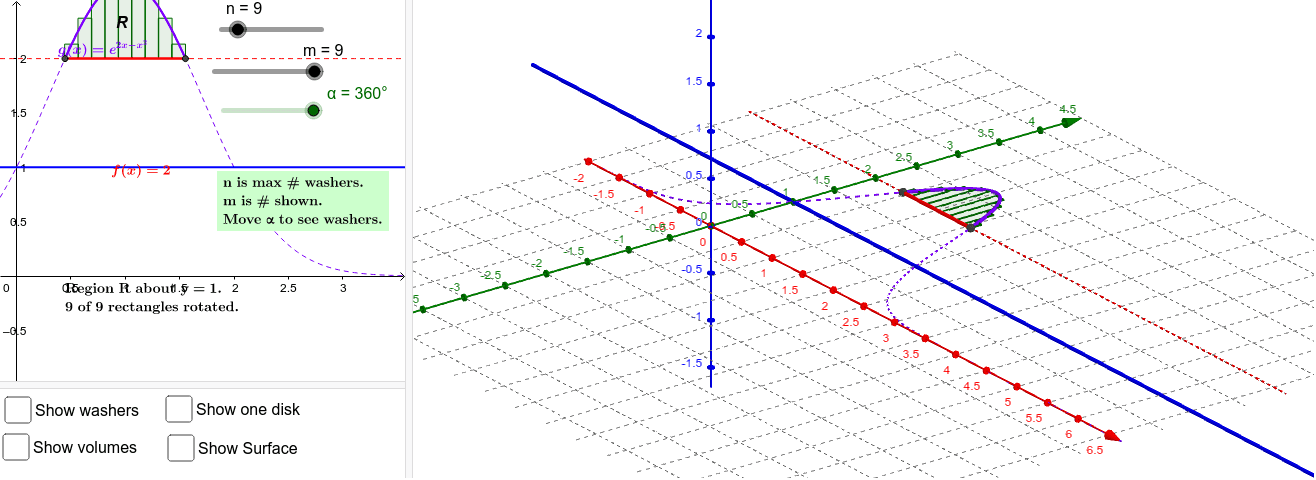
This example illustrates the volume of revolution problem from the 2007 AP AB Form B Question 1c. Key mathematical concepts include integration and solid geometry. Using GeoGebra commands such as Intersect, Sequence, Polygon, etc., the volume of the revolution body can be constructed. Suitable for high school math education and learning.
GeoGebra Commands & Parameters
Intersect(g, f, 0, 2) → A, BSequence(Cylinder[(a + (k * h), 1, 0), (a + ((k + 1) * h), 1, 0), 1 + f(a + ((k + p) * h))], k, 0, m - 1) → COSequence(Cylinder[(a + (k * h), 1, 0), (a + ((k + 1) * h), 1, 0), 1 + g(a + ((k + p) * h))], k, 0, m - 1) → CISequence(Polygon[(a + (k * h), f(a + ((k + p) * h))), (a + ((k + 1) * h), f(a + ((k + p) * h))), (a + ((k + 1) * h), g(a + ((k + p) * h))), (a + (k * h), g(a + ((k + p) * h)))], k, 0, m - 1) → RectanglesSequence(If[Defined[Volume[Element[CO, k]]], Volume[Element[CO, k]], 0], k, 1, m) → VCOSequence(If[Defined[Volume[Element[CI, k]]], Volume[Element[CI, k]], 0], k, 1, m) → VCISum(VCO - VCI) → VCPolygon((a + (DK * h), g(a + ((DK + p) * h))), (a + ((DK + 1) * h), g(a + ((DK + p) * h))), (a + ((DK + 1) * h), f(a + ((DK + p) * h))), (a + (DK * h), f(a + ((DK + p) * h)))) → Rectangle1, c, d, e, kRotate(Rectangle1, (-α), line) → Rectangle1'Integral((π * ((g(x) - 1)^(2) - (f(x) - 1)^(2))), a, b) → VolIntegRotate(f_1, (-α), line) → iRotate(g_1, (-α), line) → jRotate(Rectangles, (-α), line) → Rectangles'Surface(u, 1 + ((f(u) - 1) * cos(β)), ((f(u) - 1) * sin(β)), u, a, b, β, 0, (2 * π)) → InnerSurface(a + (DK * h), 1 + ((u - 1) * cos(β)), ((u - 1) * sin(β)), u, f(a + ((DK + p) * h)), g(a + ((DK + p) * h)), β, 0, α) → SideLeft1Surface(a + ((DK + 1) * h), 1 + ((u - 1) * cos(β)), ((u - 1) * sin(β)), u, f(a + ((DK + p) * h)), g(a + ((DK + p) * h)), β, 0, α) → SideRight1Surface(u, 1 + ((g(u) - 1) * cos(β)), ((g(u) - 1) * sin(β)), u, a, b, β, 0, (2 * π)) → OuterSurface(u, 1 + ((f(a + ((DK + p) * h)) - 1) * cos(β)), ((f(a + ((DK + p) * h)) - 1) * sin(β)), u, a + (DK * h), a + ((DK + 1) * h), β, 0, α) → Inner1Surface(u, 1 + ((g(a + ((DK + p) * h)) - 1) * cos(β)), ((g(a + ((DK + p) * h)) - 1) * sin(β)), u, a + (DK * h), a + ((DK + 1) * h), β, 0, α) → Outer1Sequence(Surface[u, 1 + ((g(a + ((k + p) * h)) - 1) * cos(β)), ((g(a + ((k + p) * h)) - 1) * sin(β)), u, a + (k * h), a + ((k + 1) * h), β, 0, α], k, 0, m - 1) → InnersSequence(Surface[u, 1 + ((f(a + ((k + p) * h)) - 1) * cos(β)), ((f(a + ((k + p) * h)) - 1) * sin(β)), u, a + (k * h), a + ((k + 1) * h), β, 0, α], k, 0, m - 1) → OutersSequence(Surface[a + (k * h), 1 + ((u - 1) * cos(β)), ((u - 1) * sin(β)), u, f(a + ((k + p) * h)), g(a + ((k + p) * h)), β, 0, α], k, 0, m - 1) → SidesLeftSequence(Surface[a + ((k + 1) * h), 1 + ((u - 1) * cos(β)), ((u - 1) * sin(β)), u, f(a + ((k + p) * h)), g(a + ((k + p) * h)), β, 0, α], k, 0, m - 1) → SidesRightRectangleSum((π * ((ℯ^((2 * x) - x^(2)) - 1)^(2) - 1)), a, a + (m * h), m, p) → VCyls
AI Drawing Prompt Reference
Illustrate the volume of a solid of revolution, showcasing integral and solid geometry concepts. Start by plotting the intersection points of two curves with the x-axis, then construct the rotating body using stacked cylinders and rectangles. Display the volume calculation with integral expressions, showing how the solid is built up from small volumes.
The prompt above was compiled from the original drawing commands and is for reference only.