
π = 2? — A Visual Paradox of Semicircle Sequences
Loading the math board and drawing, please wait…
In collections
Pi Approximations
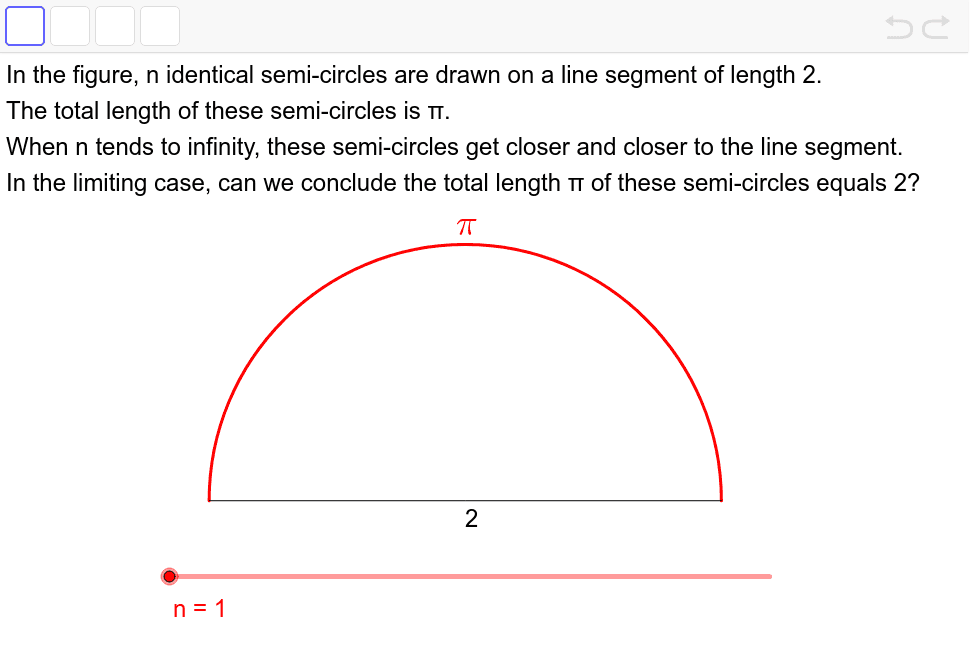
① This example demonstrates a seemingly absurd conclusion: a sequence of semicircles forming a zigzag path has a total length that remains constant (equal to 2) as the number of semicircles increases, challenging the idea that π equals 2. ② Core mathematical concepts include limits, arc length, and the nature of π, highlighting the misconception that a jagged curve approximating a straight line must have length approaching that line's length. ③ Construction details: using GeoGebra commands Semicircle, Sequence, and Segment; objects include parameter n (number of semicircles), list1, length calculation a, text1/text2, and point A; a slider controls n to visualize the constant length. ④ Suitable for high school to undergraduate mathematics, this example is ideal for discussing rigorous definitions of limits, the true meaning of curve length, and the pitfalls of geometric intuition, serving as a springboard for paradox-based inquiry or critical thinking exercises.
GeoGebra Commands & Parameters
Semicircle((0, 0), (2, 0)) → cSequence(Semicircle[((2 * (k - 1) / n), 0), ((2 * k / n), 0)], k, 1, n) → list1Segment((0, 0), (2, 0)) → a
AI Drawing Prompt Reference
Draw a horizontal segment from the origin to the point (2,0) as a baseline. Above it, construct a sequence of semicircles, each with its diameter lying on this segment, arranged end-to-end to form a zigzag path. The number of semicircles is controlled by a slider, increasing from 1 to many. As the count grows, each semicircle's diameter shrinks, but the total arc length of all semicircles remains constant at 2, equal to the baseline length. Add text near the figure explaining this apparent paradox: the jagged path's length does not approach the segment's length as the number increases, leading to the misconception that π equals 2.
The prompt above was compiled from the original drawing commands and is for reference only.