
13-Foot Ladder Geometry Problem
Loading the math board and drawing, please wait…
In collections
CCSS Support Math II Unit 2
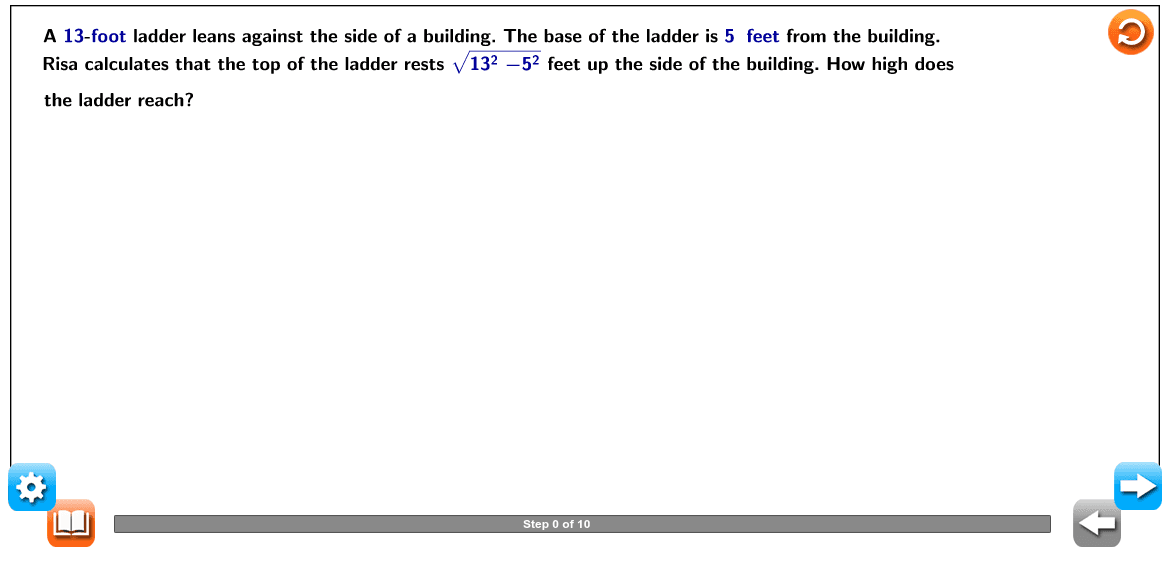
This example demonstrates a right triangle geometry problem involving a 13-foot ladder leaning against a building with its base 5 feet away. Key math concepts include the Pythagorean theorem, trigonometric functions (sine, cosine, tangent), and properties of right triangles. GeoGebra commands and objects used are Segment, Vector, LaTeX, and If to construct and analyze the position changes of the ladder's top. Suitable for high school students learning analytical geometry, trigonometric applications, and geometric constructions.
GeoGebra Commands & Parameters
Segment((0, 0), (0, 1)) → iSegment(A_0, B_0) → ScalelineSequence(Segment[A_0 + (i, 0), A_0 + (i, (-0.5))], i, 0, 10) → list1Sequence(Segment[A_0 + (i - 0.5, 0), A_0 + (i - 0.5, (-0.4))], i, 1, 10) → list2Sequence(Sequence[Segment[A_0 + ((0.5 * i) + (0.1 * j), 0), A_0 + ((0.5 * i) + (0.1 * j), (-0.3))], j, 1, 4], i, 0, 19) → list3LaTeX("\text{0}") → Scalevalue0LaTeX("\text{1}") → Scalevalue1LaTeX("\text{2}") → Scalevalue2LaTeX("\text{3}") → Scalevalue3LaTeX("\text{4}") → Scalevalue4LaTeX("\text{5}") → Scalevalue5LaTeX("\text{6}") → Scalevalue6LaTeX("\text{7}") → Scalevalue7LaTeX("\text{8}") → Scalevalue8LaTeX("\text{9}") → Scalevalue9LaTeX("\text{10}") → Scalevalue10Segment(D_0, (x(D_0), 0)) → jVector(C_0, D_0) → uLaTeX("\text{the ladder reach?}") → text3LaTeX("\text{Simplify the expression under the radical symbol.}") → text4LaTeX((("\text{\textcolor{#000099}{=" * sub1) * "}")) → text9LaTeX("\text{Find the square root of the simplified expression.}") → text11LaTeX("\text{Expression under the radical symbol}") → text17LaTeX("\text{Subtract.}") → text20LaTeX((("\text{Simplify \textcolor{#000099}{" * value1) * "²}.}")) → text18LaTeX((("\text{Simplify \textcolor{#000099}{" * value2) * "²}.}")) → text19LaTeX((((("\text{\textcolor{#000099}{" * value1) * "²-") * value2) * "²}")) → text6LaTeX((((("\text{\textcolor{#000099}{=" * sqr1) * "-") * value2) * "²}")) → text7LaTeX((((("\text{\textcolor{#000099}{=" * sqr1) * "-") * sqr2) * "}")) → text8LaTeX((((((("\text{The expression \textcolor{#000099}{" * value1) * "² - ") * value2) * "²} simplifies to \textcolor{#000099}{") * sub1) * "}.}")) → text10LaTeX((((("\text{A \textcolor{#000099}{" * value1) * "}-\textcolor{#000099}{foot} ladder leans against the side of a building. The base of the ladder is \textcolor{#000099}{") * value2) * "\; feet} from the building.}")) → text1LaTeX((((("\text{Risa calculates that the top of the ladder rests \textcolor{#000099}{\sqrt{" * value1) * "² −") * value2) * "²}} feet up the side of the building. How high does}")) → text2LaTeX("\text{\mathbf{radical\;expression} an expression containing a root, such as \textcolor{#000099}{⁵\sqrt{9}}}") → WordsTextLaTeX((("\text{First value=" * value1) * "}")) → text14LaTeX((("\text{Second value=" * value2) * "}")) → text15LaTeX((((("\text{The expression under the radical symbol is \textcolor{#000099}{" * value1) * "² - ") * value2) * "²}. Follow the order of operations to simplify this expression.}")) → text5If(sub1 ≟ 144, LaTeX[(((((((((((("\text{The simplified expression, \textcolor{#000099}{" * sub1) * "}, is a perfect square because \textcolor{#000099}{") * sqrt1) * " \;•\; ") * sqrt1) * " = ") * sub1) * "}. Therefore, \textcolor{#000099}{\sqrt{") * sub1) * "}=") * sqrt1) * "}.}")], LaTeX[(((((("\text{The simplified expression, \textcolor{#000099}{" * sub1) * "}, is not a perfect square. Therefore,\textcolor{#000099}{\sqrt{") * sub1) * "}=") * sqrt1) * "}.}")]) → text13LaTeX((("\text{Therefore, the top of the ladder reaches \textcolor{#000099}{" * sqrt1) * "} feet up the side of the building.}")) → text12
AI Drawing Prompt Reference
Draw a right triangle with one leg of 5 feet and a hypotenuse of 13 feet. Use a 13-foot ladder as the hypotenuse, with the base of the ladder 5 feet away from the building. Calculate the height where the top of the ladder touches the building using the Pythagorean theorem, and indicate the ladder's tilt with arrows.
The prompt above was compiled from the original drawing commands and is for reference only.