
10/3 and 10/4 Polygons
Loading the math board and drawing, please wait…
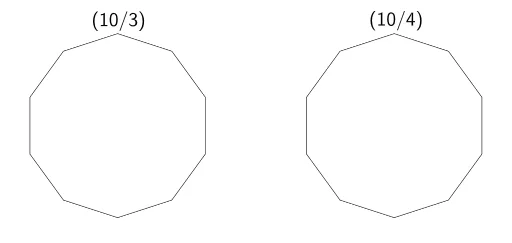
This example demonstrates Islamic geometric patterns of 10/3 and 10/4 polygons. Core mathematical concepts include polygons, symmetry, quadrilaterals, quadratic equations, and logic. The construction uses GeoGebra commands such as ConstructionStep, Rotate, Polygon, Point, Midpoint, Segment, Intersect, PolyLine, etc. Suitable for middle school and above students to learn geometric construction.
GeoGebra Commands & Parameters
ConstructionStep() → stapRotate(A, 36°) → A'Polygon(A, A', 10) → veelhoek1, f, p, B, C, D, E, F, G, H, I, g, h, i, j, k, l, m, nPoint(xAxis) → JRotate(K, 36°, J) → K'Polygon(K, K', 10) → veelhoek2, q, f_1, L, M, N, P, Q, R, S, T, r, s, t, a, b, c, d, eMidpoint(f) → UMidpoint(g) → VMidpoint(h) → WMidpoint(i) → ZMidpoint(j) → A_1Midpoint(k) → B_1Midpoint(l) → C_1Midpoint(m) → D_1Midpoint(n) → E_1Midpoint(p) → F_1Midpoint(q) → G_1Midpoint(r) → H_1Midpoint(s) → I_1Midpoint(t) → J_1Midpoint(a) → K_1Midpoint(b) → L_1Midpoint(c) → M_1Midpoint(d) → N_1Midpoint(e) → O_1Midpoint(f_1) → P_1Segment(U, Z) → g_1Segment(G_1, K_1) → h_1Segment(V, A_1) → i_1Segment(H_1, L_1) → j_1Segment(W, B_1) → k_1Segment(I_1, M_1) → l_1Segment(Z, C_1) → m_1Segment(J_1, N_1) → n_1Segment(A_1, D_1) → p_1Segment(K_1, O_1) → q_1Segment(B_1, E_1) → r_1Segment(L_1, P_1) → s_1Segment(C_1, F_1) → t_1Segment(M_1, G_1) → a_1Segment(D_1, U) → b_1Segment(N_1, H_1) → c_1Segment(E_1, V) → d_1Segment(O_1, I_1) → e_1Segment(F_1, W) → f_2Segment(P_1, J_1) → g_2Intersect(b_1, yAxis) → Q_1Intersect(d_1, f_2) → R_1Intersect(g_1, d_1) → S_1Intersect(g_1, f_2) → T_1Intersect(i_1, f_2) → U_1Intersect(g_1, xAxis) → V_1Intersect(g_1, k_1) → W_1Intersect(i_1, k_1) → Z_1Intersect(i_1, m_1) → A_2Intersect(k_1, m_1) → B_2Intersect(k_1, p_1) → C_2Intersect(p_1, m_1) → D_2Intersect(m_1, r_1) → E_2Intersect(p_1, r_1) → F_2Intersect(p_1, t_1) → G_2Intersect(r_1, t_1) → H_2Intersect(r_1, b_1) → I_2Intersect(t_1, b_1) → J_2Intersect(t_1, d_1) → K_2Intersect(b_1, d_1) → L_2Intersect(s_1, e_1) → M_2Intersect(a_1, e_1) → N_2Intersect(a_1, g_2) → O_2Intersect(c_1, g_2) → P_2Intersect(h_1, c_1) → Q_2Intersect(h_1, e_1) → R_2Intersect(j_1, e_1) → S_2Intersect(j_1, g_2) → T_2Intersect(l_1, g_2) → U_2Intersect(h_1, l_1) → V_2Intersect(h_1, n_1) → W_2Intersect(j_1, n_1) → Z_2Intersect(j_1, q_1) → A_3Intersect(l_1, q_1) → B_3Intersect(l_1, s_1) → C_3Intersect(n_1, s_1) → D_3Intersect(n_1, a_1) → E_3Intersect(q_1, a_1) → F_3Intersect(q_1, c_1) → G_3Intersect(s_1, c_1) → H_3PolyLine(Q_1, R_1, C_2, D_2, E_2, F_2, G_2, H_2, I_2, J_2, K_2, L_2, S_1, Q_1, T_1, U_1, V_1, W_1, Z_1, A_2, B_2) → h_2PolyLine(O_2, P_2, A_3, B_3, C_3, D_3, E_3, F_3, G_3, H_3, M_2, N_2, Q_2, O_2, R_2, S_2, T_2, U_2, V_2, W_2, Z_2) → i_2PolyLine(Q_1, U, C_2, B_1, E_2, C_1, G_2, D_1, I_2, E_1, K_2, F_1, S_1, Q_1, V, U_1, W, W_1, Z, A_2, A_1) → j_2PolyLine(O_2, G_1, A_3, L_1, C_3, M_1, E_3, N_1, G_3, O_1, M_2, P_1, Q_2, O_2, H_1, S_2, I_1, U_2, J_1, W_2, K_1) → k_2
AI Drawing Prompt Reference
Draw two decagons rotated by 36 degrees, find the midpoints of each side, connect adjacent midpoints to form a new polygon, and draw auxiliary lines at intersection points to showcase symmetry and geometric transformations.
The prompt above was compiled from the original drawing commands and is for reference only.