
利用圆柱壳法计算环面体积示例
几何画板及绘图内容加载中,请稍等……
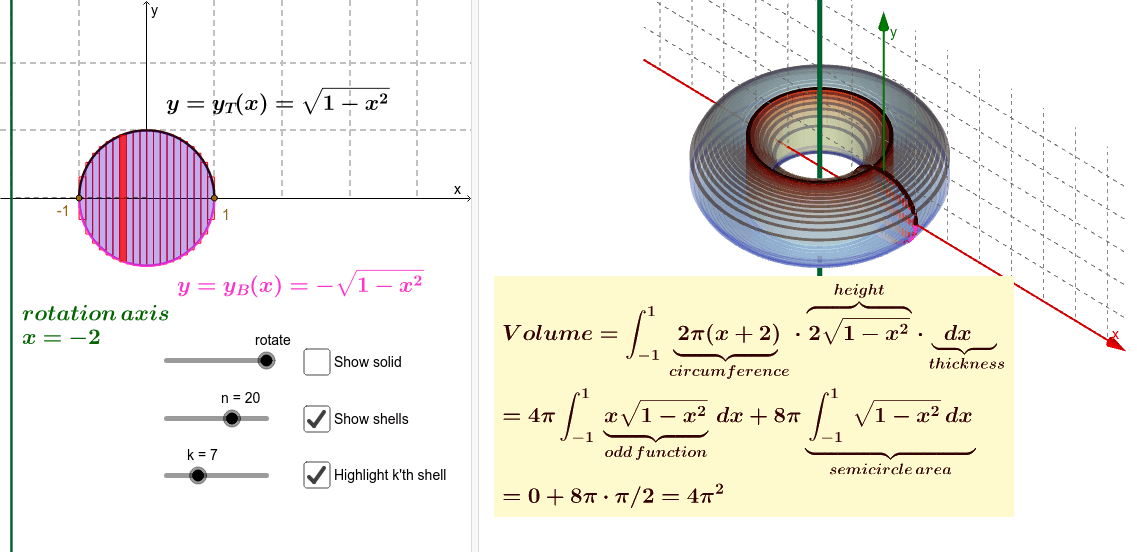
本范例演示如何利用圆柱壳法计算环面体积。涉及的核心数学概念包括积分、体积计算和圆柱壳法。作图要点使用了GeoGebra的Sequence、Surface、Polygon、Segment等命令和对象,通过动态演示环面生成的过程,直观展示积分的几何意义。适合高中及以上学生学习和理解微积分中的体积计算方法。
GeoGebra 命令及参数
Sequence(a + ((k - 0.5) * dx), k, 1, n) → midptsSequence(a + (k * dx), k, 0, n - 1) → leftptsSequence(a + (k * dx), k, 1, n) → rightptsSequence(Polygon[(xk(k - 1), y_B(Element[evalpts, k])), (xk(k - 1), y_T(Element[evalpts, k])), (xk(k), y_T(Element[evalpts, k])), (xk(k), y_B(Element[evalpts, k]))], k, 1, n) → RectanglesSequence((Element[evalpts, k], 0), k, 1, n) → evalptsplotSurface(xrot + ((xk(k - 1) - xrot) * cos(t)), h, ((xk(k - 1) - xrot) * sin(t)), t, 0, (2 * π), h, y_B(Element[evalpts, k]), y_T(Element[evalpts, k])) → ShellIn_kSurface(xrot + (r * cos(t)), y_T(Element[evalpts, k]), (r * sin(t)), t, 0, (2 * π), r, xk(k - 1) - xrot, xk(k) - xrot) → UpShell_kSurface(xrot + ((xk(k) - xrot) * cos(t)), h, ((xk(k) - xrot) * sin(t)), t, 0, (2 * π), h, y_B(Element[evalpts, k]), y_T(Element[evalpts, k])) → ShellOut_kSurface(xrot + (r * cos(t)), y_B(Element[evalpts, k]), (r * sin(t)), t, 0, (2 * π), r, xk(k - 1) - xrot, xk(k) - xrot) → ShellDown_kSequence(Surface[xrot + ((xk(k - 1) - xrot) * cos(t)), h, ((xk(k - 1) - xrot) * sin(t)), t, 0, (2 * π), h, y_B(Element[evalpts, k]), y_T(Element[evalpts, k])], k, 1, n) → ShellsInSequence(Surface[xrot + (r * cos(t)), y_T(Element[evalpts, k]), (r * sin(t)), t, 0, (2 * π), r, xk(k - 1) - xrot, xk(k) - xrot], k, 1, n) → ShellsUpSequence(Surface[xrot + (r * cos(t)), y_B(Element[evalpts, k]), (r * sin(t)), t, 0, (2 * π), r, xk(k - 1) - xrot, xk(k) - xrot], k, 1, n) → ShellsDownSequence(Surface[xrot + ((xk(k) - xrot) * cos(t)), h, ((xk(k) - xrot) * sin(t)), t, 0, (2 * π), h, y_B(Element[evalpts, k]), y_T(Element[evalpts, k])], k, 1, n) → ShellsOutSurface(xrot + (cos((-t)) * (u - xrot)), y_B(u), (sin((-t)) * (u - xrot)), u, a, b, t, 0, RotationAngle) → Solid_BSurface(xrot + (cos((-t)) * (u - xrot)), y_T(u), (sin((-t)) * (u - xrot)), u, a, b, t, 0, RotationAngle) → Solid_TSurface(xrot + ((a - xrot) * cos((-t))), h, ((a - xrot) * sin((-t))), t, 0, RotationAngle, h, y_B(a), y_T(a)) → Solid_aSurface(xrot + ((b - xrot) * cos((-t))), h, ((b - xrot) * sin((-t))), t, 0, RotationAngle, h, y_B(b), y_T(b)) → Solid_bSurface(xrot + (cos((-RotationAngle)) * (u - xrot)), ((1 - w) * y_B(u)) + (w * y_T(u)), (sin((-RotationAngle)) * (u - xrot)), w, 0, 1, u, a, b) → Solid_eSurface(xrot + u - xrot, ((1 - w) * y_B(u)) + (w * y_T(u)), (0 * (u - xrot)), w, 0, 1, u, a, b) → region3dPolygon((xk(k - 1), y_B(Element[evalpts, k])), (xk(k - 1), y_T(Element[evalpts, k])), (xk(k), y_T(Element[evalpts, k])), (xk(k), y_B(Element[evalpts, k]))) → Rectangle_k, f, g, h, iSegment((0, 0), (xrot, 0)) → c