
旋转体可视化与体积计算
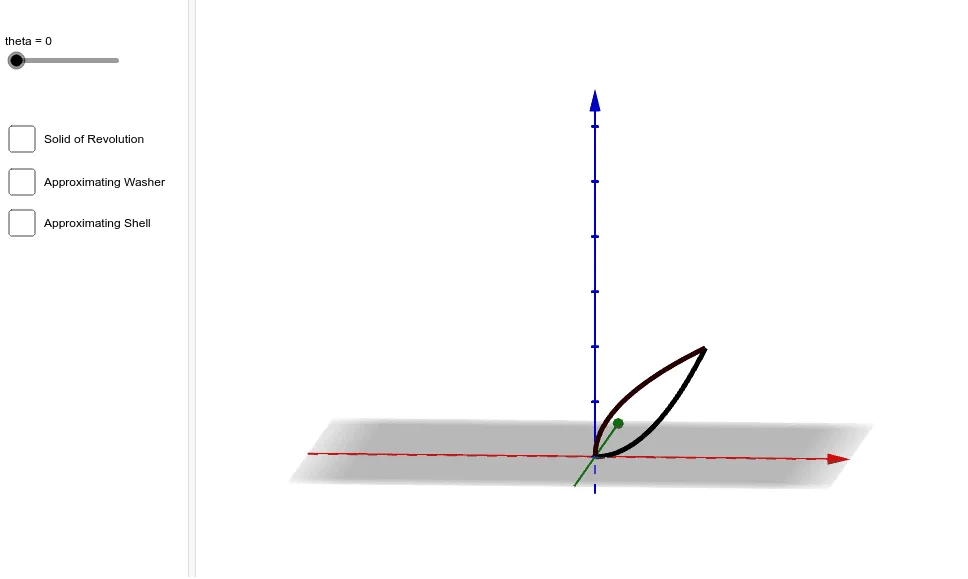
几何画板及绘图内容加载中,请稍等……
该范例演示了由函数f(x)=√x和g(x)=x围成的区域绕x轴旋转生成的旋转体。核心数学概念包括旋转体、体积计算。使用了Polygon、CurveCartesian、Surface等GeoGebra命令。适合高中数学教学,帮助学生理解旋转体的生成过程和体积计算方法。
GeoGebra 命令及参数
Polygon((0.5^(2), 0, 0.5), (0.5^(2), 0, 0.6), (sqrt(0.5), 0, 0.6), (sqrt(0.5), 0, 0.5)) → washerpoly, e, f, g, hPolygon(((0.5 * cos(theta)), (0.5 * sin(theta)), 0.5^(2)), ((0.6 * cos(theta)), (0.6 * sin(theta)), 0.5^(2)), ((0.6 * cos(theta)), (0.6 * sin(theta)), sqrt(0.5)), ((0.5 * cos(theta)), (0.5 * sin(theta)), sqrt(0.5))) → shellpolyrev, a, b, c, dPolygon(((0.5^(2) * cos(theta)), (0.5^(2) * sin(theta)), 0.5), ((0.5^(2) * cos(theta)), (0.5^(2) * sin(theta)), 0.6), ((sqrt(0.5) * cos(theta)), (sqrt(0.5) * sin(theta)), 0.6), ((sqrt(0.5) * cos(theta)), (sqrt(0.5) * sin(theta)), 0.5)) → washerpolyrev, i, j, k, lCurveCartesian(t, 0, sqrt(t), t, 0, 1) → topcurveCurveCartesian((t * cos(theta)), (t * sin(theta)), t^(2), t, 0, 1) → fncurverevCurveCartesian(t, 0, t^(2), t, 0, 1) → fncurveCurveCartesian((t * cos(theta)), (t * sin(theta)), sqrt(t), t, 0, 1) → topcurverev_1Surface((0.5 * cos(s)), (0.5 * sin(s)), t, t, 0.5^(2), sqrt(0.5), s, 0, theta) → shellinsiderevSurface((0.6 * cos(s)), (0.6 * sin(s)), t, t, 0.5^(2), sqrt(0.5), s, 0, theta) → shelloutsiderevSurface((t * cos(s)), (t * sin(s)), 0.5^(2), t, 0.5, 0.6, s, 0, theta) → shellbottomrevSurface((t * cos(s)), (t * sin(s)), t^(2), t, 0, 1, s, 0, theta) → bottomcurverevSurface((t * cos(s)), (t * sin(s)), sqrt(t), t, 0, 1, s, 0, theta) → topcurverevSurface((t * cos(s)), (t * sin(s)), 0.5, t, 0.5^(2), sqrt(0.5), s, 0, theta) → washerbottomSurface((t * cos(s)), (t * sin(s)), 0.6, t, 0.5^(2), sqrt(0.5), s, 0, theta) → washertopSurface((sqrt(0.5) * cos(s)), (sqrt(0.5) * sin(s)), t, t, 0.5, 0.6, s, 0, theta) → washeroutsideSurface((0.5^(2) * cos(s)), (0.5^(2) * sin(s)), t, t, 0.5, 0.6, s, 0, theta) → washerinsideSurface((t * cos(s)), (t * sin(s)), sqrt(0.5), t, 0.5, 0.6, s, 0, theta) → shelltoprevPolygon((0.5, 0, 0.5^(2)), (0.6, 0, 0.5^(2)), (0.6, 0, sqrt(0.5)), (0.5, 0, sqrt(0.5))) → shellpoly, p, q, r, s