
旋转叠加镜像:Turn-Flip(转折翻转)几何变换演示
几何画板及绘图内容加载中,请稍等……
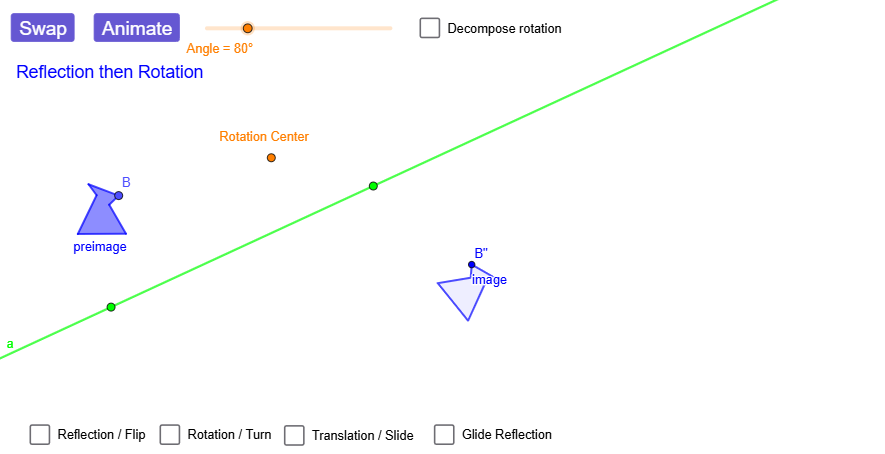
该范例通过“旋转 + 反射”的组合,展示一次 Turn-Flip(转折翻转)对多边形顶点与对应位置的作用规律。核心数学概念包括几何变换(旋转、镜面反射、平移、滑移等)、刚体运动的复合、以及由变换产生的对应点(preimage 与像点)关系。作图要点:由构造摘要可见,使用 Point、Polygon、Vector、Line 建立基准几何;通过 Rotate 与 Mirror 分别生成旋转与反射后的点/对象,并结合 Translate、glide 等建立复合变换效果;再用 Segment、Angle、Intersect 辅助确定连线、角度与交点位置,最终得到平移/反射/旋转后的多边形对应图(如 A’、B’、C’ 等)及其可视化结果。适合中学数学与几何教学(几何变换、坐标/向量辅助建模),也适合作为竞赛与数学可视化学习的入门案例。
GeoGebra 命令及参数
Point(Circle[A, 1.2851459061133876]) → BPolygon(A, B, C, D, E, F) → preimage, a_{1}, b_1, c_1, d, e, fVector(G, H) → VectorLine(I, J) → lineOfReflectionTranslate(A, Vector) → A'_{5}Translate(B, Vector) → B'_{5}Translate(C, Vector) → C'_{5}Translate(D, Vector) → D'_{5}Translate(E, Vector) → E'_{5}Translate(F, Vector) → F'_{5}Polygon(A'_{5}, B'_{5}, C'_{5}, D'_{5}, E'_{5}, F'_{5}) → translated, a', b', c', d', e', f'Mirror(A, lineOfReflection) → A'_{1}Mirror(B, lineOfReflection) → B'_{1}Mirror(C, lineOfReflection) → C'_{1}Mirror(D, lineOfReflection) → D'_{1}Mirror(E, lineOfReflection) → E'_{1}Mirror(F, lineOfReflection) → F'_{1}Polygon(A'_{1}, B'_{1}, C'_{1}, D'_{1}, E'_{1}, F'_{1}) → reflected, a'_{1}, b'_{1}, c'_{1}, d'_{1}, e'_{1}, f'_{1}Rotate(A, dummyRotationAngle, Center) → A'_{2}Rotate(B, dummyRotationAngle, Center) → B'_{2}Rotate(C, dummyRotationAngle, Center) → C'_{2}Rotate(D, dummyRotationAngle, Center) → D'_{2}Rotate(E, dummyRotationAngle, Center) → E'_{2}Rotate(F, dummyRotationAngle, Center) → F'_{2}Polygon(A'_{2}, B'_{2}, C'_{2}, D'_{2}, E'_{2}, F'_{2}) → rotated, a'_{2}, b'_{2}, c'_{2}, d'_{2}, e'_{2}, f'_{2}Line(K, lineOfReflection) → hPoint(h) → LVector(K, L) → Vector2Mirror(A, lineOfReflection) → A'_{3}Mirror(B, lineOfReflection) → B'_{3}Mirror(C, lineOfReflection) → C'_{3}Mirror(D, lineOfReflection) → D'_{3}Mirror(E, lineOfReflection) → E'_{3}Mirror(F, lineOfReflection) → F'_{3}Polygon(A'_{3}, B'_{3}, C'_{3}, D'_{3}, E'_{3}, F'_{3}) → intermediary, a'_{3}, b'_{3}, c'_{3}, d'_{3}, e'_{3}, f'_{3}Translate(A'_{3}, Vector2) → MTranslate(B'_{3}, Vector2) → NTranslate(C'_{3}, Vector2) → OTranslate(D'_{3}, Vector2) → PTranslate(E'_{3}, Vector2) → QTranslate(F'_{3}, Vector2) → RPolygon(M, N, O, P, Q, R) → image_{1}, m, n, o, p, q, rLine(S, T) → aRotate(preimageList, angleAnimator, rotationCenter) → RFanimRotListRotate(A, rotationAngle) → A'_{4}Rotate(C, rotationAngle) → C'_{4}Rotate(D, rotationAngle) → D'_{4}Rotate(E, rotationAngle) → E'_{4}Rotate(F, rotationAngle) → F'_{4}Rotate(A, rotationAngle, rotationCenter) → A'_{6}Rotate(C, rotationAngle, rotationCenter) → C'_{6}Rotate(D, rotationAngle, rotationCenter) → D'_{6}Rotate(E, rotationAngle, rotationCenter) → E'_{6}Rotate(F, rotationAngle, rotationCenter) → F'_{6}Mirror(A'_{6}, a) → WMirror(C'_{6}, a) → F_1Mirror(D'_{6}, a) → G_1Mirror(E'_{6}, a) → H_1Mirror(F'_{6}, a) → I_1Rotate(preimageList, rotationAngle, rotationCenter) → RFintermListMirror(RFintermList, a) → RFfinalListMirror(preimageList, a) → FRintermListRotate(FRintermList, rotationAngle, rotationCenter) → FRfinalListRotate(FRintermList, angleAnimator, rotationCenter) → FRanimRotListPolygon(FRanimFlipList) → FRanimFlipPolygon(FRanimRotList) → FRanimRotPolygon(FRintermList) → FRintermPolygon(RFanimRotList) → RFanimRotPolygon(RFintermList) → RFintermPolygon(RFanimFlipList) → RFanimFlipPolygon(RFfinalList) → RFfinalPolygon(FRfinalList) → imageSegment(rotationCenter, FRanimRotList(2)) → FRrotationSegmentSegment(rotationCenter, RFanimRotList(2)) → RFrotSegmentLine(rotationCenter, V) → bRotate(V, rotationAngle / 2, rotationCenter) → V'Angle(V, rotationCenter, V') → linesAngleLine(rotationCenter, V') → cRotate(b, pivotAngle1_{RefRot}, rotationCenter) → b'_{4}Intersect(b'_{4}, a) → Center_{ab}Rotate(a, pivotAngle2_{RefRot}, Center_{ab}) → a'_{4}Mirror(F, a'_{4}) → F'Mirror(E, a'_{4}) → E'Mirror(D, a'_{4}) → D'Mirror(C, a'_{4}) → C'Mirror(B, a'_{4}) → B'Mirror(A, a'_{4}) → A'Polygon(A', B', C', D', E', F') → preimage', g, i, j, k, l, sRotate(b'_{4}, pivotAngle2_{RefRot}, Center_{ab}) → tMirror(F', t) → F''Mirror(E', t) → E''Mirror(D', t) → D''Mirror(C', t) → C''Mirror(B', t) → B''Mirror(A', t) → A''Polygon(A'', B'', C'', D'', E'', F'') → preimage'', a'', b'', c'', d'', e'', f''Rotate(c, pivotAngle1_{RefRot}, rotationCenter) → c'_{4}Intersect(c, a) → Center_{ac}Rotate(a, pivotAngle1_{RotRef}, Center_{ac}) → a'_{5}Rotate(c, pivotAngle1_{RotRef}, Center_{ac}) → c'_{5}Intersect(b, c'_{5}) → Center_{bc}Rotate(b, pivotAngle2_{RotRef}, Center_{bc}) → b'_{5}Rotate(c'_{5}, pivotAngle2_{RotRef}, Center_{bc}) → f_1Mirror(A, b'_{5}) → A'_{7}Mirror(B, b'_{5}) → B'_{4}Mirror(C, b'_{5}) → C'_{7}Mirror(D, b'_{5}) → D'_{7}Mirror(E, b'_{5}) → E'_{7}Mirror(F, b'_{5}) → F'_{7}Polygon(A'_{7}, B'_{4}, C'_{7}, D'_{7}, E'_{7}, F'_{7}) → preimage'_{1}, a'_{7}, g_1, c'_{7}, d'_{7}, e'_{7}, f'_{7}Mirror(A'_{7}, f_1) → ZMirror(B'_{4}, f_1) → B_1Mirror(C'_{7}, f_1) → C_1Mirror(D'_{7}, f_1) → D_1Mirror(E'_{7}, f_1) → E_1Mirror(F'_{7}, f_1) → J_1Polygon(Z, B_1, C_1, D_1, E_1, J_1) → poly1, z_1, b_{2}, c_{2}, d_1, e_1, j_1
AI 绘图提示语参考
画一个六边形(由六个点A到F组成),以及一条反射线(由点I和J确定)。首先绘制原始六边形和反射线。然后将六边形关于反射线进行反射,得到另一个六边形。接着将反射后的六边形绕某个中心旋转一定角度,得到最终图形。整个过程展示了旋转与反射的组合变换,强调变换前后图形的对应关系。
以上提示语为根据原始绘图命令整理而来,仅供参考。