
冰山小镇:最小支配集的几何可视化
几何画板及绘图内容加载中,请稍等……
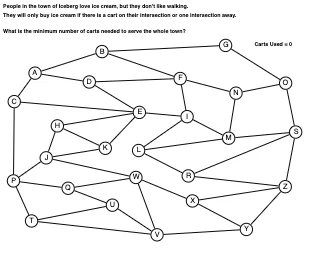
该范例通过点集上的覆盖关系,演示如何在图/几何结构中找到“最小支配集”来覆盖所有顶点(以最近或相邻连接为准)。核心数学概念包括图论中的最小支配集、最值优化(最小化选点数量)以及由几何连线诱导的邻接关系。作图要点:使用 GeoGebra 的 Segment 生成点与点之间的连边结构;用 Circle 构造用于判定“覆盖范围/支配半径”的圆形区域;结合 CountIf 对满足条件的候选点进行计数,以评估并最小化支配集的规模;通过 Text 标注关键节点或集合规模信息。构造摘要中涉及的对象与命令主要包括:命令 Segment、Circle、Text、CountIf,以及点对象 A,B,C,...,Z、Xpoint、Ypoint 等,以及由连边形成的线段对象(如 AC、AD、AB、BF 等)用于表达邻接/覆盖关系。适合中学后段到大学入门的离散数学、图论与优化教学演示,也适用于在 GeoGebra 中做交互式实验与数形结合探究。
GeoGebra 命令及参数
Segment(A, C) → ACSegment(A, D) → ADSegment(A, B) → ABSegment(B, F) → BFSegment(B, G) → BGSegment(C, E) → CESegment(C, P) → CPSegment(D, F) → DFSegment(D, E) → DESegment(E, H) → EHSegment(E, K) → EKSegment(E, I) → EISegment(F, I) → FISegment(F, N) → FNSegment(G, O) → GOSegment(H, J) → HJSegment(H, K) → HKSegment(I, L) → ILSegment(I, M) → IMSegment(J, K) → JKSegment(J, P) → JPSegment(J, W) → JWSegment(L, M) → LMSegment(L, R) → LRSegment(M, N) → MNSegment(M, S) → MSSegment(N, O) → NOSegment(O, S) → OSSegment(P, T) → PTSegment(P, Q) → PQSegment(Q, U) → QUSegment(Q, W) → QWSegment(R, Z) → RZSegment(R, S) → RSSegment(S, Z) → SZSegment(T, U) → TUSegment(T, V) → TVSegment(U, V) → UVSegment(V, W) → VWSegment(V, Ypoint) → VYSegment(W, Xpoint) → WXSegment(Xpoint, Z) → XZSegment(Xpoint, Ypoint) → XYSegment(Z, Ypoint) → YZCountIf(x ≟ true, listOfCarts) → numCartsCircle(A, 0.35) → borderACircle(B, 0.35) → borderBCircle(C, 0.35) → borderCCircle(D, 0.35) → borderDCircle(E, 0.35) → borderECircle(F, 0.35) → borderFCircle(G, 0.35) → borderGCircle(H, 0.35) → borderHCircle(I, 0.35) → borderICircle(J, 0.35) → borderJCircle(K, 0.35) → borderKCircle(L, 0.35) → borderLCircle(M, 0.35) → borderMCircle(N, 0.35) → borderNCircle(O, 0.35) → borderOCircle(P, 0.35) → borderPCircle(Q, 0.35) → borderQCircle(R, 0.35) → borderRCircle(S, 0.35) → borderSCircle(T, 0.35) → borderTCircle(U, 0.35) → borderUCircle(V, 0.35) → borderVCircle(W, 0.35) → borderWCircle(Xpoint, 0.35) → borderXCircle(Ypoint, 0.35) → borderYCircle(Z, 0.35) → borderZCircle(A, 0.35) → fillACircle(B, 0.35) → fillBCircle(C, 0.35) → fillCCircle(D, 0.35) → fillDCircle(E, 0.35) → fillECircle(F, 0.35) → fillFCircle(G, 0.35) → fillGCircle(H, 0.35) → fillHCircle(I, 0.35) → fillICircle(J, 0.35) → fillJCircle(K, 0.35) → fillKCircle(L, 0.35) → fillLCircle(M, 0.35) → fillMCircle(N, 0.35) → fillNCircle(O, 0.35) → fillOCircle(P, 0.35) → fillPCircle(Q, 0.35) → fillQCircle(R, 0.35) → fillRCircle(S, 0.35) → fillSCircle(T, 0.35) → fillTCircle(U, 0.35) → fillUCircle(V, 0.35) → fillVCircle(W, 0.35) → fillWCircle(Xpoint, 0.35) → fillXCircle(Ypoint, 0.35) → fillYCircle(Z, 0.35) → fillZText("S", S - (0.1, 0.1)) → vertexSText("A", A - (0.15, 0.1)) → vertexAText("B", B - (0.14, 0.1)) → vertexBText("C", C - (0.15, 0.1)) → vertexCText("D", D - (0.16, 0.1)) → vertexDText("E", E - (0.12, 0.1)) → vertexEText("F", F - (0.12, 0.1)) → vertexFText("G", G - (0.15, 0.1)) → vertexGText("H", H - (0.16, 0.1)) → vertexHText("I", I - (0.06, 0.1)) → vertexIText("J", J - (0.08, 0.1)) → vertexJText("K", K - (0.14, 0.1)) → vertexKText("L", L - (0.12, 0.1)) → vertexLText("M", M - (0.17, 0.1)) → vertexMText("N", N - (0.16, 0.1)) → vertexNText("O", O - (0.17, 0.1)) → vertexOText("P", P - (0.14, 0.1)) → vertexPText("Q", Q - (0.17, 0.1)) → vertexQText("R", R - (0.14, 0.1)) → vertexRText("T", T - (0.14, 0.1)) → vertexTText("U", U - (0.15, 0.1)) → vertexUText("V", V - (0.14, 0.1)) → vertexVText("W", W - (0.17, 0.1)) → vertexWText("X", Xpoint - (0.14, 0.1)) → vertexXText("Y", Ypoint - (0.14, 0.1)) → vertexYText("Z", Z - (0.14, 0.1)) → vertexZ
AI 绘图提示语参考
在平面上先放置若干点作为图的顶点(包括若干字母点 A 到 Z,并含有 Xpoint、Ypoint 以及中心点 P、Q、R、S、T、U、V、W、Xpoint、Ypoint、Z 等)。用线段把这些点按给定关系连接成一张边结构图,其中重点连出从 A 到 C、D、B,以及 B 与 F、G 相连,再连出 C 与 E、P 相连,其他点按连接对依次用线段相互相连。再以 A、B、C 为圆心各画半径为 0.35 的圆,作为对邻域覆盖的可视提示,最后在需要处加入计数与标注信息以便统计被覆盖顶点数量。
以上提示语为根据原始绘图命令整理而来,仅供参考。