
可重叠直角三角形组合的几何构造
几何画板及绘图内容加载中,请稍等……
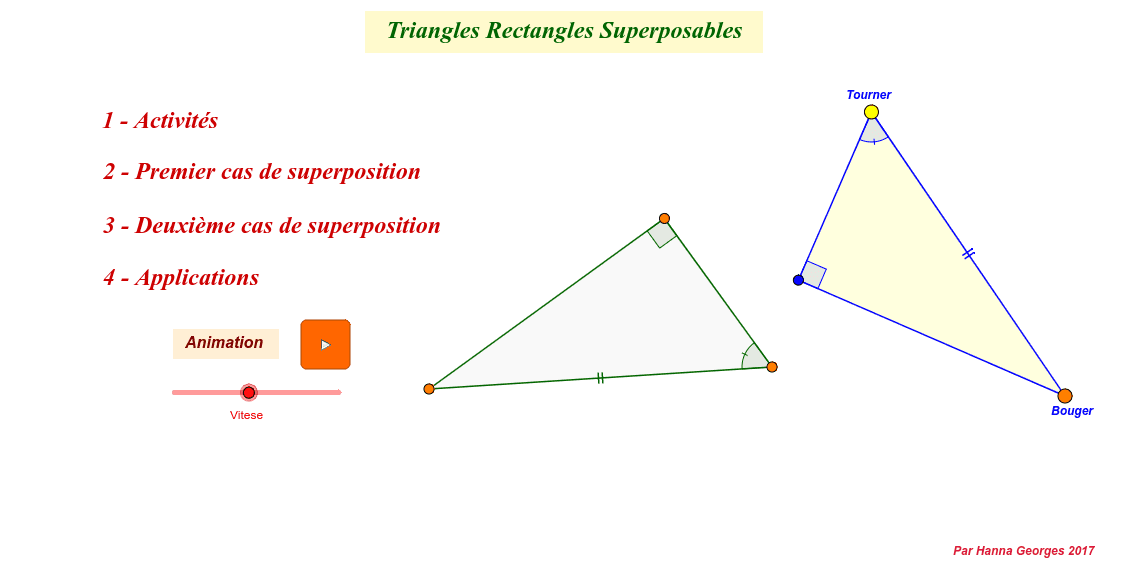
① 本范例演示了多个直角三角形通过平移、旋转、镜像等变换后相互重叠、拼合形成的复合图形,重点展示三角形全等(可重叠)关系及其在平面上的位置变化。② 核心数学概念包括三角形全等、几何变换(平移、旋转、镜像)、圆与圆弧的辅助构造、以及分段函数与参数曲线在描述边界时的应用。③ 作图要点:从构造摘要可见,使用了Semicircle(半圆)、Point(点)、Polygon(多边形)、Segment(线段)、Circle(圆)、Intersect(交点)、Line(直线)、OrthogonalLine(垂线)、Angle(角)、CircleArc(圆弧)、Rotate(旋转)、Ray(射线)、Vector(向量)、Translate(平移)、CircleSector(扇形)、Midpoint(中点)、Mirror(镜像)等GeoGebra命令,对象包括多个三角形、圆、线段及辅助点,通过变换命令生成可重叠的直角三角形组合。④ 适合中学几何教学或大学几何变换入门,可用于直观理解全等三角形的判定与变换性质,也可作为动态几何探究的示例。
GeoGebra 命令及参数
Semicircle(O_3, R_3) → s_6Point(s_6) → S_3Polygon(O_3, S_3, R_3) → poly11, r_7, o_3, s_7Point(Segment[Pos_D, W_1], v - 7) → D_9Segment(W_1, D_2) → l_5Segment(B_1, C_1) → a_2Circle(E_1, a_2) → e_3Point(e_3) → G_1Semicircle(E_1, G_1) → h_3Semicircle(B_1, C_1) → t_2Point(t_2) → D_1Segment(D_1, C_1) → f_3Circle(G_1, f_3) → k_3Intersect(h_3, k_3, 1) → H_1Segment(D_1, H_1) → a_3Circle(D, 6) → c_1Line(C, D) → sIntersect(c_1, s, 1) → FCircle(D, 7) → t_1Point(Segment[C, D], n) → NSegment(C, N) → f_1OrthogonalLine(D, f_1) → s_1Intersect(t_1, s_1, 1) → RLine(L, J) → gSegment(L, J) → hCircle(L, (m * h)) → dIntersect(d, g, 2) → GSegment(L, G) → iOrthogonalLine(J, h) → jPoint(j) → HSegment(J, H) → lCircle(J, ((m - 1) * l)) → eIntersect(e, j) → I, KSegment(J, I) → kAngle(L, J, H) → γCircle(J, 6) → tCircle(J, 4) → h_1Intersect(t, h, 1) → ACircle(J, 4) → cIntersect(c, l, 1) → BPoint(Segment[J, A], m - 2) → MSegment(J, M) → fPoint(Segment[J, B], m - 3) → M_1Segment(J, M_1) → qPoint(Segment[A, B], m - 4) → M_2Segment(A, M_2) → rPolygon(A, J, B) → poly1, b, a, j_1OrthogonalLine(D, f_1) → g_1Point(Segment[D, R], n - 1) → N_1Segment(D, N_1) → i_1Intersect(c_1, f_1, 1) → F_1Point(Segment[D, F_1], n - 2) → N_2Segment(D, N_2) → k_1Circle(F, 7.5) → d_1Point(d_1) → OIntersect(d_1, i_1, 1) → PCircle(P, O) → e_1Intersect(d_1, e_1, 2) → QPoint(Arc[d_1, O, Q], n - 4) → N_4CircleArc(F_1, O, N_4) → p_1Point(Segment[F_1, O], n - 3) → N_3Segment(F_1, N_3) → l_1Segment(F_1, N_4) → m_1Point(Segment[F_1, P], n - 5) → N_5Segment(F_1, N_5) → n_1Point(Segment[D, P], n - 6) → N_6Segment(D, N_6) → q_1Polygon(F_1, D, P) → poly2, p_2, f_2, d_2Segment(F_1, P) → r_1Angle(F_1, D, R) → αOrthogonalLine(D, s) → a_1Line(E, S) → b_1Rotate(S, 50°, E) → S'Angle(S, E, S') → βLine(E, S') → g_2Circle(E, 7) → c_2Intersect(c_2, b_1, 2) → TOrthogonalLine(T, g_2) → h_2Intersect(g_2, h_2) → UPoint(Segment[E, T], p) → P_1Segment(E, P_1) → j_2Ray(E, T) → k_2Point(k_2) → WSegment(E, W) → l_2Circle(E, W) → e_2Intersect(e_2, g_2, 2) → ZPoint(Arc[e_2, W, Z], p - 1) → P_2Segment(E, P_2) → m_2Angle(W, E, P_2) → δSegment(E, W) → i_2Point(h_2) → A_1Segment(T, A_1) → n_2Angle(E, U, T) → εPoint(Segment[T, U], p - 3) → P_3Segment(T, P_3) → q_2Point(Segment[E, U], p - 4) → P_4Segment(E, P_4) → r_2Point(Segment[T, A_1], p - 2) → P_{21}Segment(T, P_{21}) → s_2Angle(E, U, T) → ζSegment(B_1, D_1) → b_2Polygon(B_1, D_1, C_1) → poly3, c_3, b_3, d_3Segment(E_1, G_1) → g_3Segment(E_1, H_1) → i_3Segment(H_1, G_1) → j_3Polygon(E_1, H_1, G_1) → poly4, g_4, e_4, h_4Line(C_1, D_1) → l_3Line(G_1, H_1) → m_3Angle(l_3, m_3) → θSegment(D_1, H_1) → n_3Line(D_1, H_1) → p_3Circle(D_1, (u * a_3)) → q_3Intersect(q_3, p_3) → I_1, J_1Vector(D_1, J_1) → w_5Translate(B_1, w_5) → K_1Translate(D_1, w_5) → L_1Translate(C_1, w_5) → O_1Polygon(K_1, L_1, O_1) → poly3', o_1, k_4, l_4Segment(J_1, O_1) → r_3Segment(O_1, K_1) → s_3Segment(K_1, J_1) → t_3Vector(D_1, H_1) → u_1Translate(B_1, u_1) → Q_1Translate(D_1, u_1) → R_1Translate(C_1, u_1) → S_1Polygon(Q_1, R_1, S_1) → poly3'_1, s_4, q_4, r_4Rotate(Q_1, ((u - 1) * θ), H_1) → T_1Rotate(R_1, ((u - 1) * θ), H_1) → U_1Rotate(S_1, ((u - 1) * θ), H_1) → V_1Polygon(T_1, U_1, V_1) → poly5, v_5, t_4, u_2Segment(H_1, T_1) → f_4Segment(T_1, V_1) → i_4Segment(V_1, H_1) → j_4Angle(K_1, J_1, O_1) → ηAngle(T_1, H_1, V_1) → ιAngle(E_1, H_1, G_1) → κPolygon(E, U, T) → poly6, t_5, e_5, u_3Semicircle(W_1, Z_1) → c_4Point(c_4) → C_2Polygon(W_1, C_2, Z_1) → poly7, z_1, w_1, c_5Point(Circle[D_2, c_5]) → E_2Segment(D_2, E_2) → m_4Semicircle(D_2, E_2) → d_4Circle(D_2, z_1) → p_4Intersect(d_4, p_4, 1) → F_2Polygon(D_2, F_2, E_2) → poly8, e_6, d_5, f_5Segment(W_1, Z_1) → n_4Segment(Z_1, E_2) → b_4Circle(Z_1, (v * b_4)) → g_5Vector(Z_1, E_2) → w_2Translate(W_1, w_2) → J_2Translate(Z_1, w_2) → K_2Vector(Z_1, E_2) → v_3Translate(W_1, v_3) → L_2Translate(Z_1, v_3) → O_2Segment(L_2, O_2) → h_5Angle(L_2, E_2, D_2) → λRotate(L_2, ((v - 1) * λ), E_2) → R_2Rotate(O_2, ((v - 1) * λ), E_2) → S_2Segment(R_2, S_2) → i_5Point(poly7) → U_2CircleSector(W_1, U_2, C_2) → k_5Segment(W_1, U_2) → j_5Circle(D_2, j_5) → p_5Intersect(m_4, f_5) → V_2Intersect(m_4, f_5) → W_2Intersect(m_4, f_5) → Z_2Intersect(p_5, f_5) → A_3, J_3CircleSector(D_2, A_3, F_2) → q_5Segment(E_2, D_2) → m_5Vector(W_1, D_2) → u_4Translate(k_5, u_4) → c_6Rotate(c_6, ((v - 3) * λ), D_2) → d_6Angle(W_1, C_2, Z_1) → μAngle(D_2, F_2, E_2) → νSegment(W_1, D_2) → n_5Line(W_1, D_2) → s_5Point(Segment[W_1, D_2], v - 2) → A_4Vector(W_1, A_4) → w_3Translate(k_5, w_3) → r_5Midpoint(i_5) → B_3Midpoint(m_4) → D_3Point(r_5) → E_3Point(d_6) → F_3Angle(J_1, O_1, K_1) → ξAngle(H_1, G_1, E_1) → οAngle(H_1, V_1, T_1) → ρPoint(Segment[Z_1, E_2], v) → A_5Vector(Z_1, A_5) → v_2Translate(W_1, v_2) → G_2Translate(Z_1, v_2) → H_2Segment(G_2, H_2) → a_4Midpoint(a_4) → I_2Line(D_2, c_5) → a_5Circle(D_2, E_2) → f_6Intersect(f_6, a_5, 1) → T_2Ray(D_2, F_2) → b_5Point(b_5) → C_3Point(Segment[D_2, C_3], v - 4) → A_6Segment(D_2, A_6) → g_6Vector(W_1, A_4) → v_4Translate(k_5, v_4) → h_6Point(Segment[S_2, F_2], v - 5) → A_7Segment(S_2, A_7) → i_6Point(q_5) → G_3Angle(D_2, F_2, E_2) → σPoint(Segment[D_2, F_2], v - 6) → A_8Segment(D_2, A_8) → j_6Polygon(W_1, C_2, Z_1) → poly9, z_2, w_4, c_7Polygon(D_2, F_2, E_2) → poly10, e_7, d_7, f_7Rotate(Z_1, λ, W_1) → I_3Circle(W_1, I_3) → k_6Rotate(D_2, (-(((v - 8) * λ))), W_1) → K_3Rotate(F_2, (-(((v - 8) * λ))), W_1) → L_3Rotate(E_2, (-(((v - 8) * λ))), W_1) → M_3Polygon(K_3, L_3, M_3) → poly10', m_6, k_7, l_6Segment(S_2, D_2) → n_6Segment(W_1, M_3) → p_6Segment(L_3, M_3) → q_6Segment(L_3, W_1) → r_6Angle(W_1, L_3, M_3) → τAngle(M_3, W_1, L_3) → υSegment(S_3, O_3) → b_6Circle(Q_3, s_7) → t_6Point(t_6) → T_3Semicircle(Q_3, T_3) → g_7Circle(Q_3, r_7) → h_7Intersect(g_7, h_7, 1) → V_3Polygon(Q_3, V_3, T_3) → poly12, t_7, q_7, v_1Point(Segment[S_3, V_3], vo) → B_4Vector(S_3, B_4) → u_5Translate(O_3, u_5) → W_3Translate(S_3, u_5) → Z_3Segment(W_3, Z_3) → a_6Line(S_3, t_7) → i_7Intersect(i_7, s_7) → C_4Angle(O_3, S_3, C_4) → ϕRotate(W_3, ((vo - 1) * ϕ), V_3) → D_4Rotate(Z_3, ((vo - 1) * ϕ), V_3) → E_4Segment(D_4, E_4) → j_7Ray(V_3, T_3) → l_7Point(l_7) → F_4Point(Segment[V_3, F_4], vo - 2) → B_5Segment(V_3, B_5) → m_7Angle(Q_3, V_3, T_3) → χPoint(Segment[O_3, Q_3], vo - 3) → B_6Vector(O_3, B_6) → u_6Translate(R_3, u_6) → G_4Translate(O_3, u_6) → H_4Segment(G_4, H_4) → n_7Line(Q_3, s_7) → p_7Intersect(t_6, p_7, 1) → I_4Circle(T_3, I_4) → c_8Intersect(t_6, c_8, 2) → J_4CircleArc(Q_3, I_4, J_4) → d_8Point(d_8, vo - 4) → B_7Segment(Q_3, B_7) → a_7CircleArc(Q_3, I_4, B_7) → e_8Point(Segment[Q_3, T_3], vo - 5) → B_8Segment(Q_3, B_8) → b_7Point(Segment[V_3, T_3], vo - 6) → B_9Segment(V_3, B_9) → f_8Point(Segment[V_3, S_3], vot) → C_5Vector(V_3, C_5) → v_6Translate(Q_3, v_6) → K_4Translate(V_3, v_6) → L_4Translate(T_3, v_6) → M_4Polygon(K_4, L_4, M_4) → poly12', m_8, k_8, l_8Rotate(K_4, (-(((vot - 1) * ϕ))), C_5) → O_4Rotate(L_4, (-(((vot - 1) * ϕ))), C_5) → Q_4Rotate(M_4, (-(((vot - 1) * ϕ))), C_5) → R_4Polygon(O_4, Q_4, R_4) → poly12'', r_8, o_4, q_8Segment(C_5, O_4) → g_8Angle(O_3, S_3, R_3) → ψAngle(K_4, C_5, M_4) → ωAngle(O_4, C_5, R_4) → α_1Midpoint(a_6) → S_4Midpoint(t_7) → T_4Midpoint(H_4, G_4) → U_4Segment(Q_3, T_3) → h_8Midpoint(Q_3, T_3) → V_4Line(W_4, Z_4) → i_8Line(D_5, i_8) → j_8Segment(Z_4, D_5) → n_8Line(W_4, n_8) → p_8Intersect(j_8, p_8) → E_5Polygon(W_4, Z_4, D_5, E_5) → poly13, w_6, z_4, d_9, e_9Line(E_5, Z_4) → s_8Segment(W_4, D_5) → t_8OrthogonalLine(W_4, s_8) → a_8OrthogonalLine(D_5, s_8) → b_8Intersect(s_8, a_8) → F_5Intersect(s_8, b_8) → G_5Segment(E_5, Z_4) → f_9Intersect(t_8, f_9) → H_5Polygon(W_4, F_5, H_5) → poly14, h_9, w_7, f_{10}Polygon(D_5, H_5, G_5) → poly15, g_9, d_{10}, h_{10}Rotate(W_4, (-((ap12 * π))), H_5) → I_5Rotate(F_5, (-((ap12 * π))), H_5) → J_5Rotate(H_5, (-((ap12 * π))), H_5) → K_5Polygon(I_5, J_5, K_5) → poly14', k_9, i_9, j_9Angle(H_5, F_5, W_4) → β_1Angle(H_5, G_5, D_5) → γ_1Circle(M_5, O_5) → c_9Point(c_9) → P_5Polygon(M_5, O_5, P_5) → poly16, p_9, m_9, o_5OrthogonalLine(O_5, p_9) → l_9OrthogonalLine(P_5, o_5) → n_9Intersect(l_9, n_9) → Q_5Polygon(M_5, O_5, Q_5) → poly17, q_9, m_{10}, o_6Polygon(Q_5, P_5, M_5) → poly18, m_{11}, q_{10}, p_{10}Segment(O_5, P_5) → r_9Ray(P_5, Q_5) → s_9Point(s_9) → R_5Segment(P_5, R_5) → t_9Ray(O_5, Q_5) → a_9Point(a_9) → S_5Segment(O_5, S_5) → b_9Angle(Q_5, P_5, M_5) → δ_1Angle(M_5, O_5, Q_5) → ε_1Rotate(O_5, (ap22 * π), O_5) → T_5Rotate(Q_5, (ap22 * π), O_5) → U_5Segment(O_5, U_5) → i_{10}Mirror(Q_5, O_5) → V_5Segment(O_5, V_5) → g_{10}Polygon(M_5, O_5, V_5) → poly19, v_7, m_{12}, o_7Point(Segment[M_5, V_5], ap22 - 1) → C_6Segment(M_5, C_6) → j_{10}Angle(P_5, M_5, Q_5) → ζ_1Rotate(M_5, (((ap22 - 1) * 2) * ζ_1), M_5) → W_5Rotate(M_5, (-((((ap22 - 1) * 2) * ζ_1))), M_5) → Z_5Rotate(M_5, (-((((ap22 - 2) * 2) * ζ_1))), M_5) → D_6Rotate(O_5, (-((((ap22 - 3) * 2) * ζ_1))), M_5) → E_6Rotate(V_5, (-((((ap22 - 3) * 2) * ζ_1))), M_5) → F_6Polygon(D_6, E_6, F_6) → poly19', f_{11}, d_{11}, e_{10}Segment(M_5, E_6) → k_{10}Angle(K_5, J_5, I_5) → η_1
AI 绘图提示语参考
绘制一个由多个可重合的直角三角形组成的复合图形。首先画一个半圆,在其上取一点,与半圆两端构成一个直角三角形。再画另一个半圆和圆,通过交点构造出第二个直角三角形。接着画一条线段,以其为半径作圆,与直线相交得到点,构造第三个直角三角形。然后画两条相交线段,以其中一条为半径作圆,与另一条线段相交,构造出第四个直角三角形。最后画两个同心圆,与线段相交,形成第五个直角三角形。所有三角形通过平移、旋转或镜像可以重合,展示全等三角形的性质。
以上提示语为根据原始绘图命令整理而来,仅供参考。