
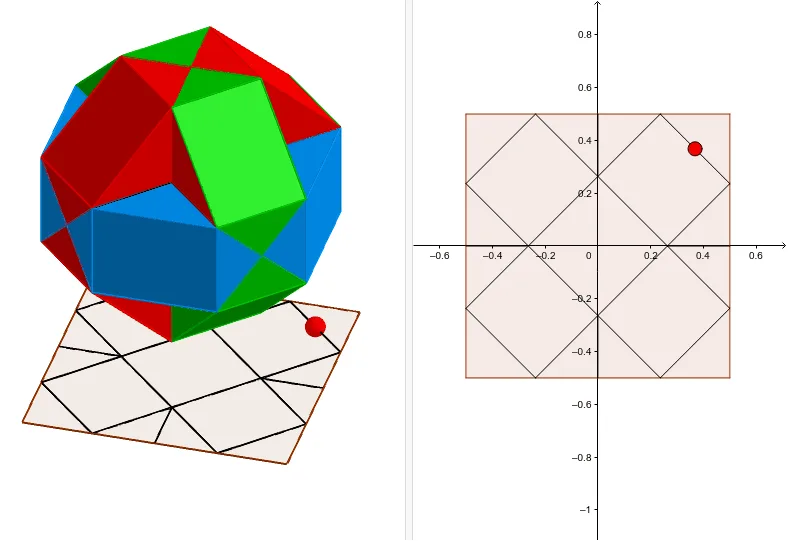
骨架八面体可变到菱形二十面体和立方体
几何画板及绘图内容加载中,请稍等……
①本范例演示了通过变换骨架八面体,使其逐渐变形为菱形二十面体和立方体的过程;②涉及的核心数学概念包括几何变换、空间几何、多面体性质、向量运算;③作图要点——从构造摘要中提炼出使用了Line(线)、Point(点)、Polygon(多边形)、Intersect(交点)、OrthogonalLine(垂线)、Segment(线段)、Rotate(旋转)、Vector(向量)、Translate(平移)、Plane(平面)、Mirror(镜像)等GeoGebra命令和对象;④适合高中及以上学生学习和理解多面体变换、空间几何关系及动态几何演示。
GeoGebra 命令及参数
Line(D, B) → sLine(A, C) → ePoint(e) → EPolygon(A, B, C, D) → poly1, a, b, c, dIntersect(xAxis, yAxis) → OOrthogonalLine(E, e) → fIntersect(f, poly1) → F, GSegment(G, F) → gRotate(G, 90°, O) → G'Rotate(F, 90°, O) → F'Segment(G', F') → g'Rotate(G', 90°, O) → G''Rotate(F', 90°, O) → F''Segment(G'', F'') → g''Rotate(G'', 90°, O) → G'''Rotate(F'', 90°, O) → F'''Segment(G''', F''') → g'''Segment(F'', G) → hSegment(F', G''') → iSegment(F, G'') → jSegment(F''', G') → kIntersect(h, k) → HIntersect(i, j) → IIntersect(h, j) → JIntersect(i, h) → KIntersect(k, poly1) → L, MIntersect(j, k) → NLine(H, I) → lLine(N, K) → mIntersect(m, c) → PIntersect(l, m) → QIntersect(l, d) → RIntersect(m, a) → SIntersect(l, b) → TSegment(K, P) → nSegment(H, R) → pSegment(N, S) → qSegment(I, T) → rPoint(zAxis) → UVector(O, U) → vTranslate(A, v) → A'Translate(B, v) → B'Translate(C, v) → C'Translate(D, v) → D'Polygon(A', B', C', D') → poly1', a', b', c', d'Translate(F'', v) → F'''_1Translate(G, v) → G'_1Segment(F'''_1, G'_1) → h'_2Translate(F, v) → F'_2Translate(G'', v) → G'''_1Segment(F'_2, G'''_1) → j'Translate(G'', v) → G'''_2Translate(F'', v) → F'''_2Segment(G'''_2, F'''_2) → g'''_3Translate(G, v) → G'_2Translate(F, v) → F'_3Segment(G'_2, F'_3) → g'_1Translate(G', v) → G''_1Translate(F', v) → F''_1Segment(G''_1, F''_1) → g''_2Translate(F', v) → F''_2Translate(G''', v) → VSegment(F''_2, V) → i'_1Translate(F''', v) → WTranslate(G', v) → G''_2Segment(W, G''_2) → k'_1Translate(G''', v) → ZTranslate(F''', v) → A_1Segment(Z, A_1) → tTranslate(H, v) → H'_1Translate(R, v) → R'Segment(H'_1, R') → p'Translate(K, v) → K'_1Translate(P, v) → P'Segment(K'_1, P') → n'_4Translate(N, v) → N'_1Translate(S, v) → S'Segment(N'_1, S') → q'Translate(I, v) → I'_1Translate(T, v) → T'Segment(I'_1, T') → r'Translate(E, v) → E'Rotate(F'_2, 90°, i'_1) → B_1Vector(I'_1, B_1) → uPolygon(H'_1, N'_1, I'_1, K'_1) → poly2, h'_1, n'_1, i'_2, k'_2Translate(U, u) → U'Translate(K'_1, u) → C_1Polygon(U', B_1, C_1) → poly3, c_1, u', b_1Polygon(K'_1, C_1, G'_1) → poly4, g'_2, k'_3, c_2Polygon(C_1, G'_1, F'_2, B_1) → poly5, c_3, g'_3, f'_2, b_2Polygon(B_1, I'_1, F'_2) → poly6, f'_1, b_3, i'_3Rotate(poly6, 90°, zAxis) → gpoly6'Rotate(G'_1, 90°, zAxis) → D_1Rotate(K'_1, 90°, zAxis) → E_1Segment(D_1, E_1) → a_1Rotate(poly5, 90°, zAxis) → gpoly5'Rotate(poly3, 90°, zAxis) → gpoly3'Rotate(poly4, 90°, zAxis) → gpoly4'Rotate(gpoly3', 90°, zAxis) → poly3''Rotate(gpoly4', 90°, zAxis) → poly4''Rotate(gpoly5', 90°, zAxis) → poly5''Rotate(gpoly6', 90°, zAxis) → poly6''Rotate(poly6'', 90°, zAxis) → poly6'''Rotate(poly3'', 90°, zAxis) → gpoly3'''Rotate(poly5'', 90°, zAxis) → gpoly5'''Rotate(poly4'', 90°, zAxis) → gpoly4'''Rotate(B', -90°, t) → B''Rotate(A', -90°, g'''_3) → A''Rotate(D', (-(90°)), g''_2) → D''Plane(D'', A'', B'') → oMirror(poly3, o) → poly3'_1Mirror(gpoly3', o) → gpoly3''_1Mirror(poly3'', o) → poly3'''_1Mirror(gpoly3''', o) → gpoly7Mirror(poly4, o) → poly4'_1Mirror(gpoly4', o) → gpoly4''_1Mirror(poly4'', o) → poly4'''_1Mirror(gpoly4''', o) → gpoly8Mirror(poly5, o) → poly5'_1Mirror(gpoly5', o) → gpoly5''_1Mirror(poly5'', o) → poly5'''_1Mirror(gpoly5''', o) → gpoly9Mirror(poly6, o) → poly6'_1Mirror(gpoly6', o) → gpoly6''_1Mirror(poly6'', o) → poly6'''_1Mirror(poly6''', o) → gpoly10Line(B'', D'') → d_1Rotate(gpoly4', -90°, d_1) → bpoly4''_2Rotate(poly3'', -90°, d_1) → poly3'''_2Rotate(poly3, -90°, d_1) → poly3'_2Rotate(gpoly5', -90°, d_1) → bpoly5''_2Rotate(gpoly6', -90°, d_1) → bpoly6''_2Rotate(gpoly3', -90°, d_1) → bpoly3''_2Rotate(gpoly3''', -90°, d_1) → bpoly11Rotate(bpoly5''_2, -90°, zAxis) → bpoly12Rotate(bpoly12, -90°, zAxis) → bpoly12'Rotate(bpoly12', -90°, zAxis) → bpoly12''Rotate(bpoly6''_2, -90°, zAxis) → bpoly13Rotate(bpoly13, -90°, zAxis) → bpoly13'Rotate(bpoly13', -90°, zAxis) → bpoly13''Mirror(bpoly6''_2, o) → bpoly14Mirror(bpoly13, o) → bbpoly13'_1Mirror(bpoly13', o) → bpoly13''_1Mirror(bpoly13'', o) → bpoly13'''Rotate(poly3'_2, -90°, zAxis) → gpoly15Rotate(gpoly15, -90°, zAxis) → poly15'Rotate(poly15', -90°, zAxis) → gpoly15''Rotate(bpoly11, -90°, zAxis) → bpoly11'Rotate(bpoly11', -90°, zAxis) → bpoly11''Rotate(bpoly11'', -90°, zAxis) → bpoly11'''Rotate(poly3'''_2, -90°, zAxis) → poly16Rotate(poly16, -90°, zAxis) → poly16'Rotate(poly16', -90°, zAxis) → gpoly16''Rotate(bpoly3''_2, -90°, zAxis) → bpoly17Rotate(bpoly17, -90°, zAxis) → bpoly17'Rotate(bpoly17', -90°, zAxis) → bpoly17''
AI 绘图提示语参考
绘制一个由四个顶点构成的空间四边形骨架,其对角线相交于原点。在一条对角线上取一点,过该点作此对角线的垂线,与四边形交于两点,连接这两点得到一条线段。将这条线段绕原点依次旋转三次,每次九十度,得到四条对称线段,它们围成一个八边形区域。连接相邻旋转线段的端点,形成四条交叉线段,这些线段与四边形边相交,产生多个交点。连接这些交点形成内部的多边形结构。最后,将整个四边形沿竖直方向平移一段距离,得到第二个四边形,并在两个四边形之间连接对应点,形成立体框架,展示从八面体到立方体的过渡形态。
以上提示语为根据原始绘图命令整理而来,仅供参考。