
3.4.6 翁达博物馆:瓷砖6——几何变换与平行六面体图案
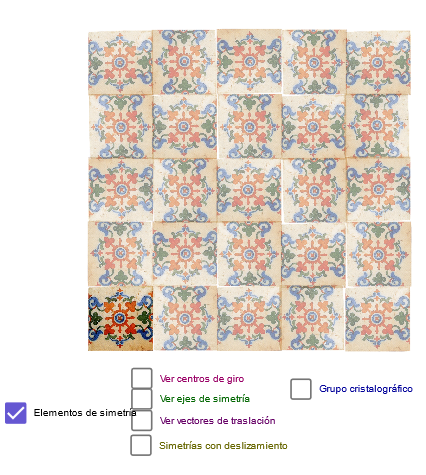
几何画板及绘图内容加载中,请稍等……
所属专题
geometriadinamica.es
本范例演示了如何利用几何变换(旋转、镜像、平移)在平行六面体框架内构造一个装饰性瓷砖图案,源自西班牙翁达博物馆的瓷砖设计。核心数学概念包括几何变换(旋转、镜像、平移)、平行六面体的空间结构、切线、中点、垂线以及周长计算。作图要点:使用GeoGebra命令如Line(直线)、Point(点)、OrthogonalLine(垂线)、Intersect(交点)、Midpoint(中点)、Mirror(镜像)、Rotate(旋转)、Vector(向量)等,构造了对象A、B、b、G、e、J、h、f、H、g、E、I、B_1、a、vp、vg、dif、c、vs、vr、vt、v、vd、gr、D、F、K、L、M、N、O、P、Q、R、S、T、U、V、W、Z,通过旋转和镜像生成对称的瓷砖纹样。适合初中至高中阶段学习几何变换、对称性和空间图形的学生,也可用于数学与艺术结合的项目式学习。
GeoGebra 命令及参数
Line(A, B) → bLine(G, b) → ePoint(e) → JOrthogonalLine(J, e) → hOrthogonalLine(G, e) → fPoint(f) → HOrthogonalLine(H, f) → gIntersect(g, h) → EMidpoint(E, H) → IMidpoint(I, E) → B_1Midpoint(G, J) → DMidpoint(J, E) → FMidpoint(H, G) → KMidpoint(D, I) → LMidpoint(K, L) → MMidpoint(L, F) → NMidpoint(F, J) → OMidpoint(J, D) → PMidpoint(G, D) → QMidpoint(K, G) → RMidpoint(Q, M) → SMidpoint(L, D) → TMidpoint(P, N) → UMidpoint(F, E) → VMidpoint(K, H) → WMidpoint(W, V) → ZMidpoint(H, I) → A_1Midpoint(N, B_1) → C_1Midpoint(Z, W) → D_1Midpoint(D, U) → E_1Midpoint(U, J) → F_1Midpoint(T, Q) → G_1Midpoint(S, G) → H_1Midpoint(S, K) → I_1Midpoint(M, T) → J_1Midpoint(T, N) → K_1Midpoint(N, O) → L_1Midpoint(F, C_1) → M_1Midpoint(C_1, L) → N_1Midpoint(L, D_1) → O_1Midpoint(D_1, K) → P_1Midpoint(H, D_1) → Q_1Midpoint(D_1, I) → R_1Midpoint(I, C_1) → S_1Midpoint(C_1, E) → T_1Mirror(F_1, h) → U_1Mirror(L_1, h) → V_1Mirror(M_1, h) → W_1Mirror(T_1, h) → Z_1Mirror(B_1, h) → A_2Mirror(L_1, h) → C_2Line(S, A_1) → tLine(I, T) → a_1Line(U, B_1) → b_1Line(E_1, N_1) → c_1Line(F_1, M_1) → d_1Line(G_1, R_1) → e_1Line(W_1, P_1) → g_1Line(Q_1, Z_1) → h_1Point(a_1) → F_2Point(b) → A1Min(90, ((a - 1) * 90)) → r1Rotate(F_2, ((-r1))°, T) → K_{11}Rotate(T, ((-r1))°, T) → T'_7Rotate(U, ((-r1))°, T) → U'_3Rotate(T, ((-r1))°, T) → T'_8Rotate(T, ((-r1))°, T'_8) → T'_9Rotate(F_2, ((-r1))°, T) → J_{13}Rotate(L, ((-r1))°, T) → L'_2Mirror(U'_3, b_1) → A_{14}Mirror(T'_8, b_1) → B_{14}Mirror(T'_9, b_1) → O_{15}Mirror(K_{11}, b_1) → G_{16}Mirror(T'_7, b_1) → H_{16}Mirror(J_{13}, b_1) → J_{17}Mirror(L'_2, b_1) → K_{17}Midpoint(C_1, E) → K_{20}Line(G_1, O_1) → l_1OrthogonalLine(G_1, l_1) → m_1OrthogonalLine(J_1, l_1) → q_1OrthogonalLine(O_1, l_1) → r_1OrthogonalLine(R_1, l_1) → s_1OrthogonalLine(E_1, m_1) → t_1OrthogonalLine(F_1, m_1) → a_2Point(a_1) → CMin(180, ((a - 1) * 180)) → r2Min(270, ((a - 1) * 270)) → r3Rotate(T, r1°, T) → T'_4Rotate(F_2, r1°, T) → G_2Rotate(T, r2°, T) → T'_5Rotate(F_2, r2°, T) → J_2Rotate(T, r3°, T) → T'_6Rotate(F_2, r3°, T) → N_2Rotate(F_2, r1°, T) → Q_2Rotate(C, r1°, T) → C'Rotate(F_2, r2°, T) → Z_2Rotate(C, r2°, T) → C'_1Rotate(F_2, r3°, T) → H_3Rotate(C, r3°, T) → C'_2Rotate(C, r1°, T) → C'_3Rotate(L, r1°, T) → L'_1Rotate(K_1, r1°, T) → Q_3Rotate(C, r2°, T) → C'_4Rotate(L, r2°, T) → L'_3Rotate(K_1, r2°, T) → Z_3Rotate(C, r3°, T) → C'_5Rotate(L, r3°, T) → L'_4Rotate(K_1, r3°, T) → H_4Mirror(C'_4, a_1) → F_5Mirror(L'_3, a_1) → G_5Mirror(Z_3, a_1) → J_5Mirror(Z_2, a_1) → O_5Mirror(C'_1, a_1) → P_5Mirror(T'_5, a_1) → W_5Mirror(J_2, a_1) → Z_5Mirror(C, a_1) → C'_6Mirror(L, a_1) → L'_5Mirror(K_1, a_1) → R_6Mirror(F_2, a_1) → T_6Mirror(C, a_1) → C'_7Mirror(T, a_1) → T'_{10}Mirror(F_2, a_1) → W_6Min(180, ((a - 5.5) * 180)) → r4Vector(S, D) → uVector(S, L) → wLine(S, O) → qLine(F, M) → rLine(D_1, V) → sIntersect(t, m_1) → B_2Intersect(a_1, m_1) → P_2Intersect(b_1, m_1) → R_2Intersect(h, m_1) → S_2Intersect(a_2, q) → T_2Intersect(t_1, q) → W_2Intersect(l_1, q) → A_3Intersect(t, q_1) → B_3Intersect(q_1, a_1) → C_3Intersect(b_1, q_1) → E_3Intersect(h, q_1) → G_3Intersect(a_2, r) → I_3Intersect(r, t_1) → J_3Intersect(r, l_1) → K_3Intersect(r_1, a_1) → L_3Intersect(b_1, r_1) → N_3Intersect(h, r_1) → P_3Intersect(t, r_1) → R_3Intersect(l_1, s) → S_3Intersect(s, t_1) → T_3Intersect(s, a_2) → U_3Vector(U, P) → zVector(U, O) → u_1Rotate(pic1, 270°, D_1) → pic1'Rotate(pic1', 270°, D_1) → pic1''Rotate(pic1'', 270°, D_1) → pic1'''Rotate(pic1', 270°, M) → pic1''_1Rotate(pic1''_1, 270°, M) → pic2Rotate(pic1''_1, 270°, S) → pic3Rotate(pic3, 270°, S) → pic3'Rotate(pic3, 270°, Q) → pic3'_1Rotate(pic3'_1, 270°, Q) → pic4Rotate(pic4, 270°, D) → pic4'Rotate(pic4', 270°, D) → pic4''Rotate(pic2, 270°, L) → pic2'Rotate(pic1'', 270°, Z) → pic1'''_1Rotate(pic1'''_1, 270°, Z) → pic5Rotate(pic4', 270°, P) → pic4''_1Rotate(pic4''_1, 270°, P) → pic6Rotate(pic4''_1, 270°, J) → pic7Rotate(pic6, 270°, O) → pic6'Rotate(pic6', 270°, O) → pic6''Rotate(pic6'', 270°, O) → pic6'''Rotate(pic6''', 270°, N) → pic8Rotate(pic8, 270°, C_1) → pic8'Rotate(pic6'', 270°, F) → pic6'''_1Rotate(pic6'''_1, 270°, V) → pic9
AI 绘图提示语参考
绘制一个由几何变换生成的装饰性瓷砖图案,首先确定一条基准线段,在其上取点并过该点作基准线的垂线,再以相同方式生成另一条平行垂线形成一组平行线;在这些垂线之间取多个中点构建网格结构,通过这些中点连线形成复杂的几何图形;最后以其中一条垂线为对称轴,对部分图形进行镜像反射,从而产生对称的瓷砖纹样,整体呈现平行六面体框架内的几何美感。
以上提示语为根据原始绘图命令整理而来,仅供参考。