
弧度、数轴与单位圆
几何画板及绘图内容加载中,请稍等……
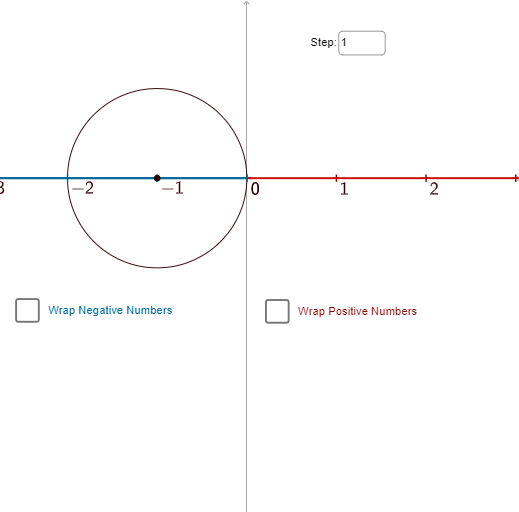
①本范例演示了数轴上的点与单位圆上点的一一对应关系;②涉及的核心数学概念包括弧度制、三角函数、单位圆、数轴;③作图要点——使用了Vector(向量)、Text(文本)、Length(长度)、Intersect(交点)、Point(点)、Circle(圆)、If(条件)、Rotate(旋转)、Tangent(切线)、Ray(射线)、UnitVector(单位向量)、Sequence(序列)、CircleArc(圆弧)、Take(取值)、Segment(线段)、Textfield(文本框)、CurveCartesian(笛卡尔曲线)等GeoGebra命令/对象;④适合高中数学教学,用于帮助学生理解三角函数与单位圆的联系,适合学习解析几何和三角函数的学生。
GeoGebra 命令及参数
Vector((0, 0), (1, 0)) → u_1Text(A50) → B50Text(A49) → B49Text(A48) → B48Text(A47) → B47Text(A46) → B46Text(A45) → B45Text(A44) → B44Text(A43) → B43Text(A42) → B42Text(A41) → B41Text(A40) → B40Text(A39) → B39Text(A38) → B38Text(A37) → B37Text(A36) → B36Text(A35) → B35Text(A34) → B34Text(A33) → B33Text(A32) → B32Text(A31) → B31Text(A30) → B30Text(A29) → B29Text(A28) → B28Text(A27) → B27Text(A26) → B26Text(A25) → B25Text(A24) → B24Text(A23) → B23Text(A22) → B22Text(A21) → B21Text(A20) → B20Text(A19) → B19Text(A18) → B18Text(A17) → B17Text(A16) → B16Text(A15) → B15Text(A14) → B14Text(A13) → B13Text(A12) → B12Text(A11) → B11Text(A10) → B10Text(A9) → B9Text(A8) → B8Text(A7) → B7Text(A6) → B6Text(A5) → B5Text(A4) → B4Text(A3) → B3Text(A2) → B2Text(A1) → B1Length(numb) → lIntersect(xAxis, yAxis) → BPoint(xAxis) → OCircle(O, B) → cIf(WrapPositive ≥ pi / 2, WrapPositive - pi / 2, 0) → fRotate(M, f, O) → M'Tangent(M', c) → b,Point(b) → DRay(M', D) → eUnitVector(e) → uPoint(xAxis) → CIf(WrapPositive ≤ pi / 2, WrapPositive, 1.5707963267948966) → αRotate(B, α, B) → B'Rotate(C, α, B) → C'Ray(B', C') → a'Rotate(B', f, B) → B''Sequence(Point[M', Vector[If[(k * st) - f ≥ 0, Vector[(u * ((k * st) - f))]]]], k, 0, l) → list1CircleArc(O, M, M') → dIf(f ≟ 0, RemoveUndefined[list1], Append[(0, 0), RemoveUndefined[list1]]) → ptsRSequence((cos(k) - 1, sin(k)), k, 0, f, st) → ptsCCircle(O, B) → gUnitVector(a') → vSequence(Point[M, Vector[((k * st) * v)]], k, 0, l) → list2Sequence(Text[Element[numb, k + W + 1], Element[ptsR, k + 1], true, true], k, 0, l - 1) → numRTake(numR, 2) → NewPtsRPoint(c) → ASegment(O, A) → iiRotate(A, WrapPositive) → A'If(WrapPositive > pi / 2, Segment[Rotate[O, WrapPositive - pi / 2, O], Rotate[A, WrapPositive - pi / 2, O]]) → jTextfield(st) → inputBox1Rotate(A, 6.2831, O) → A'_1Sequence(Text[Element[numb, k], Element[list2, k], true, true], k, 1, l) → nmbXTake(Sequence[Text[Element[numb, k], Element[ptsC, k], true, true], k, 1, l], 2) → numCText(C1) → D1Text(C2) → D2Text(C3) → D3Text(C4) → D4Text(C5) → D5Text(C6) → D6Text(C7) → D7Text(C8) → D8Text(C9) → D9Text(C10) → D10Text(C11) → D11Text(C12) → D12Text(C13) → D13Text(C14) → D14Text(C15) → D15Text(C16) → D16Text(C17) → D17Text(C18) → D18Text(C19) → D19Text(C20) → D20Text(C21) → D21Text(C22) → D22Text(C23) → D23Text(C24) → D24Text(C25) → D25Text(C26) → D26Text(C27) → D27Text(C28) → D28Text(C29) → D29Text(C30) → D30Text(C31) → D31Text(C32) → D32Text(C33) → D33Text(C34) → D34Text(C35) → D35Text(C36) → D36Text(C37) → D37Text(C38) → D38Text(C39) → D39Text(C40) → D40Text(C41) → D41Text(C42) → D42Text(C43) → D43Text(C44) → D44Text(C45) → D45Text(C46) → D46Text(C47) → D47Text(C48) → D48Text(C49) → D49Text(C50) → D50If(WrapNegative ≤ pi / 2, WrapNegative, 1.5707963267948966) → εRay(A, O) → kIf(WrapNegative > pi / 2 + 0.5, WrapNegative - pi / 2 - 0.5, 0) → mRotate(A, ε, M) → A'_2Rotate(O, ε, M) → O'Ray(A'_2, O') → k'UnitVector(k') → wSequence(Point[M, Vector[((i * st) * w)]], i, 0, l) → ptsXNRotate(M, (-m), O) → MMTangent(MM, c) → n,Point(n) → FRay(MM, F) → pUnitVector(p) → qSequence(Point[MM, Vector[If[(k * st) - m ≥ 0, Vector[(q * ((k * st) - m))]]]], k, 0, l) → ptsRNIf(m ≟ 0, RemoveUndefined[ptsRN], Append[(0, 0), RemoveUndefined[ptsRN]]) → ptsRN_1Take(Sequence[Text[Element[numbN, k + WN + 1], Element[ptsRN_1, k + 1], true, true], k, 0, l - 1], 2) → numRNCircleArc(O, MM, M) → rSequence((cos(k) - 1, (-sin(k))), k, 0, m, st) → ptsCNTake(Sequence[Text[Element[numbN, k], Element[ptsCN, k], true, true], k, 1, l], 2) → numCNSequence(Text[Element[numbN, k], Element[ptsXN, k], true, true], k, 1, l) → numXNIf(WrapPositive > pi / 2, Segment[Rotate[O, WrapPositive - pi / 2, O], Rotate[A, WrapPositive - pi / 2, O]]) → sCircle(O, B) → c_1Segment(O, A) → a_1If(a ≟ false ∧ h ≟ false, true, false) → startSequence(Point[M, Vector[((i * st) * u_1)]], i, 0, l) → ptsXPRay(M, C) → b_1Sequence(Text[Element[numb, k], Element[ptsXP, k], true, true], k, 1, l) → list3Ray(A, O) → d_1Vector((0, 0), (-1, 0)) → v_1Sequence(Point[M, Vector[((i * st) * v_1)]], i, 0, l) → ptsXNSSequence(Text[Element[numbN, k], Element[ptsXNS, k], true, true], k, 1, l) → list4CurveCartesian(((0.2 / 16 * (t + (6 * pi))) * cos(t + (6 * pi))) - 1, ((0.2 / 16 * (t + (6 * pi))) * sin(t + (6 * pi))), t, 0, WrapPositive - pi / 2) → oTangent(End, o) → e_1UnitVector(e_1) → w_1Vector(End, Point[End, Vector[(0.12 * w_1)]]) → f_1CurveCartesian(((0.2 / 16 * (t + (6 * pi))) * cos(t + (6 * pi))) - 1, ((-0.2 / 16 * (t + (6 * pi))) * sin(t + (6 * pi))), t, 0, WrapNegative - pi / 2 - 0.5) → j_1Tangent(K, j_1) → iUnitVector(i) → g_1Vector(K, Point[K, Vector[(0.12 * g_1)]]) → h_1If(WrapNegative > pi / 2 + 0.5, Segment[Rotate[O, (-WrapNegative) + pi / 2 + 0.5, O], Rotate[A, (-WrapNegative) + pi / 2 + 0.5, O]]) → t
AI 绘图提示语参考
画一条水平数轴,并在其上标出从-2π到2π的多个等分点,每个点旁边标注对应的弧度值。以原点为中心画一个单位圆,从原点出发画一条与数轴重合的射线。在射线上从原点开始每隔一定距离标出单位长度的点,并将这些点与单位圆上的对应点用线段连接。在单位圆上标出角度为0°、30°、45°、60°、90°等特殊角度的点,并标注这些点的坐标。
以上提示语为根据原始绘图命令整理而来,仅供参考。