
毕达哥拉斯定理——面积分割
几何画板及绘图内容加载中,请稍等……
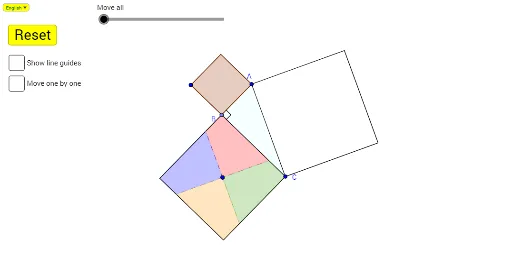
该范例演示了毕达哥拉斯定理的一种面积分割证明方法。核心数学概念包括面积、毕达哥拉斯定理及其证明。通过构造中点、圆、线段、旋转、交点等,展示了面积分割的几何作图过程。适合初中及以上学生学习几何证明。
GeoGebra 命令及参数
Midpoint(A, C) → A_0Circle(A_0, C) → cPoint(c) → BSegment(A, C) → aSegment(C, B) → bSegment(B, A) → dRotate(B, 90°, C) → B_2Rotate(C, -90°, B) → B_1Rotate(B, -90°, A) → A_2Rotate(A, 90°, B) → A_1Rotate(A, -90°, C) → C_2Rotate(C, 90°, A) → C_1Segment(A, A_2) → eSegment(A_2, A_1) → fSegment(A_1, B) → gSegment(B, B_1) → hSegment(B_1, B_2) → iSegment(B_2, C) → jSegment(A, C_1) → kSegment(C_1, C_2) → lSegment(C_2, C) → mMidpoint(A, B_1) → DLine(D, a) → nIntersect(n, j) → EMidpoint(D, E) → FOrthogonalLine(F, n) → p_4Intersect(p_4, b) → GIntersect(p_4, i) → HSegment(D, E) → q_3Segment(H, G) → r_3Midpoint(C, A_1) → ILine(I, a) → s_3Intersect(s_3, e) → JMidpoint(J, I) → KOrthogonalLine(K, s_3) → t_3Segment(J, I) → a_1Intersect(t_3, f) → LIntersect(t_3, d) → MSegment(L, M) → b_1Distance(A, B) → ABDistance(B, C) → BCMin(AB, BC) → MinSIf(BC > AB, Distance[D, F], Distance[L, K]) → Len2Circle(C, Len2) → c_1Circle(C_1, Len2) → d_1Intersect(c_1, m, 1) → N_1Intersect(c_1, a, 1) → N_2Intersect(d_1, l, 1) → N_4Intersect(d_1, k, 1) → N_3Line(N_1, b) → e_1Line(N_2, d) → f_1Line(N_4, d) → g_1Line(N_3, b) → h_1Intersect(e_1, f_1) → O_1Intersect(e_1, g_1) → O_2Intersect(g_1, h_1) → O_3Intersect(f_1, h_1) → O_4Segment(N_1, O_1) → i_1Segment(N_2, O_4) → j_1Segment(N_3, O_3) → k_1Segment(N_4, O_2) → l_1Circle(C, Len2) → p_1Circle(C_1, Len2) → q_1Intersect(q_1, k, 1) → M_4Intersect(q_1, l, 1) → M_3Intersect(p_1, m, 1) → M_2Intersect(p_1, a, 1) → M_1Line(M_1, b) → m_1Line(M_3, b) → n_1Line(M_4, h) → r_1Line(M_2, j) → s_1Intersect(n_1, r_1) → P_4Intersect(n_1, s_1) → P_3Intersect(m_1, s_1) → P_2Intersect(m_1, r_1) → P_1Segment(M_3, P_4) → t_1Segment(M_4, P_1) → a_2Segment(M_1, P_2) → b_2Segment(M_2, P_3) → c_2Circle(Q_1, Len2) → d_2Line(Q_1, m) → e_2Line(Q_1, a) → f_2Intersect(d_2, f_2, 1) → Q_2Intersect(d_2, e_2, 1) → Q_3Line(Q_3, b) → g_2Line(Q_2, b) → h_2Line(Q_2, d) → i_2Line(Q_3, d) → j_2Intersect(g_2, i_2) → Q_4Intersect(h_2, j_2) → Q_5If(BC > AB, Polygon[Q_1, Q_3, Q_4, Q_2], Polygon[Q_1, Q_2, Q_5, Q_3]) → RedPolyCircle(R_1, Len2) → k_2Line(R_1, a) → l_2Line(R_1, m) → m_2Intersect(k_2, l_2, 1) → R_2Intersect(k_2, m_2, 2) → R_3Line(R_2, d) → n_2Line(R_3, d) → p_2Line(R_2, b) → q_2Line(R_3, b) → r_2Intersect(p_2, q_2) → R_4Intersect(n_2, r_2) → R_5If(BC > AB, (Polygon[R_1, R_2, R_5, R_3] * Polygon[R_1, R_3, R_4, R_5])) → oIf(BC > AB, Polygon[R_1, R_2, R_5, R_3], Polygon[R_1, R_3, R_4, R_2]) → BluePolyCircle(S_1, Len2) → s_2Line(S_1, a) → t_2Line(S_1, m) → a_3Intersect(s_2, a_3, 2) → S_2Intersect(s_2, t_2, 2) → S_3Line(S_2, b) → b_3Line(S_3, b) → c_3Line(S_2, d) → d_3Line(S_3, d) → e_3Intersect(c_3, d_3) → S_5Intersect(b_3, e_3) → S_4If(BC > AB, Polygon[S_1, S_2, S_4, S_3], Polygon[S_1, S_3, S_5, S_2]) → AmberPolyCircle(T_1, Len2) → f_3Line(T_1, a) → g_3Line(T_1, m) → h_3Intersect(f_3, h_3, 1) → T_2Intersect(f_3, g_3, 2) → T_3Line(T_2, d) → i_3Line(T_3, d) → j_3Line(T_3, b) → k_3Line(T_2, b) → l_3Intersect(j_3, l_3) → T_4Intersect(i_3, k_3) → T_5If(BC > AB, Polygon[T_1, T_3, T_4, T_2], Polygon[T_1, T_2, T_5, T_3]) → GreenPolyCircle(U_1, MinS) → p_3Line(U_1, g) → m_3Intersect(p_3, m_3, 2) → U_2Rotate(U_2, 90°, U_1) → U_3Rotate(U_1, -90°, U_2) → U_4Polygon(U_3, U_1, U_2, U_4) → poly1, u_3, u_1, u_2, u_4Vector(Q_1, C) → pVector(R_1, C_2) → qVector(S_1, C_1) → rVector(T_1, A) → sTranslate(RedPoly, p_t) → RedPoly'Translate(BluePoly, q_t) → BluePoly'Translate(AmberPoly, r_t) → AmberPoly'Translate(GreenPoly, s_t) → GreenPoly'Vector(U_1, O_1) → uVector(U_1, P_1) → vIf(BC > AB, Vector[(Brown * u)], Vector[(Brown * v)]) → u_tTranslate(U_3, u_t) → NTranslate(U_1, u_t) → OTranslate(U_2, u_t) → PTranslate(U_4, u_t) → QPolygon(N, O, P, Q) → poly1', n_3, o_1, p_5, q_4Polygon(A, B, C) → poly2, c_4, a_4, b_4Circle(B, S90) → d_4Intersect(d_4, b, 1) → RIntersect(d_4, d, 1) → SRotate(B, -90°, R) → B'Segment(S, B') → e_4Segment(B', R) → f_4Translate(RedPoly, v_1) → RedPoly'_1Translate(BluePoly, v_2) → BluePoly'_1Translate(AmberPoly, v_3) → AmberPoly'_1Translate(GreenPoly, v_4) → GreenPoly'_1If(BC > AB, Vector[(Rearrange * u)], Vector[(Rearrange * v)]) → v_tTranslate(U_3, v_t) → TTranslate(U_1, v_t) → UTranslate(U_2, v_t) → VTranslate(U_4, v_t) → WPolygon(T, U, V, W) → poly1'_1, t_4, u_5, v_5, w_1SelectedIndex(Bahasa) → nn
AI 绘图提示语参考
绘制一个直角三角形ABC,其中A、B、C分别为直角顶点、斜边顶点和底边顶点。通过构造中点、圆、旋转、线段和交点,展示毕达哥拉斯定理的面积分割证明。首先画出A、C两点,然后画出AC线段,接着构造AC的中点A0,以A0为圆心画圆c,圆c与AC交于B点。再构造AB、BC、CA线段,通过旋转和交点构造一系列辅助线段和点,最终通过这些辅助线段和点证明毕达哥拉斯定理。
以上提示语为根据原始绘图命令整理而来,仅供参考。