
二十面体展开图
几何画板及绘图内容加载中,请稍等……
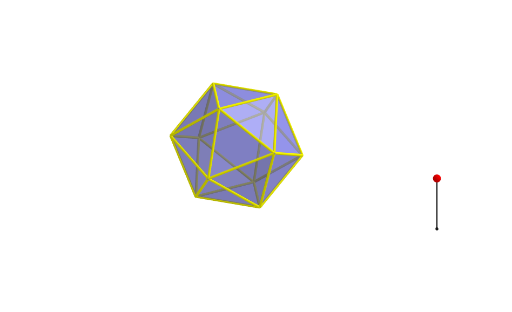
这个范例展示了二十面体的展开图。二十面体是一种由20个等边三角形组成的正多面体。通过GeoGebra命令如Point、Icosahedron、Segment、Rotate等,可以构造出二十面体的展开图。适合初中及以上学生学习立体几何。
GeoGebra 命令及参数
Point(Circle[Midpoint[A, B], (Distance[A, B] * sqrt(3) / 2), Segment[A, B]]) → CIcosahedron(A, B, C) → a, D, faceABC, faceACF, faceAFG, faceADG, faceABD, faceBDH, faceBEH, faceBCE, faceCEI, faceCFI, E, faceEHK, faceEIK, faceIKL, faceFIL, faceHJK, faceJKL, faceGJL, faceFGL, faceDHJ, faceDGJ, F, edgeAC, edgeAB, edgeBC, edgeAF, edgeCF, edgeAG, edgeFG, edgeAD, edgeDG, edgeBD, G, edgeBH, edgeDH, edgeBE, edgeEH, edgeCE, edgeCI, edgeEI, edgeFI, edgeEK, edgeHK, H, edgeIK, edgeIL, edgeKL, edgeFL, edgeJK, edgeHJ, edgeJL, edgeGL, edgeGJ, edgeDJ, I, J, K, LSegment(M, M + (0, 0, 2)) → bPoint(b) → NRotate(Polygon[A, B, D], (α * t), Segment[A, B]) → poly1Rotate(Polygon[A, D, G], (α * t), Segment[A, D]) → poly2Rotate(Polygon[B, D, H], (α * t), Segment[D, B]) → poly3Rotate(Polygon[G, D, J], (α * t), Segment[G, D]) → poly4Rotate(Polygon[D, H, J], (α * t), Segment[D, H]) → poly5Rotate(Polygon[G, J, L], (α * t), Segment[G, J]) → poly6Rotate(poly2, (α * t), Segment[A, B]) → poly2'Rotate(poly3, (α * t), Segment[A, B]) → poly3'Rotate(poly4, (α * t), Segment[A, D]) → poly4'Rotate(poly4', (α * t), Segment[A, B]) → poly4''Rotate(poly5, (α * t), Segment[D, B]) → poly5'Rotate(poly5', (α * t), Segment[A, B]) → poly5''Rotate(poly6, (α * t), Segment[G, D]) → poly6'Rotate(poly6', (α * t), Segment[A, D]) → poly6''Rotate(poly6'', (α * t), Segment[A, B]) → poly6'''Rotate(Polygon[J, K, L], (α * t), Segment[L, J]) → poly7Rotate(poly7, (α * t), Segment[G, J]) → poly7'Rotate(poly7', (α * t), Segment[G, D]) → poly7''Rotate(poly7'', (α * t), Segment[A, D]) → poly7'''Rotate(poly7''', (α * t), Segment[A, B]) → poly8Circle(A, B, C) → cCenter(c) → OOrthogonalLine(O, Plane[A, B, C]) → dRotate(poly1, 120°, d) → poly1'Rotate(poly2', 120°, d) → poly2''Rotate(poly3', 120°, d) → poly3''Rotate(poly4'', 120°, d) → poly4'''Rotate(poly5'', 120°, d) → poly5'''Rotate(poly6''', 120°, d) → poly9Rotate(poly1', 120°, d) → poly1''Rotate(poly2'', 120°, d) → poly2'''Rotate(poly3'', 120°, d) → poly3'''Rotate(poly4''', 120°, d) → poly10Rotate(poly5''', 120°, d) → poly11Rotate(poly9, 120°, d) → poly9'Polygon(A, B, C) → poly12, c_1, a_1, b_1Polygon(A, B, C) → poly13, c_2, a_2, b_2Rotate(poly1', 120°, d) → poly1''_1Rotate(Polygon[A, B, D], (α * t), Segment[A, B]) → poly14Rotate(poly1, 120°, d) → poly1'_1Rotate(poly3', 120°, d) → poly3''_1Rotate(poly2'', 120°, d) → poly2'''_1Rotate(poly2', 120°, d) → poly2''_1Rotate(poly2, (α * t), Segment[A, B]) → poly2'_1Rotate(poly3, (α * t), Segment[A, B]) → poly3'_1Rotate(poly5', (α * t), Segment[A, B]) → poly5''_1Rotate(poly4', (α * t), Segment[A, B]) → poly4''_1Rotate(poly6'', (α * t), Segment[A, B]) → poly6'''_1Rotate(poly7''', (α * t), Segment[A, B]) → poly15Rotate(poly3'', 120°, d) → poly3'''_1Rotate(poly5''', 120°, d) → poly16Rotate(poly4''', 120°, d) → poly17Rotate(poly9, 120°, d) → poly9'_1Rotate(poly5'', 120°, d) → poly5'''_1Rotate(poly4'', 120°, d) → poly4'''_1Rotate(poly6''', 120°, d) → poly18