
两位数的位值:理解数字的组成与位置
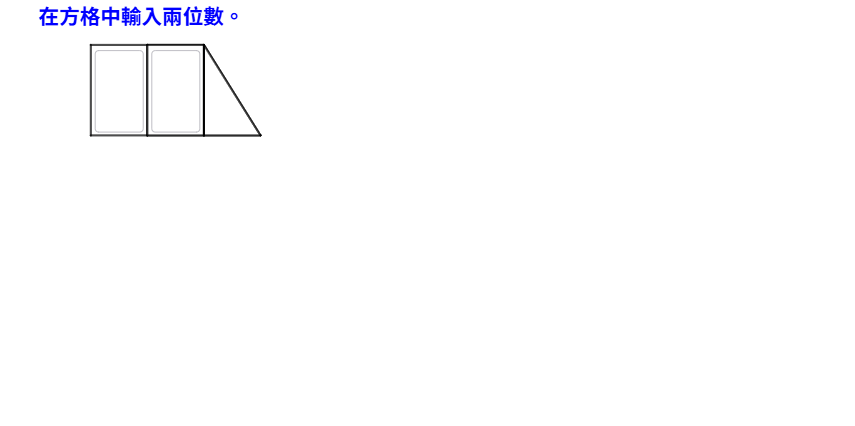
几何画板及绘图内容加载中,请稍等……
这个范例展示了如何通过几何图形理解两位数的位值概念。核心数学概念包括位值、数字分解和坐标几何。作图要点涉及使用GeoGebra命令如Polygon、Translate和Sequence来构造数字的图形表示。适合初中生学习数字概念,或用于数学教学辅助。
GeoGebra 命令及参数
If(t > 2 / 3 ∧ t < 1, (3 * (t - 2 / 3)), If[t ≤ 2 / 3, 0, 1]) → t5If(t > 0 ∧ t < 1 / 3, (3 * (t - 0)), If[t ≤ 0, 0, 1]) → t3If(t > 1 / 3 ∧ t < 2 / 3, (3 * (t - 1 / 3)), If[t ≤ 1 / 3, 0, 1]) → t4Textfield(digit1) → InputBox1Polygon((0, 0), (7, 0), (7, 12), (0, 12)) → poly1, f, g, h, iPolygon(A, A + (-7.5, 12), A + (-15, 12), A + (-15, 0)) → q1, j, k, l, mTextfield(digit3) → InputBox3Textfield(digit2) → InputBox2Polygon(C, C + (-7.5, 12), C + (-30, 12), C + (-30, 0)) → q4, c, b, e, f_1Translate(If[digit3 ≟ "0", pic0, If[digit3 ≟ "1", pic1, If[digit3 ≟ "2", pic2, If[digit3 ≟ "3", pic3, If[digit3 ≟ "4", pic4, If[digit3 ≟ "5", pic5, If[digit3 ≟ "6", pic6, If[digit3 ≟ "7", pic7, If[digit3 ≟ "8", pic8, If[digit3 ≟ "9", pic9]]]]]]]]]], Vector[C - (30, 0)]) → picCTranslate(pic0, Vector[C - (22.5, 0)]) → picC_0Translate(pic0, Vector[C - (15, 0)]) → picC_{00}Sequence(Segment[C + ((-7.5 * i), 0), C + ((-7.5 * i), 12)], i, 1, 3) → l5Polygon(B, B + (-7.5, 12), B + (-22.5, 12), B + (-22.5, 0)) → q5, b_1, g_1, h_1, i_1Sequence(Segment[B + ((-7.5 * i), 0), B + ((-7.5 * i), 12)], i, 1, 2) → l6Translate(If[digit2 ≟ "0", pic0, If[digit2 ≟ "1", pic1, If[digit2 ≟ "2", pic2, If[digit2 ≟ "3", pic3, If[digit2 ≟ "4", pic4, If[digit2 ≟ "5", pic5, If[digit2 ≟ "6", pic6, If[digit2 ≟ "7", pic7, If[digit2 ≟ "8", pic8, If[digit2 ≟ "9", pic9]]]]]]]]]], Vector[B - (22.5, 0)]) → picBTranslate(pic0, Vector[B - (15, 0)]) → picB_0Sequence(Segment[A + ((-7.5 * i), 0), A + ((-7.5 * i), 12)], i, 1, 1) → l7Translate(If[digit1 ≟ "0", pic0, If[digit1 ≟ "1", pic1, If[digit1 ≟ "2", pic2, If[digit1 ≟ "3", pic3, If[digit1 ≟ "4", pic4, If[digit1 ≟ "5", pic5, If[digit1 ≟ "6", pic6, If[digit1 ≟ "7", pic7, If[digit1 ≟ "8", pic8, If[digit1 ≟ "9", pic9]]]]]]]]]], Vector[A - (15, 0)]) → picAIf(digit1 ≠ "", true, false) → input1If(digit2 ≠ "", true, false) → input2If(digit3 ≠ "", true, false) → input3If(digit4 ≠ "", true, false) → input4Element(TextToUnicode[digit1] - 48, 1) → placevalue1