
规则十二边形面积的几何分割与积分计算
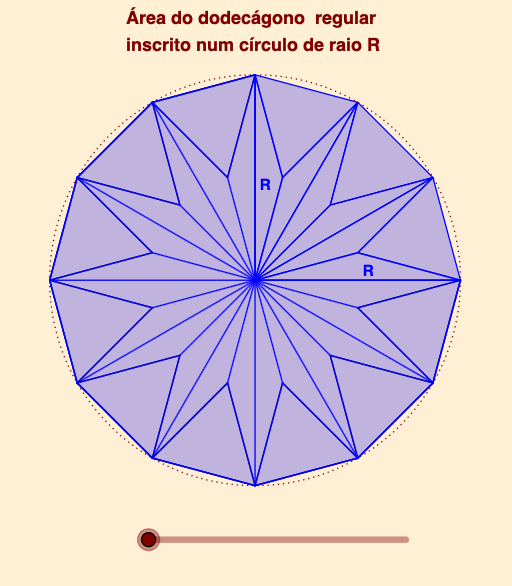
几何画板及绘图内容加载中,请稍等……
该范例演示如何用规则十二边形的对称性将面积拆分为若干全等的几何部分,并进一步用积分或函数关系表达其面积。核心数学概念包括:规则多边形的性质、等边三角形与圆的关系、分段或线性函数刻画边界、以及与定积分相关的面积计算思想。作图要点是从已知几何构造出中心与关键顶点位置,借助旋转与平移生成十二边形的各条边与分割三角形;随后用向量/线段确定分割边界,结合相交计算得到作图所需的交点,再用圆或弧对应的度量关系建立函数/高度量表达,最终用定积分框架得到面积结果。构造摘要中体现的 GeoGebra 命令与对象主要包括:Point(点)、Rotate(旋转)、Polygon(多边形)、Vector(向量)、Segment(线段)、Intersect(求交)、Translate(平移)、Circle(圆),以及由这些命令生成的多边形 pol1、pol2、pol5、pol7 等与若干函数对象 f、g、h、i、j、k、l、m、n、p、q、r 以及交点/辅助点系列。适合高中阶段几何扩展、大学预科或微积分入门课程,用于讲解规则多边形面积的几何法与积分联系。
GeoGebra 命令及参数
Point(xAxis) → BPoint(xAxis) → ARotate(B, 15°, A) → B'Polygon(A, B', 12) → pol1, f, p, q, r, C, D, E, F, G, H, I, g, J, K, L, h, i, j, k, l, m, nPolygon(D, E, 3) → pol5, h_1, i_1, j_1, PVector(P, B') → v_1Polygon(F, G, 3) → pol7, n_1, p_1, q_1, RVector(R, I) → u_1Polygon(A, B', 3) → pol2, s, t, a, MPolygon(B', C, 3) → pol3, b, c, d, NPolygon(C, D, 3) → pol4, e, f_1, g_1, OPolygon(E, F, 3) → pol6, k_1, l_1, m_1, QPolygon(G, H, 3) → pol8, r_1, s_1, t_1, SPolygon(H, I, 3) → pol9, a_1, b_1, c_1, TPolygon(I, J, 3) → pol10, d_1, e_1, f_2, UPolygon(J, K, 3) → pol11, g_2, h_2, i_2, VPolygon(K, L, 3) → pol12, j_2, k_2, l_2, WPolygon(L, A, 3) → pol13, m_2, n_2, p_2, ZSegment(A, G) → q_2Segment(L, F) → r_2Segment(K, E) → s_2Segment(J, D) → t_2Segment(I, C) → a_2Segment(H, B') → b_2Intersect(q_2, r_2) → A_1Segment(M, A_1) → c_2Segment(N, A_1) → d_2Segment(O, A_1) → e_2Segment(P, A_1) → f_3Segment(Q, A_1) → g_3Segment(R, A_1) → h_3Segment(S, A_1) → i_3Segment(T, A_1) → j_3Segment(U, A_1) → k_3Segment(V, A_1) → l_3Segment(W, A_1) → m_3Segment(Z, A_1) → n_3Rotate(K, 60°, L) → K'Vector(Q, K') → uTranslate(pol6, Vector[(u * o)]) → pol6'Translate(pol7, Vector[(u_1 * o)]) → pol7'Translate(pol5, Vector[(v_1 * o)]) → pol5'Polygon(A_1, R, G) → t1, g_4, p_3, r_3Translate(A_1, Vector[(u_1 * o)]) → B_1Translate(R, Vector[(u_1 * o)]) → R'Translate(G, Vector[(u_1 * o)]) → G'Polygon(B_1, R', G') → t1', g', q_3, r'Polygon(A_1, D, P) → t2, p_4, s_3, d_3Translate(A_1, Vector[(v_1 * o)]) → C_1Translate(D, Vector[(v_1 * o)]) → D'Translate(P, Vector[(v_1 * o)]) → P'Polygon(C_1, D', P') → t2', p', t_3, d'Polygon(A_1, R, F) → t3, f_4, a_3, r_4Vector(R, H) → vTranslate(Polygon[Rotate[A_1, (120° * o), R], Rotate[R, (120° * o), R], Rotate[F, (120° * o), R]], Vector[(v * o)]) → t4Polygon(F, Q, A_1) → t5, b_3, f_5, q_4Vector(A_1, K') → wTranslate(Polygon[Rotate[F, (30° * o), A_1], Rotate[Q, (30° * o), A_1], Rotate[A_1, (30° * o), A_1]], Vector[(w * o)]) → t6Polygon(A_1, Q, E) → t7, e_3, c_3, q_5Translate(Polygon[Rotate[A_1, ((-(30°)) * o), A_1], Rotate[Q, ((-(30°)) * o), A_1], Rotate[E, ((-(30°)) * o), A_1]], Vector[(w * o)]) → t8Polygon(A_1, P, E) → t9, e_4, h_4, p_5Vector(P, C) → w_1Translate(Polygon[Rotate[A_1, ((-(120°)) * o), P], Rotate[P, ((-(120°)) * o), P], Rotate[E, ((-(120°)) * o), P]], Vector[(w_1 * o)]) → t10Polygon(G, A_1, H, D, C, B', A, L, K, J, I) → pol14, g_5, i_5, h_5, i_4, d_4, c_4, b', a_4, l_4, k_4, j_4Segment(A_1, K) → m_4Segment(A_1, L) → n_4Circle(A_1, B') → s_4
AI 绘图提示语参考
绘制一个正十二边形,并将其分解为12个等边三角形。首先在x轴上创建点A和B,然后以A为旋转中心,将B旋转15度得到B'。接着使用A和B'作为顶点,构造正十二边形pol1,并生成辅助函数f、g、h等。通过旋转和翻译操作,进一步构造其他等边三角形,如pol5、pol7等,并生成相应的辅助线和函数。最后,通过交点操作确定辅助线的交点A1,并使用这些交点构造更多的三角形,如t1、t1'等,完成正十二边形的面积计算。
以上提示语为根据原始绘图命令整理而来,仅供参考。