
求函数反函数及定义域示例 by Walch Education
几何画板及绘图内容加载中,请稍等……
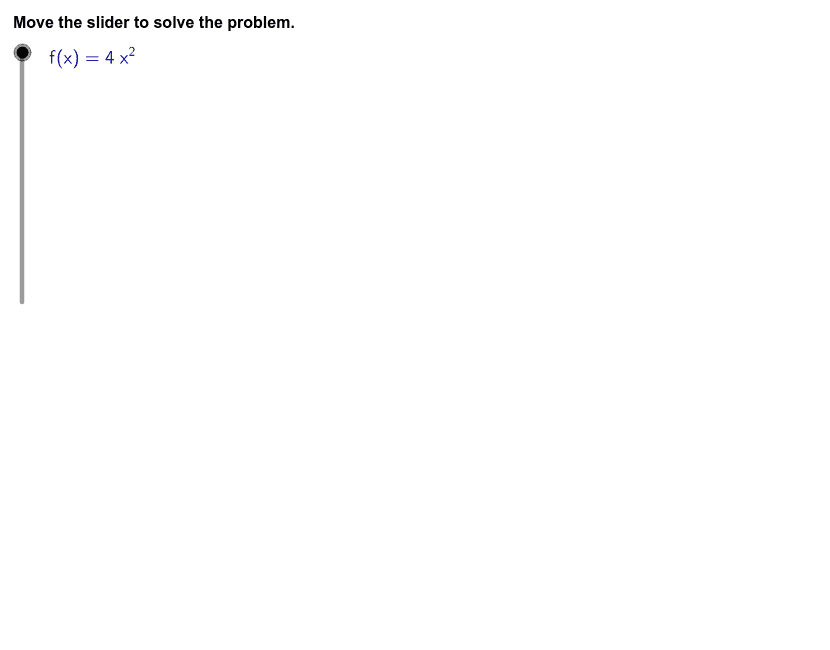
①本范例演示了如何求函数f(x)=4x^2的反函数g(x)及其定义域;②涉及的核心数学概念包括反函数、定义域、配方法、分段函数;③作图要点提炼自构造摘要,使用了LaTeX、If、TableText、stepMax、stepper、steps、counter、text系列对象等;④适合高中数学学生学习和理解反函数概念及求解方法。
GeoGebra 命令及参数
LaTeX(steps) → counterLaTeX((("\textcolor{#000099}{f(x)=" * f) * "}")) → ProblemLaTeX("\text{Switch the domain and function variables, and then rename }\textcolor{#000099}{f(x)}\text{ as }\textcolor{#006633}{g(x).}") → text1LaTeX((("\text{Since the inverse function results from switching the input and output variables}\cr\text{of the original function, identify which variable represents the input and which}\cr\text{represents the output. For the function }\textcolor{#000099}{f(x) = " * f) * "}\text{, }\textcolor{#000099}{x}\text{ is the input (independent)}\cr\text{variable, and }\textcolor{#000099}{f(x)}\text{ is the output (dependent) variable. Therefore, swap }\textcolor{#000099}{f(x)}\text{ and }\textcolor{#000099}{x}.")) → text2LaTeX("\text{Next, rename }\textcolor{#000099}{f(x)}\text{ as }\textcolor{#006633}{g(x)}\text{, since this new relation represents the inverse of the}\cr\text{original function.}") → text4LaTeX((((("\text{The resulting inverse relation, }\textcolor{#006633}{x = " * a) * "[g(x)]^2}\text{, is the possible inverse function of}\cr\text{the original function. It must be evaluated to determine whether it has }\cr\text{one-to-one correspondence with the original function, }\textcolor{#000099}{f(x) = ") * a) * "x^2}.")) → text6LaTeX("\text{Solve the possible inverse for }\textcolor{#006633}{g(x)}.") → text7LaTeX("\text{Determine the domain of }\textcolor{#006633}{g(x)}.") → text9LaTeX("\text{Determine the range of }\textcolor{#006633}{g(x)}.") → text13LaTeX("\text{We need to compare the range of }\textcolor{#006633}{g(x)}\text{ to the domain of }\textcolor{#000099}{f(x)}.") → text14LaTeX("\text{Determine the domain of }\textcolor{#000099}{f(x)}.") → text16LaTeX("\text{Determine whether the function }\textcolor{#000099}{f(x)}\text{ exhibits one-to-one correspondence.}") → text18LaTeX("\text{Determine the parts of its domain over which }\textcolor{#000099}{f(x)}\text{ exhibits one-to-one}\cr\text{correspondence.}") → text21LaTeX("\text{Determine the range of }\textcolor{#000099}{f(x)}.") → text23LaTeX("\text{Match domains to ranges to find the inverse(s) of }\textcolor{#000099}{f(x)}.") → text25LaTeX("\text{Check that the range of }\textcolor{#000099}{f(x)}\text{ matches the domain of }\textcolor{#006633}{g(x)}.") → text28If(a ≥ 0, "", "-") → signtextIf(a ≥ 0, "non-negative", "negative") → numberwordsIf(a ≥ 0, LaTeX["[0, + \infty)"], LaTeX["(-\infty,0]"]) → domaingLaTeX((("\text{Because }\textcolor{#000099}{f(x)}\text{ is a quadratic function and }\textcolor{#000099}{x^2}\text{ can never be negative, the}\cr\text{range of }\textcolor{#000099}{f(x)}\text{ is }\textcolor{#000099}{" * domaing) * "}.")) → text24If(a ≥ 0, sqrt(x) / asqrt, sqrt((-x)) / asqrt) → g_1If(a ≥ 0, ((-sqrt(x))) / asqrt, ((-sqrt((-x)))) / asqrt) → g_2LaTeX((((("\text{The range of }\textcolor{#000099}{f(x)}\text{ is }\textcolor{#000099}{" * domaing) * "}\text{. The domain of }\textcolor{#006633}{g(x)}\text{ is }\textcolor{#006633}{") * domaing) * "}.")) → text29LaTeX("\text{Use the buttons below to return to the original problem or}\cr\text{randomly generate a similar practice problem.}") → text31TableText({{LaTeX[(("\textcolor{#000099}{f(x)=" * a) * "x^2}")], LaTeX["\text{Original function}"]}, {LaTeX[(("\textcolor{#000099}{x=" * a) * "[f(x)]^2}")], LaTeX["\text{Switch }\textcolor{#000099}{f(x)}\text{ and }\textcolor{#000099}{x}."]}}) → text3TableText({{LaTeX[(("\textcolor{#000099}{x=" * a) * "[f(x)]^2}")], LaTeX["\text{Equation with variables switched}"]}, {LaTeX[(("\textcolor{#006633}{x=" * a) * "[g(x)]^2}")], LaTeX["\text{Rename }\textcolor{#000099}{f(x)}\text{ as }\textcolor{#006633}{g(x)}."]}}) → text5LaTeX("\text{The function }\textcolor{#000099}{f(x)}\text{ can only have an inverse over the part(s) of its domain}\cr\text{for which it exhibits one-to-one correspondence.}") → text19LaTeX((((((((("\text{We can determine that the function }\textcolor{#000099}{f(x) = " * a) * "x^2}\text{ does not show}\cr\text{one-to-one correspondence for all domain values because }\textcolor{#000099}{f(a) = ") * a) * "a^2}\text{ and }\cr\textcolor{#000099}{f(–a) = ") * a) * "(–a)^2 = ") * a) * "a^2}\text{. Since }\textcolor{#000099}{f(x)}\text{ has the same value for two different}\cr\text{values of }\textcolor{#000099}{x}\text{, }\textcolor{#000099}{f(x)}\text{ is not one-to-one.}\cr\text{An equivalant graphical test is the horizontal line test. If any horizontal}\cr\text{line touches the graph of }\textcolor{#000099}{f(x)}\text{ more than once, then }\textcolor{#000099}{f(x)}\text{ is not one-to-one.}")) → text20LaTeX("\text{We need to know where }\textcolor{#006633}{g(x)}\text{ is defined in order to know its domain,}\cr\text{which we want to compare to the range of }\textcolor{#000099}{f(x)}.") → text10LaTeX((((("\text{The function }\textcolor{#006633}{g(x)}\text{ is a radical function; specifically, it is a square root} \cr\text{function. Recall that the value of the expression inside the square root} \cr\text{must be positive in order for the function to be defined. The expression} \cr\text{under the square root is }\textcolor{#006633}{" * signtext) * "x}\text{; therefore, the values of }\textcolor{#006633}{x}\text{ are limited to}\cr\text{") * numberwords) * " numbers.}")) → text11LaTeX("\text{There are no limitations on the output values; therefore, the range}\cr\text{of }\textcolor{#006633}{g(x)}\text{ is }\textcolor{#006633}{(−\infty, +\infty)}.") → text15LaTeX("\text{There are no limitations on the input values; therefore, the domain}\cr\text{of }\textcolor{#000099}{f(x)}\text{ is }\textcolor{#000099}{(−\infty, +\infty)}.") → text17LaTeX("\text{ The restricted domains of }\textcolor{#000099}{f(x)}\text{, on which }\textcolor{#000099}{f(x)}\text{ is one-to-one, are }\textcolor{#000099}{(−\infty, 0]}\cr\text{ and }\textcolor{#000099}{[0, +\infty)}\text{. Only the point }\textcolor{#000099}{(0, 0)}\text{ is not restricted, because all of}\cr\text{ the other points do not have one-to-one correspondence. The horizontal}\cr\text{ line crosses the graph at two points for all other points on the graph.}") → text22LaTeX("\text{In order for a function to have an inverse, it must be one-to-one. Therefore, }\cr\text{match the restricted domains of }\textcolor{#000099}{f(x)}\text{ to the range of }\textcolor{#006633}{g(x)}.") → text26TableText({{LaTeX["\text{Restricted domain of }\textcolor{#000099}{f(x)}\text{:}"], LaTeX["\text{Inverse function with matching range:}"]}, {LaTeX["\textcolor{#000099}{[0,+\infty)}"], LaTeX[(("\textcolor{#006633}{g(x)=" * g_1) * "}")]}, {LaTeX["\textcolor{#000099}{(-\infty,0]}"], LaTeX[(("\textcolor{#006633}{g(x)=" * g_2) * "}")]}}) → text27LaTeX((((((((("\text{The inverse of }\textcolor{#000099}{f(x)=" * a) * "x^2}\text{ on the restricted domain }\textcolor{#000099}{0≤x<+\infty}\text{ is }\textcolor{#006633}{g(x)=") * g_1) * "}.\cr \text{The inverse of }\textcolor{#000099}{f(x)=") * a) * "x^2}\text{ on the restricted domain }\textcolor{#000099}{-\infty<x≤0}\text{ is }\textcolor{#006633}{g(x)=") * g_2) * "}.")) → text30LaTeX((("\text{Thus, the domain of }\textcolor{#006633}{g(x)}\text{ is }\textcolor{#006633}{" * domaing) * "}\text{ because }\textcolor{#006633}{x}\text{ is raised to the }\textcolor{#006633}{\frac{1}{2}}\text{ power}\cr\text{ (recall that }\textcolor{#006633}{\sqrt{x} = x^\frac{1}{2}}\text{).}")) → text12TableText({{LaTeX[(("\textcolor{#006633}{x=" * a) * "[g(x)]^2}")], LaTeX["\text{Possible inverse}"]}, {LaTeX[(("\textcolor{#006633}{\frac{x}{" * a) * "}=[g(x)]^2}")], LaTeX[(("\text{Divide both sides by }\textcolor{#006633}{" * a) * "}.")]}, {LaTeX[(("\textcolor{#006633}{[g(x)]^2}=\frac{x}{" * a) * "}")], LaTeX["\text{Use Symmetric Property of Equality.}"]}, {LaTeX[(((("\textcolor{#006633}{g(x)}=\pm\sqrt{\frac{" * signtext) * "x}{") * abs(a)) * "}}")], LaTeX["\text{Find both roots of the equation. (Recall }(-1)^2=(1)^2\text{.)}"]}, {LaTeX[(((("\textcolor{#006633}{g(x)}=\pm\frac{\sqrt{" * signtext) * "x}}{\sqrt{") * abs(a)) * "}}")], LaTeX["\text{Distribute the square root operation.}"]}, {LaTeX[(((("\textcolor{#006633}{g(x)}=\pm\frac{\sqrt{" * signtext) * "x}}{") * asqrt) * "}")], LaTeX["\text{Simplify.}"]}, {LaTeX[(((("\textcolor{#006633}{g(x)}=\pm\frac{1}{" * asqrt) * "}\sqrt{") * signtext) * "x}")], LaTeX["\text{Separate out the coefficient.}"]}}) → text8
AI 绘图提示语参考
画一个函数 f(x) = 4x^2 的图像,并展示其反函数 g(x) 的求解过程。首先,交换 f(x) 中的 x 和 f(x) 得到 x = 4y^2,然后解出 y 得到 g(x)。标出 f(x) 的图像,并用不同颜色区分 g(x) 在两个区间 [0, +∞) 和 (-∞, 0] 上的图像,分别对应 f(x) 的两个单调区间。最后,用文本说明 g(x) 的定义域和值域,以及 f(x) 的单调区间与 g(x) 定义域的对应关系。
以上提示语为根据原始绘图命令整理而来,仅供参考。