
利用单位圆求角度的六种三角函数值
几何画板及绘图内容加载中,请稍等……
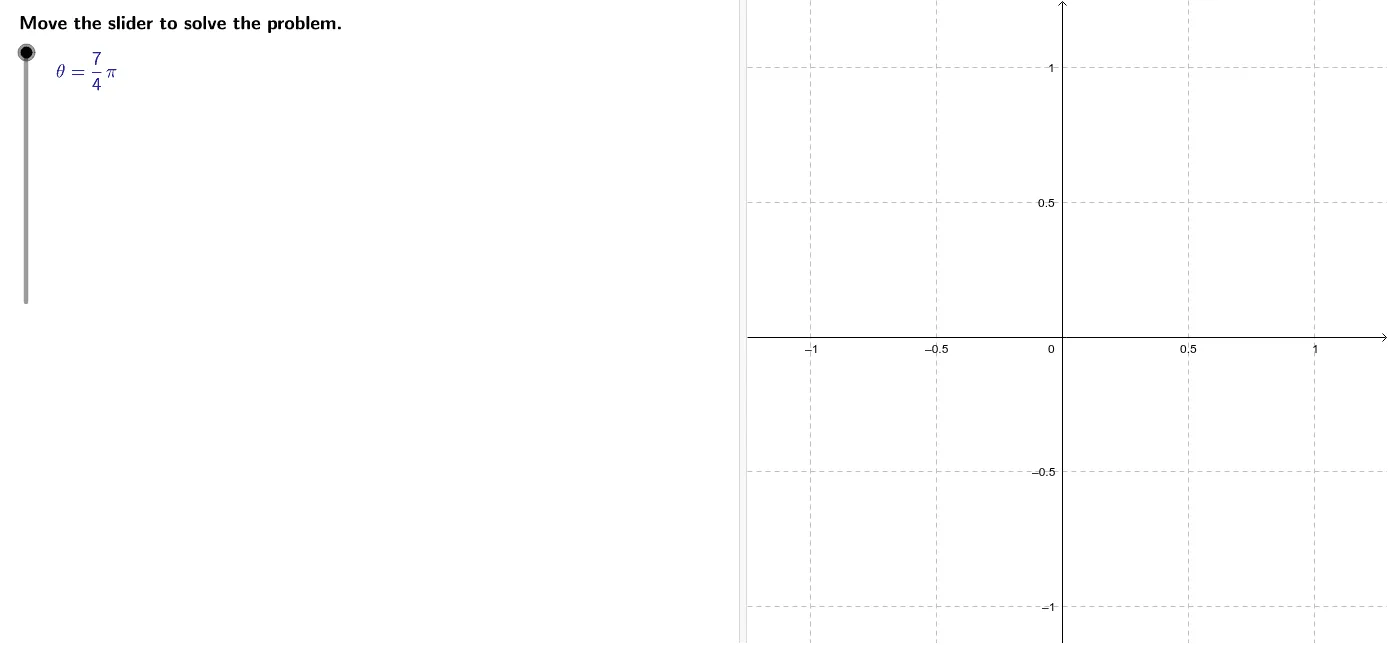
本范例通过单位圆演示如何找到角度θ=7π/4的六种三角函数值。涉及的核心数学概念包括三角函数、单位圆和角度测量。作图要点使用了GeoGebra的LaTeX、Corner、Element、FractionText、Circle、Segment、Angle、If、Midpoint等命令和对象来精确绘制单位圆和角度,并计算对应的三角函数值。适合高中数学学生学习和理解三角函数的定义及应用。
GeoGebra 命令及参数
LaTeX(steps) → counterLaTeX("\text{Move the slider to solve the problem.}") → text0Corner(1) → ACorner(3) → BElement(fractions, n) → fracFractionText(frac) → fractextCircle((0, 0), 1) → cSegment((0, 0), C) → aSegment((0, 0), (1, 0)) → bAngle(b, a) → αSegment((0, 0), (-1, 0)) → dIf(0 < frac ≤ 0.5, Angle[b, a], If[0.5 < frac ≤ 1, Angle[a, d], If[1 < frac < 1.5, Angle[d, a], Angle[a, b]]]) → βElement(coords, n) → showcoordSegment(C, (x(C), 0)) → eSegment((0, 0), (x(C), 0)) → fMidpoint(e) → DMidpoint(f) → ELaTeX(Element[xvalue, n]) → xlabelLaTeX(Element[yvalue, n]) → ylabel1Midpoint(a) → GSegment((0, 0), F) → gSegment((0, 0), (x(F), 0)) → hSegment((x(F), 0), F) → iLaTeX(Element[yvalue, n]) → ylabel2Midpoint(g) → HMidpoint(h) → IMidpoint(i) → JLaTeX(Element[xvalue, n]) → xlabel2Element(refractions, n) → refracFractionText(refrac) → refractextLaTeX((("\text{Substitute }\textcolor{#000099}{" * fractext) * "\pi}\text{ for }\textcolor{#000099}{\theta}.")) → text5LaTeX((((((("\textcolor{#000099}{\tan\left(" * fractext) * "\pi\right)=\frac{\sin\left(") * fractext) * "\pi\right)}{\cos\left(") * fractext) * "\pi\right)}}")) → text6LaTeX((((((("\textcolor{#000099}{\tan\left(" * fractext) * "\pi\right)=\frac{") * ylabel1) * "}{") * xlabel) * "}}")) → text8LaTeX("\text{Simplify.}") → text9LaTeX("\textcolor{#000099}{\sec(\theta)=\frac{1}{\cos(\theta)}}") → text12LaTeX((((((((("\textcolor{#000099}{\sec\left(" * fractext) * "\pi\right)=\frac{1}{\cos\left(") * fractext) * "\pi\right)}=\frac{1}{") * xlabel) * "}=") * Element[secval, n]) * "}")) → text13LaTeX("\textcolor{#000099}{\csc(\theta)=\frac{1}{\sin(\theta)}}") → text14LaTeX((((((((("\textcolor{#000099}{\csc\left(" * fractext) * "\pi\right)=\frac{1}{\sin\left(") * fractext) * "\pi\right)}=\frac{1}{") * ylabel1) * "}=") * Element[cscval, n]) * "}")) → text15LaTeX("\textcolor{#000099}{\cot(\theta)=\frac{\cos(\theta)}{\sin(\theta)}}") → text16LaTeX((((((((((((("\textcolor{#000099}{\cot\left(" * fractext) * "\pi\right)=\frac{\cos\left(") * fractext) * "\pi\right)}{\sin\left(") * fractext) * "\pi\right)}=\frac{") * xlabel) * "}{") * ylabel1) * "}=") * Element[cotval, n]) * "}")) → text17LaTeX((((("\text{Use the unit circle to find the values of }\textcolor{#000099}{\cos\left(" * fractext) * "\pi\right)}\text{ and }\textcolor{#000099}{\sin\left(") * fractext) * "\pi\right)}.")) → text1LaTeX((((((((((((("\text{The coordinates of the point }\textcolor{#000099}{\theta=" * fractext) * "\pi}\text{ on the unit circle are }\cr\textcolor{#000099}{") * showcoord) * "}\text{ which correspond to the trigonometric ratios }\cr\textcolor{#000099}{\cos\left(") * fractext) * "\pi\right)=") * xlabel) * "}\text{ and }\textcolor{#000099}{\sin\left(") * fractext) * "\pi\right)=") * ylabel1) * "}.")) → text3LaTeX((("\text{Use the ratio identity }\textcolor{#000099}{\tan(\theta)=\frac{\sin(\theta)}{\cos(\theta)}}\text{ to find the value of }\textcolor{#000099}{\tan\left(" * fractext) * "\pi\right)}.")) → text4LaTeX((((((((("\text{Substitute }\textcolor{#000099}{" * xlabel) * "}\text{ for }\textcolor{#000099}{\cos\left(") * fractext) * "\pi\right)}\text{ and }\cr\textcolor{#000099}{") * ylabel1) * "}\text{ for }\textcolor{#000099}{\sin\left(") * fractext) * "\pi\right)}.")) → text7LaTeX("\text{Use the reciprocal identities to find the remaining trigonometric values.}") → text11LaTeX("\text{Use the buttons below to return to the original problem or}\cr\text{randomly generate a similar practice problem.}") → RandomizationTextLaTeX((("\textcolor{#000099}{\theta=" * fractext) * "\pi}")) → ProblemLaTeX((((("\textcolor{#000099}{\tan\left(" * fractext) * "\pi\right)=") * Element[tanval, n]) * "}")) → text10If(1 ≤ n ≤ 5, LaTeX[(((("\text{Since }\textcolor{#000099}{0 \le " * fractext) * "\pi \le \frac{\pi}{2}}\text{ (or, in degrees, }\textcolor{#000099}{0\le ") * degrees) * "^{\circ} \le 90^{\circ}}\text{),}\cr\text{the angle is in the first quadrant. The angle is its own}\cr\text{reference angle.}")], If[6 ≤ n ≤ 9, LaTeX[(((((("\text{Since }\textcolor{#000099}{\frac{\pi}{2} < " * fractext) * "\pi \le \pi }\text{ (or, in degrees, } \textcolor{#000099}{ 90^{\circ} < ") * degrees) * "^{\circ} \le 180^{\circ}}\text{),}\cr\text{the angle is in the second quadrant. The reference angle is }\textcolor{#006633}{") * refractext) * "\pi}\cr\text{measured up from the negative }\textit{x}\text{-axis as shown.}")], If[10 ≤ n ≤ 13, LaTeX[(((((("\text{Since }\textcolor{#000099}{ \pi < " * fractext) * "\pi \le \frac{3\pi}{2} }\text{ (or, in degrees, } \textcolor{#000099}{ 180^{\circ} < ") * degrees) * "^{\circ} \le 270^{\circ}}\text{),}\cr\text{the angle is in the third quadrant. The reference angle is }\textcolor{#006633}{") * refractext) * "\pi}\cr\text{measured down from the negative }\textit{x}\text{-axis as shown.}")], LaTeX[(((((("\text{Since }\textcolor{#000099}{ \frac{3\pi}{2} < " * fractext) * "\pi \le 2\pi }\text{ (or, in degrees, }\textcolor{#000099}{ 270^{\circ} < ") * degrees) * "^{\circ} \le 360^{\circ}}\text{),}\cr\text{the angle is in the fourth quadrant. The reference angle is }\textcolor{#006633}{") * refractext) * "\pi}\cr\text{measured down from the positive }\textit{x}\text{-axis as shown.}")]]]) → text2
AI 绘图提示语参考
画一个单位圆,标出角度θ=7π/4,并展示该角度对应的余弦、正弦、正切等六种三角函数值。首先绘制单位圆和角度θ,然后找到角度θ终边与单位圆的交点,并显示该点的坐标。接着,根据坐标计算并显示余弦、正弦、正切等三角函数值,并使用不同颜色和标签区分。最后,用文字说明如何使用单位圆和三角函数的定义来求解这些值。
以上提示语为根据原始绘图命令整理而来,仅供参考。