
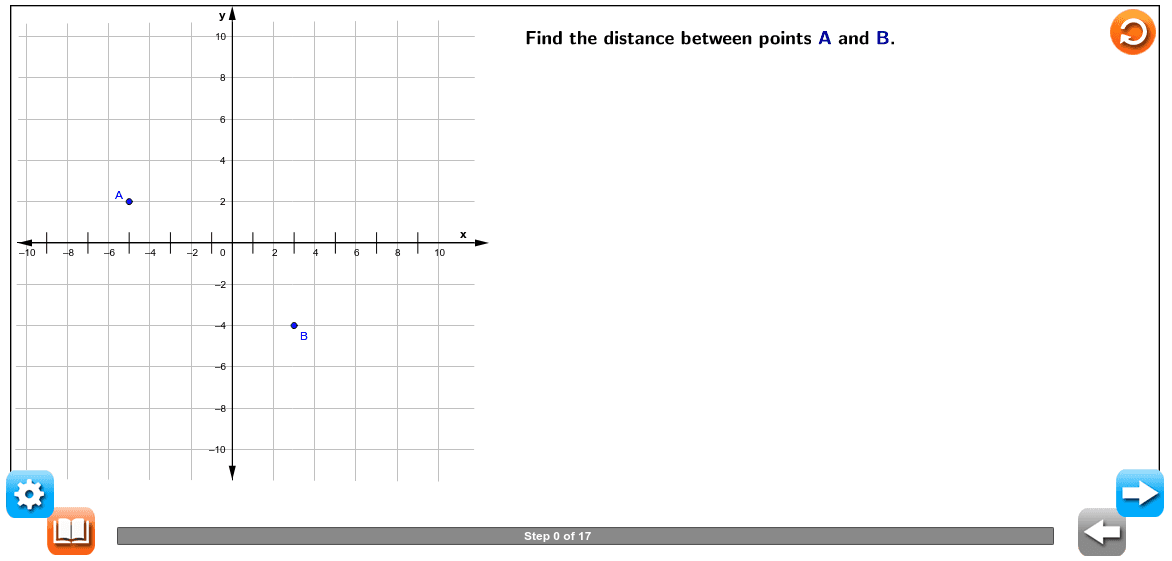
点A和点B之间的距离计算
几何画板及绘图内容加载中,请稍等……
①本范例演示如何计算二维坐标系中两点A和B之间的距离;②涉及的核心数学概念包括坐标几何、勾股定理和距离公式;③作图要点——从下方『构造摘要』提炼用到了哪些 GeoGebra 命令/对象,如SelectedElement, Polygon, Intersect, Point, Vector, LaTeX, Segment等;④适合高中数学学生学习和理解解析几何中的基本计算方法。
GeoGebra 命令及参数
SelectedElement(valueE) → vareSelectedElement(valueB) → varbSelectedElement(valueD) → vardSelectedElement(valueA) → varaSelectedElement(valueB) → XCASelectedElement(valueA) → XCBPolygon(A', B', C', D) → poly1, a, b, c, dPolygon(E, F, G, H) → poly2, e, f, g, hPolygon(I, J, K, L) → poly3, i', j, k, lIntersect(xAxis, yAxis) → MPoint(xAxis) → NVector(M, N) → uPoint(yAxis) → OVector(M, O) → vPoint(yAxis) → RVector(M, R) → wPoint(xAxis) → SVector(M, S) → mPolygon(T, U, V, W) → poly4, t, u_1, v_1, w_1LaTeX("\text{Find the distance between points \textcolor{#000099}{A} and \textcolor{#000099}{B}.}") → Question1LaTeX("\text{Draw a right triangle using the given points.}") → step1LaTeX("\text{Either of these coordinates can be used for the third point in the right }") → step4_1LaTeX("\text{Find the length of the hypotenuse of the right triangle.}") → step6LaTeX("\text{Use the Pythagorean Theorem to find the length of the hypotenuse }") → step7_1LaTeX("\text{of the right triangle.In this triangle,the hypotenuse is the distance}") → step7_2LaTeX("\text{hypotenuse.}") → step8_3LaTeX("\text{Recall that the lengths of the legs can be found through subtraction,}") → step9_1LaTeX("\text{using the coordinates of the legs’ endpoints.For the horizontal leg, }") → step9_2LaTeX("\text{on the graph.}") → step9_6LaTeX("\text{Pythagorean Theorem}") → step11_2LaTeX("\text{Add.}") → step14_2LaTeX("\text{Take the positive square root of}") → step15_2LaTeX("\text{both sides of the equation.}") → step15_3LaTeX("\text{Simplify.}") → step16_2LaTeX("\text{same \textcolor{#000099}{y}-coordinate as \textcolor{#000099}{B},or with the same \textcolor{#000099}{x}-coordinate as \textcolor{#000099}{B} and the }") → step2_2LaTeX("\text{same \textcolor{#000099}{y}-coordinate as \textcolor{#000099}{A}.}") → step2_3LaTeX("\text{Plot another point either with the same \textcolor{#000099}{x}-coordinate as \textcolor{#000099}{A} and the }") → step2_1LaTeX("\text{\textcolor{#000099}{A,B},and \textcolor{#000099}{C} as vertices,as shown. }") → step5_2LaTeX("\text{between points \textcolor{#000099}{A} and \textcolor{#000099}{B}.}") → step7_3LaTeX("\text{can be set up and solved for \textcolor{#000099}{c}.}") → step10_3Segment(A, C) → nSegment(C, B) → pSegment(A, B) → qLaTeX((((("\text{\textcolor{#000099}{(" * varb) * ",") * vare) * ")}.Therefore,the point with the same \textcolor{#000099}{x}-coordinate as \textcolor{#000099}{A} and}")) → step3_2LaTeX((((("\text{The coordinates of point \textcolor{#000099}{A} are \textcolor{#000099}{(" * vara) * ", ") * vard) * ")},and those of point \textcolor{#000099}{B} are}")) → step3_1LaTeX((((("\text{triangle.Let’s use \textcolor{#000099}{(" * vara) * ",") * vare) * ")}.}")) → step4_2LaTeX((((("\text{Plot a point at \textcolor{#000099}{(" * vara) * ",") * vare) * ")} and label it \textcolor{#000099}{C}.Then draw a right triangle with}")) → step5_1LaTeX("\text{The Pythagorean Theorem is \textcolor{#000099}{a^{2}+b^{2}=c^{2}},where \textcolor{#000099}{a} and \textcolor{#000099}{b} are the}") → step8_1LaTeX("\text{lengths of the legs of a right triangle and \textcolor{#000099}{c} is the length of the}") → step8_2LaTeX((((("\text{\textcolor{#000099}{(" * vara) * ",") * vare) * ")}.You can also count the number of units for each leg as shown}")) → step9_5LaTeX((("\text{The length of the hypotenuse,\textcolor{#000099}{c},is \textcolor{#000099}{" * result) * "} units.Therefore,the distance}")) → step17_1LaTeX((("\text{between points \textcolor{#000099}{A} and \textcolor{#000099}{B} is \textcolor{#000099}{" * result) * "} units.}")) → step17_2LaTeX((((("\text{Square \textcolor{#000099}{" * val1) * "} and \textcolor{#000099}{") * val2) * "}.}")) → step13_2LaTeX("\text{\textcolor{#000099}{a^2+b^2=c^2.}}") → data2_3LaTeX("\text{right triangle(\textcolor{#000099}{c}) to the lengths of its legs (\textcolor{#000099}{a} and \textcolor{#000099}{b}).The theorem states that}") → data2_2LaTeX((((("\text{the same \textcolor{#000099}{y}-coordinate as \textcolor{#000099}{B} is at \textcolor{#000099}{(" * vara) * ",") * vare) * ")},and the point with the}")) → step3_3LaTeX((((("\text{same \textcolor{#000099}{x}-coordinate as \textcolor{#000099}{B} and the same \textcolor{#000099}{y}-coordinate as \textcolor{#000099}{A} is at \textcolor{#000099}{(" * varb) * ",") * vard) * ")}.}")) → step3_4LaTeX((((((((("\text{\textcolor{#000099}{a},subtract the \textcolor{#000099}{x}-values of the coordinates \textcolor{#000099}{(" * varb) * ",") * vare) * ")} and \textcolor{#000099}{(") * vara) * ",") * vare) * ")}.For}")) → step9_3LaTeX((((("\text{the vertical leg,\textcolor{#000099}{b},subtract the \textcolor{#000099}{y}-values of the coordinates \textcolor{#000099}{(" * vara) * ",") * vard) * ")} and}")) → step9_4LaTeX((((((("\text{In this case,the lengths of the legs are \textcolor{#000099}{" * varb) * "\;–\;(") * vara) * ")=") * val1) * "} units and}")) → step10_1LaTeX((((((((((("\text{\textcolor{#000099}{" * vard) * "\;–\;(") * vare) * ")=") * val2) * "} units,respectively.Therefore,the equation \textcolor{#000099}{") * val1) * "^{2}+") * val2) * "^{2}=c^{2}}}")) → step10_2LaTeX("\text{\textcolor{#000099}{a^{2}+b^{2}}") → step11_1LaTeX("\text{\textcolor{#000099}{=c^{2}}") → step11_3LaTeX((((("\text{\textcolor{#000099}{(" * val1) * ")^{2}+(") * val2) * ")^{2}}}")) → step12_1LaTeX("\text{\textcolor{#000099}{=c^{2}}") → step11_4LaTeX((((("\text{\textcolor{#000099}{" * square1) * "+") * square2) * "}")) → step13_1LaTeX("\text{\textcolor{#000099}{=c^{2}}") → step11_5LaTeX((("\text{\textcolor{#000099}{" * total) * "}")) → step14_1LaTeX("\text{\textcolor{#000099}{=c^{2}}") → step11_6LaTeX((("\text{\textcolor{#000099}{\sqrt{" * total) * "}}")) → step15_1LaTeX("\text{\textcolor{#000099}{=\sqrt{c^{2}}") → step11_7LaTeX((("\text{\textcolor{#000099}{" * result) * "}")) → step16_1LaTeX("\text{\textcolor{#000099}{=c}}") → step11_8LaTeX((((("\text{Substitute \textcolor{#000099}{" * val1) * "} for \textcolor{#000099}{a} and \textcolor{#000099}{") * val2) * "} for \textcolor{#000099}{b}.}")) → step12_2LaTeX("\text{\mathbf{Pythagorean\;Theorem} a theorem that relates the length of the hypotenuse of a}") → data2_1Segment(Z, A_1) → iSegment(B_1, C_1) → rSegment(D_1, E_1) → sSegment(F_1, G_1) → a_1Segment(H_1, I_1) → b_1Segment(J_1, O_1) → c_1Segment(K_1, P_1) → d_1Segment(L_1, Q_1) → e_1Segment(M_1, R_1) → f_1Segment(N_1, S_1) → g_1LaTeX("\text{\mathbf{Hypotenuse} the side opposite the vertex of the \textcolor{#000099}{90º} angle in a right triangle.}") → data1LaTeX("\text{X coordinate of A:}") → DKT1LaTeX("\text{Y coordinate of A:}") → DKTr1LaTeX("\text{X coordinate of B:}") → DKT2LaTeX("\text{Y coordinate of B:}") → DKTr2