
分数与带分数的转换
几何画板及绘图内容加载中,请稍等……
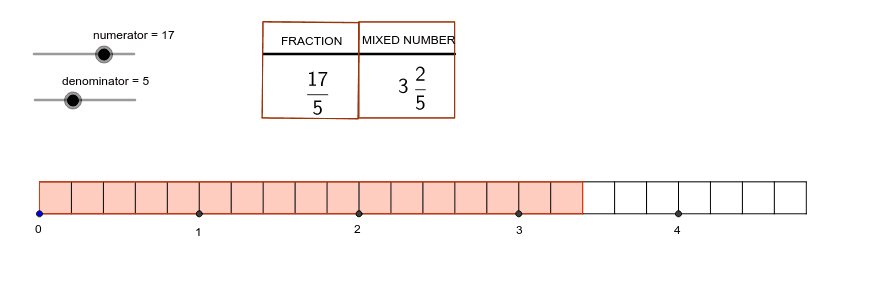
①这个范例通过可视化方式演示了如何将假分数转换为带分数;②涉及的核心数学概念包括分数的基本性质、等值分数、带分数与假分数的互化;③作图要点——从下方『构造摘要』提炼用到了Circle(圆)、Line(线)、Intersect(交点)、OrthogonalLine(垂线)、Segment(线段)、Polygon(多边形)等GeoGebra命令/对象;④适合初中数学学生学习和理解分数的基本运算与转换,也可用于数学教学演示。
GeoGebra 命令及参数
Circle(A, length) → cLine(A, xAxis) → aIntersect(c, a, 2) → B_1Circle(A, height) → dOrthogonalLine(A, a) → bIntersect(d, b, 2) → C_1OrthogonalLine(B_1, a) → eOrthogonalLine(C_1, e) → fIntersect(e, f) → D_1Segment(A, B_1) → gSegment(C_1, D_1) → hSegment(A, C_1) → iSegment(B_1, D_1) → jCircle(A, unit) → kCircle(A, 2 * unit) → pCircle(A, 3 * unit) → qCircle(A, 4 * unit) → rCircle(A, 5 * unit) → sCircle(A, 6 * unit) → tCircle(A, 7 * unit) → c1Circle(A, 8 * unit) → d1Circle(A, 9 * unit) → e1Circle(A, 10 * unit) → f1Circle(A, 11 * unit) → g1Circle(A, 12 * unit) → h1Circle(A, 13 * unit) → k1Circle(A, 14 * unit) → p1Circle(A, 15 * unit) → q1Circle(A, 16 * unit) → r1Circle(A, 17 * unit) → s1Circle(A, 18 * unit) → t1Circle(A, 19 * unit) → c2Circle(A, 20 * unit) → d2Circle(A, 21 * unit) → e2Circle(A, 22 * unit) → f2Circle(A, 23 * unit) → g2Circle(A, 24 * unit) → h2Intersect(k, g, 1) → E_1Intersect(p, g, 1) → F_1Intersect(q, g, 1) → G_1Intersect(r, g, 1) → H_1Intersect(s, g, 1) → I_1Intersect(t, g, 1) → J_1Intersect(c1, g, 1) → K_1Intersect(d1, g, 1) → L_1Intersect(e1, g, 1) → M_1Intersect(f1, g, 1) → N_1Intersect(g1, g, 1) → OIntersect(h1, g, 1) → PIntersect(k1, g, 1) → QIntersect(p1, g, 1) → RIntersect(q1, g, 1) → SIntersect(r1, g, 1) → TIntersect(s1, g, 1) → UIntersect(t1, g, 1) → VIntersect(c2, g, 1) → WIntersect(d2, g, 1) → ZIntersect(e2, g, 1) → A1Intersect(f2, g, 1) → B1Intersect(g2, h2, 1) → C1Intersect(g2, g) → D1,Intersect(h2, g) → E1,Circle(A, denominator * unit) → k2Circle(A, 2 * denominator * unit) → p2Circle(A, 3 * denominator * unit) → q2Circle(A, 4 * denominator * unit) → r2Circle(A, 5 * denominator * unit) → s2Circle(A, 6 * denominator * unit) → t2Circle(A, 7 * denominator * unit) → c3Circle(A, 8 * denominator * unit) → d3Circle(A, 9 * denominator * unit) → e3Circle(A, 10 * denominator * unit) → f3OrthogonalLine(E_1, g) → lOrthogonalLine(F_1, g) → mOrthogonalLine(G_1, g) → nOrthogonalLine(H_1, g) → a1OrthogonalLine(I_1, g) → b1OrthogonalLine(J_1, g) → i1OrthogonalLine(K_1, g) → j1OrthogonalLine(L_1, g) → l1OrthogonalLine(M_1, g) → m1OrthogonalLine(N_1, g) → n1OrthogonalLine(O, g) → a2OrthogonalLine(P, g) → b2OrthogonalLine(Q, g) → i2OrthogonalLine(R, g) → j2OrthogonalLine(S, g) → l2OrthogonalLine(T, g) → m2OrthogonalLine(U, g) → n2OrthogonalLine(V, g) → a3OrthogonalLine(W, g) → b3OrthogonalLine(Z, g) → g3OrthogonalLine(A1, g) → h3OrthogonalLine(B1, g) → i3OrthogonalLine(D1, g) → j3OrthogonalLine(E1, g) → k3Intersect(k3, h) → K1Intersect(j3, h) → L1Intersect(h, i3) → M1Intersect(h, h3) → N1Intersect(h, g3) → O1Intersect(h, b3) → P1Intersect(h, a3) → Q1Intersect(h, n2) → R1Intersect(h, m2) → S1Intersect(h, l2) → T1Intersect(h, j2) → U1Intersect(h, i2) → V1Intersect(h, b2) → W1Intersect(h, a2) → Z1Intersect(h, n1) → A2Intersect(h, m1) → B2Intersect(h, l1) → C2Intersect(j1, h) → D2Intersect(i1, h) → E2Intersect(h, b1) → F2Intersect(h, a1) → G2Intersect(h, n) → H2Intersect(h, m) → I2Intersect(h, l) → J2Intersect(h, i) → K2Segment(L1, D1) → l3Segment(M1, B1) → m3Segment(N1, A1) → n3Segment(O1, Z) → p3Segment(P1, W) → q3Segment(Q1, V) → r3Segment(R1, U) → s3Segment(S1, T) → t3Segment(T1, S) → a4Segment(U1, R) → b4Segment(V1, Q) → c4Segment(W1, P) → d4Segment(Z1, O) → e4Segment(A2, N_1) → f4Segment(B2, M_1) → g4Segment(C2, L_1) → h4Segment(D2, K_1) → i4Segment(E2, J_1) → j4Segment(F2, I_1) → k4Segment(G2, H_1) → l4Segment(H2, G_1) → m4Segment(I2, F_1) → n4Segment(J2, E_1) → p4Intersect(k2, g) → B,Intersect(p2, g) → C,Intersect(q2, g) → D,Intersect(r2, g) → E,Intersect(s2, g) → F,Intersect(t2, g) → G,Intersect(c3, g) → H,Intersect(d3, g) → I,Intersect(e3, g) → J,Intersect(f3, g) → K,Circle(A, 11 * denominator * unit) → q4Circle(A, 12 * denominator * unit) → r4Intersect(q4, g) → L,Intersect(r4, g) → M,Intersect(i, h) → NCircle(N, numerator * unit) → s4Intersect(s4, h) → F1,Circle(A, numerator * unit) → t4Intersect(t4, g) → G1,Polygon(A, G1, F1, N) → poly1, a_1, g1_1, f1_1, n_1Segment(H1, I1) → a5Polygon(J1, L2, 4) → poly2, b5, c5, d5, e5, M2, N2Polygon(O2, P2, 4) → poly3, o2, g5, h5, i5, Q2, R2
AI 绘图提示语参考
画一个坐标系,显示一个圆和x轴的交点,再画一个与x轴垂直的线,找到该线与圆的交点。接着,以原点为中心,分别画半径为1到10个单位的同心圆,并找到这些圆与x轴的交点。最后,连接这些交点,形成由多个线段组成的图形,展示分数转换的过程。
以上提示语为根据原始绘图命令整理而来,仅供参考。