
函数平均变化率的计算示例
几何画板及绘图内容加载中,请稍等……
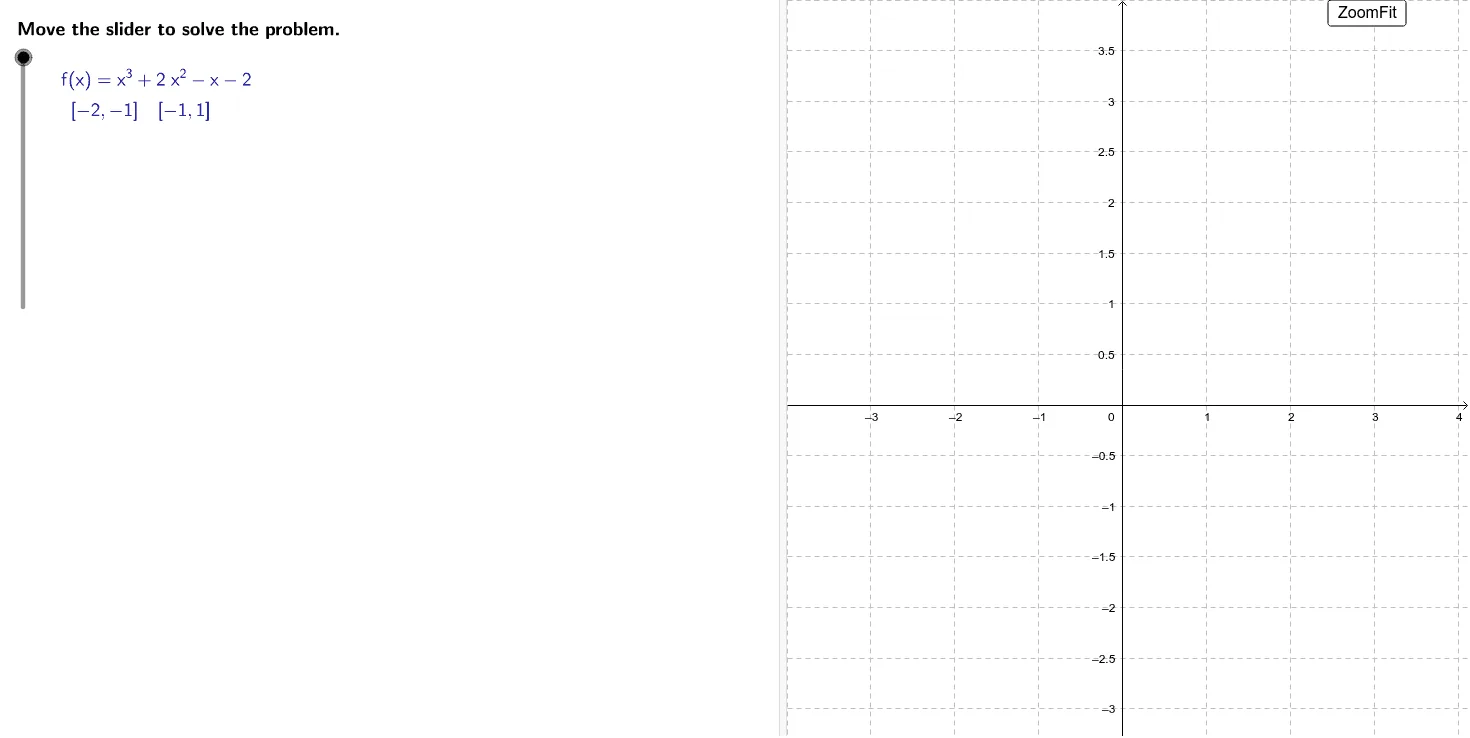
本范例演示了如何计算函数f(x) = x³ + 2x² – x – 2在区间[-2, -1]和[-1, 1]上的平均变化率。涉及的核心数学概念包括函数、区间和变化率计算。作图要点使用了GeoGebra的LaTeX、多项式、排序、序列、表格文本、元素、系数、扁平化、求和等命令和对象。适合高中阶段学习微积分的学生使用。
GeoGebra 命令及参数
LaTeX(steps) → counterLaTeX("\text{Move the slider to solve the problem.}") → text0Corner(1) → ACorner(3) → BPolynomial((((x - a) * (x - b)) * (x - c))) → fZip(If[a ≟ 1, b, 100], a, map, b, ends) → pickEndsSort(pickEnds \ {100}) → usedEndsSequence(LaTeX[(((("[" * Element[usedEnds, i]) * ",") * Element[usedEnds, i + 1]) * "]")], i, 1, Length[usedEnds] - 1) → intervalsTableText({intervals}) → intervalDisplayLaTeX((((("\textcolor{#000099}{f(x)=" * f) * "}\cr\textcolor{#000099}{") * intervalDisplay) * "}")) → ProblemElement(intervals, chooseInterval) → chosenIntervalLaTeX((("\text{Calculate the average rate of change of }\textcolor{#000099}{f(x)}\text{ over the}\cr\text{interval }\textcolor{#000099}{" * chosenInterval) * "}.")) → text1LaTeX((((("\text{First find the values of }\textcolor{#000099}{f(" * Element[usedEnds, chooseInterval]) * ")}\text{ and }\textcolor{#000099}{f(") * Element[usedEnds, chooseInterval + 1]) * ")}.")) → text2Coefficients(f) → coeffsLaTeX((("\text{Calculate }\textcolor{#000099}{f(" * Element[usedEnds, chooseInterval]) * ")}.")) → text3LaTeX((("\textcolor{#000099}{f(x)=" * f) * "}")) → text5LaTeX((((("\textcolor{#000099}{f(" * Element[usedEnds, chooseInterval]) * ")=") * f(Element[usedEnds, chooseInterval])) * "}")) → text7LaTeX((("\text{Calculate }\textcolor{#000099}{f(" * Element[usedEnds, chooseInterval + 1]) * ")}.")) → text8LaTeX((("\textcolor{#000099}{f(x)=" * f) * "}")) → text10LaTeX((((("\textcolor{#000099}{f(" * Element[usedEnds, chooseInterval + 1]) * ")=") * f(Element[usedEnds, chooseInterval + 1])) * "}")) → text12Element(usedEnds, chooseInterval) → LendElement(usedEnds, chooseInterval + 1) → RendLaTeX("\text{Simplify.}") → text18LaTeX((("\textcolor{#000099}{r=" * r) * "}")) → text19Zip((a, f(a)), a, usedEnds) → showEndsSequence((f(Element[usedEnds, i]) - f(Element[usedEnds, i + 1])) / (Element[usedEnds, i] - Element[usedEnds, i + 1]), i, 1, Length[usedEnds] - 1) → rateListZip(If[a < 0, "negative", If[a > 0, "positive", If[a ≟ 0, "zero", "undefined"]]], a, rateList) → rateWordTableText({intervals, rateList, rateWord}, "v") → text24If(Defined[IndexOf["positive", rateWord]], LaTeX["\text{When the average rate of change is positive on}\cr\text{an interval, the function rises more than it falls}\cr\text{on that interval.}\cr"], "") → wordposIf(Defined[IndexOf["zero", rateWord]], LaTeX["\text{When the average rate of change is zero on an}\cr\text{interval, the function either is constant}\cr\text{throughout the interval (a horizontal line) or has}\cr\text{the same value at the ends of the interval and}\cr\text{moves away from that value and then back. The}\cr\text{second possibility results in at least one}\cr\text{maximum or minimum on the interval.}\cr"], "") → wordzeroIf(Defined[IndexOf["negative", rateWord]], LaTeX["\text{When the average rate of change is negative on}\cr\text{an interval, the function falls more than it rises}\cr\text{on that interval.}\cr"], "") → wordnegIf(Defined[IndexOf["undefined", rateWord]], LaTeX["\text{When the average rate of change is undefined on}\cr\text{an interval, either the interval has zero width or}\cr\text{at least one of the endpoints is undefined.}\cr"], "") → wordundeSequence(Sequence[If[Element[rateList, i] ≟ Element[rateList, j], 1, 0], i, j + 1, Length[rateList]], j, 1, Length[rateList]) → matchFlatten(match) → flatmatchSum(flatmatch) → summatchIf(summatch > 0, LaTeX["\text{}\cr\text{Note that just because the average rate of}\cr\text{change in two intervals is the same does not}\cr\text{mean that the function behaves identically in}\cr\text{the two intervals.}\cr"], "") → matchedLaTeX(((((wordpos * wordneg) * wordzero) * wordunde) * matched)) → text25LaTeX("") → text22LaTeX("\text{Original function}") → text4LaTeX("\text{Original function}") → text9LaTeX("\text{Rate of change formula}") → text14LaTeX((((("\text{The rate of change of }\textcolor{#000099}{f(x)}\text{ over the interval }\textcolor{#000099}{" * chosenInterval) * "}\text{ is }\textcolor{#000099}{") * r) * "}.")) → text20LaTeX((((("\text{Substitute the values for }\textcolor{#000099}{f(" * Lend) * ")}\text{ and }\textcolor{#000099}{f(") * Rend) * ")}\text{ into the rate of change formula and solve.}")) → text13LaTeX("\text{Use the buttons below to return to the original problem or}\cr\text{randomly generate a similar practice problem.}") → RandomizationTextLaTeX((("\text{Substitute }\textcolor{#000099}{" * Element[usedEnds, chooseInterval]) * "}\text{ for }\textcolor{#000099}{x}\text{ and simplify.}")) → text6LaTeX((("\text{Substitute }\textcolor{#000099}{" * Element[usedEnds, chooseInterval + 1]) * "}\text{ for }\textcolor{#000099}{x}\text{ and simplify.}")) → text11LaTeX("\textcolor{#000099}{r=\frac{f_1(x) - f_2(x)}{x_1-x_2}}") → text15LaTeX((((((((("\text{Substitute }\textcolor{#000099}{" * fleft) * "}\text{ for }\textcolor{#000099}{f_1(x)}\text{, }\textcolor{#000099}{") * fright) * "}\text{ for }\textcolor{#000099}{f_2(x)}\text{, }\cr\textcolor{#000099}{") * Lend) * "}\text{ for }\textcolor{#000099}{x_1}\text{, and }\textcolor{#000099}{") * Rend) * "}\text{ for }\textcolor{#000099}{x_2}.")) → text16LaTeX((((((((("\textcolor{#000099}{r=\frac{(" * f(Lend)) * ")-(") * f(Rend)) * ")}{(") * Lend) * ")-(") * Rend) * ")}}")) → text17LaTeX("\text{Graph the function and the endpoints of the intervals.}") → text21LaTeX("\text{Determine if the rate of change over each interval is positive, negative, 0, or undefined, }\cr\text{and whether the rates of change for different intervals are the same.}") → text23
AI 绘图提示语参考
画一个函数图像,展示函数 f(x) = x³ + 2x² – x – 2 在区间 [-2, -1] 和 [-1, 1] 上的平均变化率。首先绘制函数图像,然后标记这两个区间,并计算每个区间内函数值的变化量除以区间宽度,得到平均变化率。用不同颜色或符号标示每个区间的平均变化率,并显示其正负或大小。最后,在图上用文字说明每个区间的平均变化率及其意义。
以上提示语为根据原始绘图命令整理而来,仅供参考。