
任意抛物线载荷的剪力与弯矩图
几何画板及绘图内容加载中,请稍等……
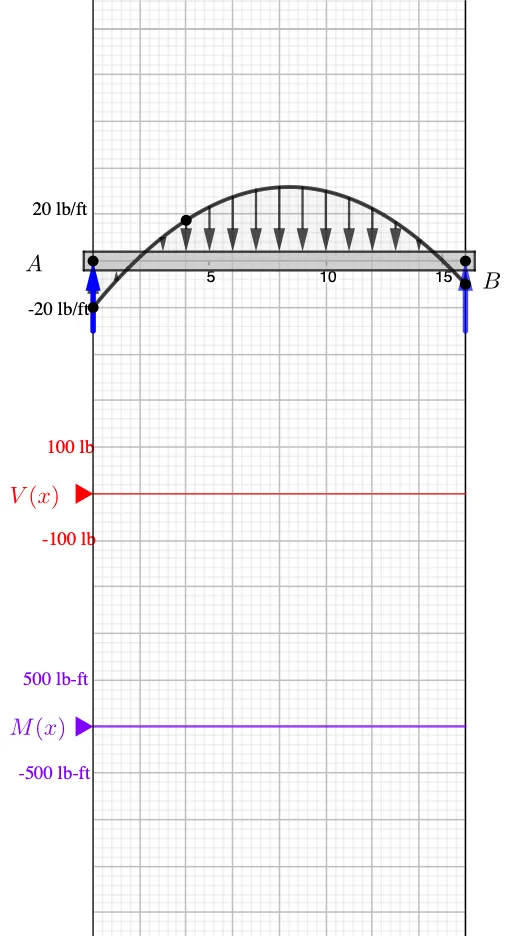
①本范例演示了在任意抛物线载荷作用下,梁的剪力与弯矩图的绘制与变化规律;②涉及的核心数学概念包括积分、导数、函数图像、向量运算等;③作图要点:使用了Point, Polynomial, Integral, IntegralBetween, Segment, Textfield, Polygon, Length, Vector, Sequence, Max, Min等GeoGebra命令与对象,实现了载荷、剪力、弯矩的动态计算与可视化;④适合高中及以上学生及工程技术人员学习结构力学与工程应用。
GeoGebra 命令及参数
Point(Line[B, B + j]) → B'Point(Line[A, A + j]) → A'Polynomial(Stretch[{A', C', B'}, xAxis, Scale_w / AxisStepY[]]) → wIntegral(w, 0, beamLen) → WIntegralBetween((w(x))^(2) / 2, 0, 0, beamLen) → QxIntegral((x * w(x)), 0, beamLen) → QyPoint(x = ((-AxisStepX[])) / 4) → Vmember(A, B, (0.2 * AxisStepY[])) → beam, beam_t, beam_b, beam_L, beam_rPoint(x = ((-AxisStepX[])) / 4) → MSegment(V', (x(V'), v'(right))) → v_rIntegral(v) → mTextfield(Scale_V) → InputBoxVTextfield(Scale_M) → InputBoxMPolygon((right, y(Corner[2])), (right, y(Corner[3])), Corner[3], Corner[2]) → mask, mask_l, mask_t, mask_r, mask_bSegment((0, y(V)), (right, y(V))) → VaxisSegment((0, y(M)), (right, y(M))) → MaxisLength(userObjects) → c_1Length(userObjects) → c_1Length(userObjects) → c_1Length(userObjects) → c_1Length(userObjects) → c_1Length(userObjects) → c_1Length(userObjects) → c_1Length(userObjects) → c_1Length(userObjects) → c_1Length(userObjects) → c_1Length(userObjects) → c_1Length(userObjects) → c_1Length(userObjects) → c_1Length(userObjects) → c_1Length(userObjects) → c_1Length(userObjects) → c_1Length(userObjects) → c_1Length(userObjects) → c_1Length(userObjects) → c_1Length(userObjects) → c_1Length(userObjects) → c_1Length(userObjects) → c_1Length(userObjects) → c_1Length(userObjects) → c_1Length(userObjects) → c_1Length(userObjects) → c_1Length(userObjects) → c_1Length(userObjects) → c_1Length(userObjects) → c_1Length(userObjects) → c_1Length(userObjects) → c_1Length(userObjects) → c_1Length(userObjects) → c_1Length(userObjects) → c_1Length(userObjects) → c_1Length(userObjects) → c_1Length(userObjects) → c_1Integral(w', 0, beamLen) → W'Vector(A - (1.5 * j), A) → aVector(B - (1.5 * j), B) → bSequence(Vector[(k, w'(k)), (k, (0.4 * sgn(w'(k))))], k, 0, beamLen, 1) → distLoadTextfield(Scale_w) → InputBoxWSegment((0, y(V)), (0, v'(0.0001))) → v_AMax({y(Max[v, 0, beamLen]), F_A, (-F_B)}) → V_{max}Min({y(Min[v, 0, beamLen]), F_A, (-F_B)}) → V_{min}