
数列与积的奇偶性分析
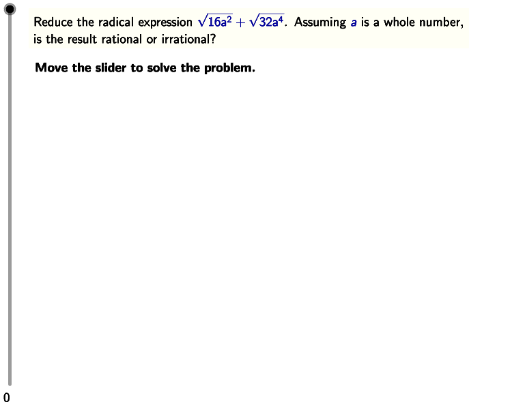
几何画板及绘图内容加载中,请稍等……
该范例演示了数列中奇数和偶数项的分析,通过构造摘要中的命令,可以观察到数列的生成过程。核心数学概念包括数列、奇偶性分析。使用了LaTeX、Zip、PrimeFactors等命令。适合高中数学教学和学习。
GeoGebra 命令及参数
LaTeX(steps) → counterCorner(1) → ACorner(3) → BZip((2 * a), a, apowers) → a2powersPrimeFactors(coeff1) → c1pUnique(c1p) → c1pvalFrequency(c1p) → c1pcountZip(If[a / 2 ≟ floor(a / 2), a, a - 1], a, c1pcount) → c1pevenZip(If[a / 2 ≟ floor(a / 2), 0, 1], a, c1pcount) → c1poddIf(Sum[c1podd] ≟ 0, "y", "n") → c1perfectPrimeFactors(coeff2) → c2pUnique(c2p) → c2pvalFrequency(c2p) → c2pcountZip(If[a / 2 ≟ floor(a / 2), a, a - 1], a, c2pcount) → c2pevenZip(If[a / 2 ≟ floor(a / 2), 0, 1], a, c2pcount) → c2poddIf(Sum[c2podd] ≟ 0, "y", "n") → c2perfectLaTeX((((((((("\sqrt{" * coeff1) * "a^{") * Element[a2powers, 1]) * "}}+\sqrt{") * coeff2) * "a^{") * Element[a2powers, 2]) * "}}")) → originalLaTeX("\text{Use the properties of radicals to rewrite the expression.}") → text1LaTeX("\text{Rewrite each radical in the expression as a product of radicals, and evaluate}\cr\text{where possible.}") → text2LaTeX("\text{Rewrite using the product property of radicals.}") → text5LaTeX("\text{Evaluate the radicals of perfect squares.}") → text7If(c1perfect ≟ "y", LaTeX[sqrt(coeff1)], LaTeX[(("\sqrt{" * coeff1) * "}")]) → c1evalperfIf(c2perfect ≟ "y", LaTeX[sqrt(coeff2)], LaTeX[(("\sqrt{" * coeff2) * "}")]) → c2evalperfIf(Element[apowers, 1] ≟ 1, LaTeX["a"], LaTeX[("a^" * Element[apowers, 1])]) → a1evalperfIf(Element[apowers, 2] ≟ 1, LaTeX["a"], LaTeX[("a^" * Element[apowers, 2])]) → a2evalperfLaTeX(((((c1evalperf * a1evalperf) * " +") * c2evalperf) * a2evalperf)) → text8LaTeX((((("\text{The radical expression }\textcolor{#000099}{" * original) * "}\text{ can be rewritten as }\textcolor{#000099}{") * text8) * "}.")) → text9LaTeX("\text{Reduce any remaining radicals.}") → text10LaTeX("\text{Factor out perfect squares within the radicand(s).}") → text13Product(Zip[a^(b / 2), a, c1pval, b, c1peven]) → c1perfProduct(Zip[a^(b), a, c1pval, b, c1podd]) → c1restIf(c1perfect ≟ "y", LaTeX[c1perf], If[c1perf ≟ 1, LaTeX[(("\sqrt{" * c1rest) * "}")], LaTeX[(((("\sqrt{" * c1perf^(2)) * "\cdot") * c1rest) * "}")]]) → writec1perfProduct(Zip[a^(b / 2), a, c2pval, b, c2peven]) → c2perfProduct(Zip[a^(b), a, c2pval, b, c2podd]) → c2restIf(c2perfect ≟ "y", LaTeX[c2perf], If[c2perf ≟ 1, LaTeX[(("\sqrt{" * c2rest) * "}")], LaTeX[(((("\sqrt{" * c2perf^(2)) * "\cdot") * c2rest) * "}")]]) → writec2perfLaTeX(((((writec1perf * a1evalperf) * " +") * writec2perf) * a2evalperf)) → text14LaTeX("\text{Rewrite using the product property of radicals.}") → text15If(c1perfect ≟ "y", LaTeX[c1perf], If[c1perf ≟ 1, LaTeX[(("\sqrt{" * c1rest) * "}")], LaTeX[(((("\sqrt{" * c1perf^(2)) * "}\cdot\sqrt{") * c1rest) * "}")]]) → writec1perfsplitIf(c2perfect ≟ "y", LaTeX[c2perf], If[c2perf ≟ 1, LaTeX[(("\sqrt{" * c2rest) * "}")], LaTeX[(((("\sqrt{" * c2perf^(2)) * "}\cdot\sqrt{") * c2rest) * "}")]]) → writec2perfsplitLaTeX(((((writec1perfsplit * a1evalperf) * " +") * writec2perfsplit) * a2evalperf)) → text16LaTeX("\text{Evaluate the radicals of perfect squares.}") → text17If(c1perfect ≟ "y", LaTeX[c1perf], If[c1perf ≟ 1, LaTeX[(("\sqrt{" * c1rest) * "}")], LaTeX[(((c1perf * "\cdot\sqrt{") * c1rest) * "}")]]) → writec1perfrootIf(c2perfect ≟ "y", LaTeX[c2perf], If[c2perf ≟ 1, LaTeX[(("\sqrt{" * c2rest) * "}")], LaTeX[(((c2perf * "\cdot\sqrt{") * c2rest) * "}")]]) → writec2perfrootLaTeX(((((writec1perfroot * a1evalperf) * " +") * writec2perfroot) * a2evalperf)) → text18LaTeX((("\text{The remaining radical(s) cannot be further reduced. The final reduced expression}\cr\text{is }\textcolor{000099}{" * text18) * "}.")) → text19LaTeX("\text{Determine whether the resulting expression is rational or irrational.}") → text20LaTeX((((((((("\sqrt{" * coeff1) * "}\sqrt{a^{") * Element[a2powers, 1]) * "}}+\sqrt{") * coeff2) * "}\sqrt{a^{") * Element[a2powers, 2]) * "}}")) → text6If(c1perfect ≟ "y" ∧ c2perfect ≟ "y", LaTeX[(("\text{The sum of two rational numbers is a rational number therefore }\cr\textcolor{#000099}{" * text18) * "}\text{ is rational.}")], LaTeX[(("\text{The sum of an irrational and either a rational or an irrational number is an}\cr\text{irrational number therefore }\textcolor{#000099}{" * text18) * "}\text{ is irrational.}")]) → text23LaTeX("\text{Original expression}") → text3LaTeX("\text{Move the slider to solve the problem.}") → text0LaTeX((("\text{Reduce the radical expression }\textcolor{#000099}{" * original) * "}\text{. Assuming }\textcolor{#000099}\textit{a}\text{ is a whole number,}\cr\text{is the result rational or irrational?}")) → ProblemLaTeX("\text{Expression from the previous step}") → text11If(c1perfect ≟ "y", LaTeX[((("\text{Because }\textcolor{#000099}\textit{a}\text{ is a whole number and }\textcolor{#000099}{" * writec1perfroot) * a1evalperf) * "}\text{ contains no radicals, the first part of the}\cr\text{expression is rational.}")], LaTeX[((("\text{Because }\textcolor{#000099}\textit{a}\text{ is a whole number and }\textcolor{#000099}{" * writec1perfroot) * a1evalperf) * "}\text{ contains an irreducible radical,}\cr\text{the first part of the expression is irrational.}")]) → text21If(c2perfect ≟ "y", LaTeX[((("\text{Because }\textcolor{#000099}\textit{a}\text{ is a whole number and }\textcolor{#000099}{" * writec2perfroot) * a2evalperf) * "}\text{ contains no radicals, the second part of}\cr\text{the expression is rational.}")], LaTeX[((("\text{Because }\textcolor{#000099}\textit{a}\text{ is a whole number and }\textcolor{#000099}{" * writec2perfroot) * a2evalperf) * "}\text{ contains an irreducible radical,}\cr\text{the second part of the expression is irrational.}")]) → text22LaTeX("\text{Use the buttons below to return to the original problem or}\cr\text{to randomly generate a similar practice problem.}") → RandomizationText
AI 绘图提示语参考
绘制一个数列的奇偶项分析图,包含数列的奇偶项、因式分解后的奇偶项系数、以及最终简化后的表达式。首先,绘制数列的奇偶项,然后展示因式分解后的奇偶项系数,接着计算并展示奇偶项系数的因数分解结果,最后将这些结果用于简化表达式,并展示最终的简化表达式。
以上提示语为根据原始绘图命令整理而来,仅供参考。