
Writing Quadratic Functions - Does "a" Matter?
Loading the math board and drawing, please wait…
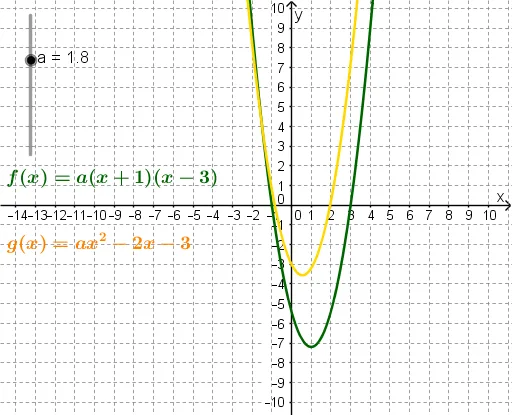
①This example dynamically explores how the coefficient 'a' in a quadratic function affects the parabola's opening direction, width, and vertex position, making the relationship between algebraic parameters and graphical features tangible. ②Core mathematical concepts include the standard form of a quadratic function f(x)=a(x-h)^2+k, the geometric meaning of 'a' (direction and vertical stretch/compression), and parameter-to-graph correspondence. ③Construction details: Based on the summary, objects include 'a' (likely a slider), 'f' (quadratic function graph), 'g' (auxiliary or comparison function), and text objects 'text1' and 'text1_1' for annotations. GeoGebra commands involve sliders and function definitions to enable dynamic parameter changes with explanatory text. ④Suitable for middle school to high school students learning quadratic functions, and useful for classroom demonstrations or self-guided exploration to bridge algebraic expressions and geometric visualization.
GeoGebra Commands & Parameters
Numeric a(1.8)f(x) = ((a * (x - 3)) * (x + 1))g(x) = (a * x^(2)) - (2 * x) - 3
AI Drawing Prompt Reference
Draw a dynamic quadratic function graph where the coefficient 'a' is controlled by a slider with an initial value of about 1.8. The main parabola passes through points (3,0) and (-1,0), with its opening direction and width changing as 'a' varies. Also display a second auxiliary parabola defined as a times x squared minus 2x minus 3, for comparison. Include text annotations explaining that the sign of 'a' determines the opening direction, its absolute value affects the width, and the vertex position shifts accordingly. The graph should clearly illustrate the relationship between the algebraic parameter and the graphical features.
The prompt above was compiled from the original drawing commands and is for reference only.