
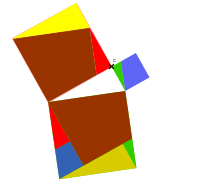
Wordless Pythagorean Theorem based on Translations
Loading the math board and drawing, please wait…
In collections
Similarity & Right Triangle Trigonometry
Similarity, Right Triangles, and Trigonometry (SRT) Cluster
This example visually demonstrates the Pythagorean Theorem through translations, illustrating the relationship between the sides of a right triangle. Key concepts include the Pythagorean Theorem, vector translations, and geometric constructions. It uses commands like Circle, Line, Point, Intersect, Segment, Distance, OrthogonalLine, Polygon, Vector, Translate. Suitable for high school geometry education and understanding spatial transformations and proofs.
GeoGebra Commands & Parameters
Circle(A, B) → cLine(A, B) → aPoint(c) → CIntersect(c, a) → D, ESegment(C, E) → bSegment(C, B) → dDistance(E, B) → eOrthogonalLine(C, b) → fOrthogonalLine(E, b) → gOrthogonalLine(E, a) → hOrthogonalLine(B, a) → iOrthogonalLine(B, f) → jOrthogonalLine(C, f) → kCircle(E, B) → pCircle(C, E) → qCircle(C, B) → rIntersect(p, h) → F, GIntersect(q, f) → H, IIntersect(r, k) → J, KOrthogonalLine(F, h) → lOrthogonalLine(H, g) → mOrthogonalLine(K, k) → nIntersect(j, n) → LIntersect(l, i) → MIntersect(m, g) → NPolygon(C, H, N, E) → poly1, c_1, h_1, n_1, e_1Polygon(C, K, L, B) → poly2, c_2, k_1, l_1, b_1Polygon(E, F, M, B) → poly3, e_2, f_1, m_1, b_2Line(M, B) → sIntersect(s, k_1) → OVector(O, E) → uTranslate(B, u) → B'Translate(L, u) → L'Translate(O, u) → O'Vector(B, M) → vTranslate(O, v) → O'_1Translate(K, v) → K'Translate(C, v) → C'Translate(B, v) → B'_1Intersect(c_2, s) → RPolygon(R, C, B) → poly4, b_3, r_1, c_3Polygon(B, L, K, R) → poly5, b_4, l_2, k_2, r_2OrthogonalLine(N, s) → tIntersect(t, c_1) → SOrthogonalLine(S, t) → a_1Intersect(b, e_1) → TIntersect(a_1, b) → UVector(B, F) → wTranslate(B, w) → B'_2Translate(L, w) → L'_1Translate(K, w) → K'_1Translate(R, w) → R'Polygon(U, C, S) → poly6, s_1, u_1, c_4Vector(U, R') → zPoint(poly6) → VPolygon(N, S, U, E) → poly7, n_2, s_2, u_2, e_3Intersect(a_1, c_1) → WPolygon(H, N, W) → poly8, w_1, h_2, n_3Translate(B, w) → B'_3Translate(L, w) → L'_2Translate(K, w) → K'_2Translate(R, w) → R'_1Polygon(B'_3, L'_2, K'_2, R'_1) → poly5', b'_3, l'_2, k'_2, r'_1Translate(U, z) → U'Translate(C, z) → C'_1Translate(S, z) → S'Polygon(U', C'_1, S') → poly6', s', u', c'_1Vector(N, B'_3) → v_1Translate(H, v_1) → H'Translate(N, v_1) → N'Translate(W, v_1) → W'Polygon(H', N', W') → poly8', w', h', n'Translate(R, v) → R'_2Translate(C, v) → C'_2Translate(B, v) → B'_4Polygon(R'_2, C'_2, B'_4) → poly4', b'_4, r'_2, c'_2Vector(S', L'_2) → z_1Translate(N, z_1) → N'_1Translate(S, z_1) → S'_1Translate(U, z_1) → U'_1Translate(E, z_1) → E'Polygon(N'_1, S'_1, U'_1, E') → poly7', n'_1, s'_1, u'_1, e'
AI Drawing Prompt Reference
Draw a right triangle to demonstrate the Pythagorean theorem through translations. Start by sketching the legs and hypotenuse, then draw perpendicular lines on the legs and hypotenuse to find intersection points. Construct new shapes using circles and these points, showing translation relationships. Finally, form multiple closed figures by translating and connecting points, visually representing the Pythagorean theorem.
The prompt above was compiled from the original drawing commands and is for reference only.