
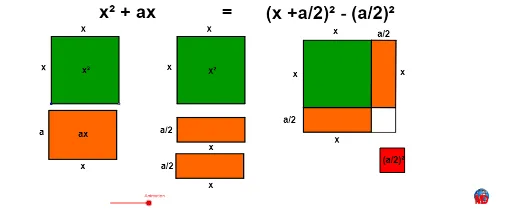
Wordless Proof: x²+ax= (x+a/2)²-(a/2)²
Loading the math board and drawing, please wait…
This example visually demonstrates the algebraic identity x²+ax= (x+a/2)²-(a/2)² through dynamic geometry. Key math concepts include perfect square formula, algebraic manipulation, and geometric intuition. GeoGebra commands used in construction are Circle, Point, Polygon, Line, OrthogonalLine, Intersect, Midpoint, Vector, Translate, Rotate, and Segment. Ideal for high school students to understand the connection between algebra and geometry, enhancing visual mathematical reasoning.
GeoGebra Commands & Parameters
Circle(A, c) → c_1Point(c_1) → BPolygon(A, B, 4) → poly1, a_1, b, d, e, C, DLine(E, a_1) → gOrthogonalLine(E, g) → iCircle(E, a) → hIntersect(h, i) → H, IMidpoint(I, E) → LVector(L, N) → vTranslate(L, Vector[(If[Animation < 5, Animation / 5, 1] * v)]) → L'Vector(A, D_2) → w_1Circle(E, c) → fIntersect(f, g) → F, GOrthogonalLine(G, g) → jLine(I, g) → kIntersect(k, j) → JPolygon(E, G, J, I) → poly2, e_1, g_1, j_1, i_1Translate(A, Vector[(If[Animation < 5, Animation / 5, 1] * w_1)]) → KVector(A, K) → uTranslate(poly1, u) → poly1'Midpoint(J, G) → MPolygon(L, M, J, I) → poly3, l, m, j_2, i_2Polygon(L, M, G, E) → poly4, l_1, m_1, g_2, e_2Vector(E, O) → wTranslate(M, Vector[(If[Animation < 5, Animation / 5, 1] * v)]) → M'Translate(J, Vector[(If[Animation < 5, Animation / 5, 1] * v)]) → J'Translate(I, Vector[(If[Animation < 5, Animation / 5, 1] * v)]) → I'Polygon(L', M', J', I') → poly3', l', m', j', i'Translate(L, Vector[(If[Animation < 5, Animation / 5, 1] * w)]) → L'_1Translate(M, Vector[(If[Animation < 5, Animation / 5, 1] * w)]) → M'_1Translate(G, Vector[(If[Animation < 5, Animation / 5, 1] * w)]) → G'Translate(E, Vector[(If[Animation < 5, Animation / 5, 1] * w)]) → E'Polygon(L'_1, M'_1, G', E') → poly4', l'_1, m'_1, g', e'Vector(K, P) → zTranslate(poly1', n) → poly1''Translate(poly1'', z) → poly1'''Vector(I', P) → pTranslate(L', Vector[(If[Animation < 10, (Animation - 5) / 5, 1] * p)]) → L''Translate(M', Vector[(If[Animation < 10, (Animation - 5) / 5, 1] * p)]) → M''Translate(J', Vector[(If[Animation < 10, (Animation - 5) / 5, 1] * p)]) → J''Translate(I', Vector[(If[Animation < 10, (Animation - 5) / 5, 1] * p)]) → I''Polygon(L'', M'', J'', I'') → poly3'', l'', m'', j'', i''Vector(L'_1, J'') → qRotate(L'_1, Animation, L'_1) → QRotate(L'_1, If[Animation < 7.84, Animation, 7.84], L'_1) → RRotate(M'_1, If[Animation < 7.85, Animation, 7.85], L'_1) → SRotate(G', If[Animation < 7.85, Animation, 7.85], L'_1) → G''Rotate(E', If[Animation < 7.85, Animation, 7.85], L'_1) → E''Polygon(R, S, G'', E'') → poly4'', r, s, g'', e''Translate(R, Vector[(If[Animation < 10, (Animation - 5) / 5, 1] * q)]) → R'Translate(S, Vector[(If[Animation < 10, (Animation - 5) / 5, 1] * q)]) → S'Translate(G'', Vector[(If[Animation < 10, (Animation - 5) / 5, 1] * q)]) → G'''Translate(E'', Vector[(If[Animation < 10, (Animation - 5) / 5, 1] * q)]) → E'''Polygon(R', S', G''', E''') → poly4''', r', s', g''', e'''Translate(L'_1, Vector[(If[Animation < 10, (Animation - 5) / 5, 1] * q)]) → TTranslate(M'_1, Vector[(If[Animation < 10, (Animation - 5) / 5, 1] * q)]) → UTranslate(G', Vector[(If[Animation < 10, (Animation - 5) / 5, 1] * q)]) → G''_1Translate(E', Vector[(If[Animation < 10, (Animation - 5) / 5, 1] * q)]) → E''_1Polygon(T, U, G''_1, E''_1) → poly4''_1, t, u_1, g''_1, e''_1Vector(J'', V) → v_1Polygon(J'', M'', 4) → poly5, b_1, d_1, f_1, h_1, W, ZTranslate(poly5, Vector[(If[Animation < 15, (Animation - 10) / 10, 1] * v_1)]) → poly5'Translate(poly5, Vector[(If[Animation < 15, (Animation - 10) / 10, 1] * v_1)]) → poly5'_1Segment(D, C) → k_1Point(a_1) → B_1Segment(D, B_1) → p_1Midpoint(k_1) → C_1Midpoint(p_1) → D_1Translate(D, u) → D'Translate(C, u) → C'Segment(D', C') → q_1Translate(C, u) → C'_1Translate(A, u) → A'Translate(B, u) → B'Segment(A', B') → s_1Translate(D, u) → D'_1Translate(B_1, u) → F_1Segment(D'_1, F_1) → t_1Translate(D', z) → D''Translate(C', z) → C''Segment(D'', C'') → a_2Translate(D'_1, z) → G_1Translate(F_1, z) → H_1Segment(G_1, H_1) → b_2Translate(C'_1, z) → I_1Translate(A', z) → A''Translate(B', z) → B''Segment(A'', B'') → d_2Midpoint(q_1) → K_1Midpoint(a_2) → M_1Midpoint(b_2) → N_1Midpoint(t_1) → L_1Midpoint(e_1) → O_1Midpoint(i') → P_1Midpoint(e') → Q_1Midpoint(i'') → R_1Midpoint(l'') → S_1Midpoint(g''') → T_1Midpoint(s') → U_1Midpoint(l') → V_1Midpoint(g') → W_1Segment(C, B) → n_1Translate(C, u) → C'_2Translate(B, u) → B'_1Segment(C'_2, B'_1) → r_1Midpoint(C, B_1) → A_1Midpoint(D'', J'') → E_1Centroid(poly5') → J_1Centroid(poly2) → Z_1Centroid(poly1'') → A_2Centroid(poly3'') → B_2Centroid(poly4''') → C_2Segment(C'', B'') → f_2
AI Drawing Prompt Reference
Create a dynamic geometry visualization demonstrating the algebraic identity x²+ax= (x+a/2)²-(a/2)². Start by drawing a square and its diagonal, then draw a circle centered at the midpoint of the diagonal. Connect the intersection points to form a new shape. Next, rotate and translate parts of the figure to show the two sides of the identity, including a rotating square and a moving triangle, resulting in a symmetric geometric proof.
The prompt above was compiled from the original drawing commands and is for reference only.