
Why Is the Area of a Triangle (b ∙ h)/2? Visual Proof
Loading the math board and drawing, please wait…
In collections
Euclidean Geometry
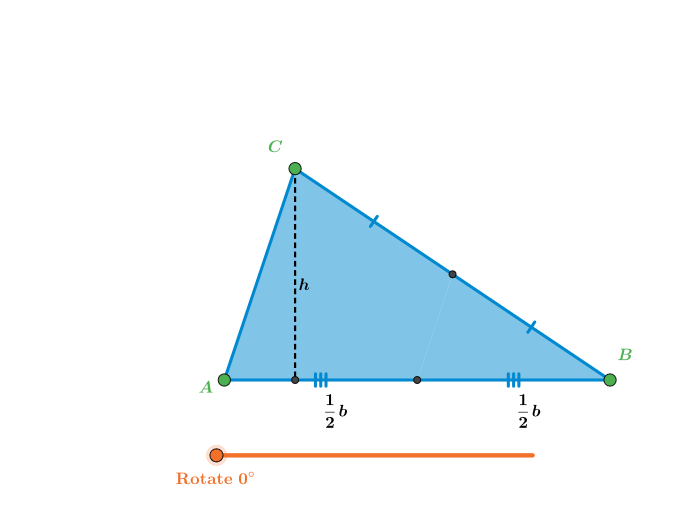
This example demonstrates the intuitive proof of the triangle area formula (b ∙ h)/2 by dissecting a triangle into a parallelogram with the same area. It uses Polygon, OrthogonalLine, Intersect, Segment, Midpoint, Rotate, etc., in GeoGebra. Suitable for middle school and above students learning geometry.
GeoGebra Commands & Parameters
Polygon(A, B, C) → t1, c, a, bOrthogonalLine(C, c) → fIntersect(f, c) → HSegment(C, H) → gMidpoint(A, B) → DMidpoint(B, C) → EPolygon(A, D, E, C) → q1, a_1, d, e, c_1Polygon(D, B, E) → t2, e_1, d_1, b_1Rotate(D, α, E) → D'Rotate(B, α, E) → B'Rotate(E, α, E) → E'Polygon(D', B', E') → t2', e', d', b'
AI Drawing Prompt Reference
Draw a triangle ABC, then dissect it into a parallelogram with the same area. First, draw triangle ABC, then draw a perpendicular line from C to AB and find the foot of the perpendicular H. Connect CH. Next, find the midpoints D and E of AB and BC, respectively, and draw triangle ADE and quadrilateral DEBC. Then, rotate quadrilateral DEBC around point E to overlap with triangle ABC, forming a new parallelogram.
The prompt above was compiled from the original drawing commands and is for reference only.