
Whitney Umbrella Geometric Construction Example
Loading the math board and drawing, please wait…
In collections
geometriadinamica.es
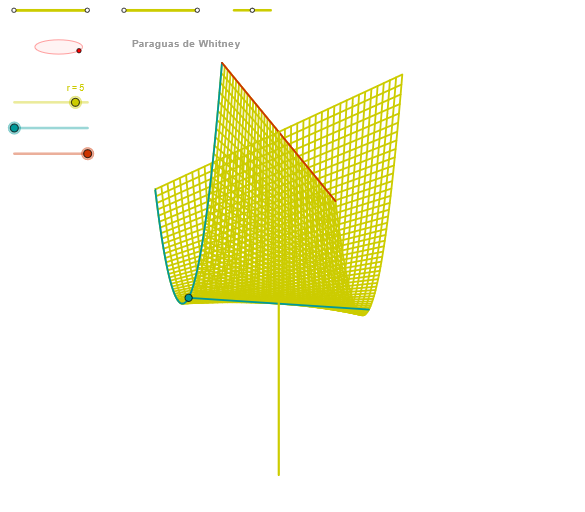
This example demonstrates the construction of a Whitney umbrella using geometric principles, focusing on symmetry and similarity. Key mathematical concepts include symmetry, similarity transformations, and geometric construction. The construction involves GeoGebra commands such as Segment, Point, OrthogonalLine, Circle, Intersect, Ellipse, etc. It is suitable for middle or high school mathematics courses to teach geometric transformations and graphical analysis.
GeoGebra Commands & Parameters
Segment(Q5, Q6) → p5Point(p5) → P5Segment(Q3, Q4) → p2Point(p2) → P3Segment(P3, Q4) → p4Point(p4) → P4Segment(Q1, Q2) → p1Point(p1) → P1Segment(P1, Q2) → p3Point(p3) → P2OrthogonalLine(C, xAxis) → zz2Circle(C, 0.62) → zz0Intersect(zz0, zz2, 1) → ZZ4Intersect(zz0, zz2, 2) → ZZ3Ellipse(ZZ3, ZZ4, 0.65) → zElipse2Point(zElipse2) → ZIntersect(zElipse2, zz2) → ZZ7, ZZ8Angle(ZZ8, C, Z) → zAngIncOrthogonalLine(C, yAxis) → zz1Intersect(zz0, zz1, 2) → ZZ2Intersect(zz0, zz1, 1) → ZZ1Ellipse(ZZ1, ZZ2, 0.65) → zElipse1Point(zElipse1) → XYIntersect(zElipse1, zz1) → ZZ5, ZZ6Angle(ZZ6, C, XY) → zAngRotCurveCartesian(((r / 4 * u) * cos(zAngRot)), (((r / 4 * u) * sin(zAngRot)) * sin(zAngInc)), u, u1, u2) → curva1Segment(ZZ5, ZZ6) → zz4Segment(ZZ7, ZZ8) → zz3Intersect(zElipse2, zElipse1, 1) → zPunto1Intersect(zElipse2, zElipse1, 4) → zPunto2Segment(zPunto1, zPunto2) → zSeg2CurveCartesian((r / 4 * (((β * v) * sin(zAngRot)) + (β * cos(zAngRot)))), (r / 4 * (((((-β) * v) * cos(zAngRot)) * sin(zAngInc)) + ((β * sin(zAngRot)) * sin(zAngInc)) + (v^(2) * cos(zAngInc)))), v, v1, v2) → curva2CurveCartesian((r / 4 * (((u * α) * sin(zAngRot)) + (u * cos(zAngRot)))), (r / 4 * (((((-u) * α) * cos(zAngRot)) * sin(zAngInc)) + ((u * sin(zAngRot)) * sin(zAngInc)) + (α^(2) * cos(zAngInc)))), u, u1, u2) → a1Sequence(CurveCartesian[(r / 4 * (((u * v) * sin(zAngRot)) + (u * cos(zAngRot)))), (r / 4 * (((((-u) * v) * cos(zAngRot)) * sin(zAngInc)) + ((u * sin(zAngRot)) * sin(zAngInc)) + (v^(2) * cos(zAngInc)))), v, v1, v2], u, u1, u2, (2 * paso)) → list2Sequence(CurveCartesian[(r / 4 * (((u * v) * sin(zAngRot)) + (u * cos(zAngRot)))), (r / 4 * (((((-u) * v) * cos(zAngRot)) * sin(zAngInc)) + ((u * sin(zAngRot)) * sin(zAngInc)) + (v^(2) * cos(zAngInc)))), u, u1, u2], v, v1, v2, paso) → list1CurveCartesian(0, ((r / 4 * u) * cos(zAngInc)), u, -4, 4) → a
AI Drawing Prompt Reference
Construct a Whitney umbrella–style geometric shape in a coordinate plane using analytic geometry. Start from a circle with center C and an x-axis reference, draw the line orthogonal to the x-axis through C, and find intersection points between the circle and these orthogonal lines. Use those points to define two ellipses, then take their intersections with the relevant orthogonal lines to determine an angle at C and another angle coming from the perpendicular setup. With these angle parameters, generate parameterized Cartesian curves (two different parameter families over specified ranges) that share the same geometric symmetry behavior, producing the twisted umbrella-like surface implied by the construction.
The prompt above was compiled from the original drawing commands and is for reference only.