
Where is the Treasure? – Using Clues and GeoGebra Tools to Locate Buried Treasur
Loading the math board and drawing, please wait…
In collections
Geometry: Introductory Definitions, Postulates, Theorems
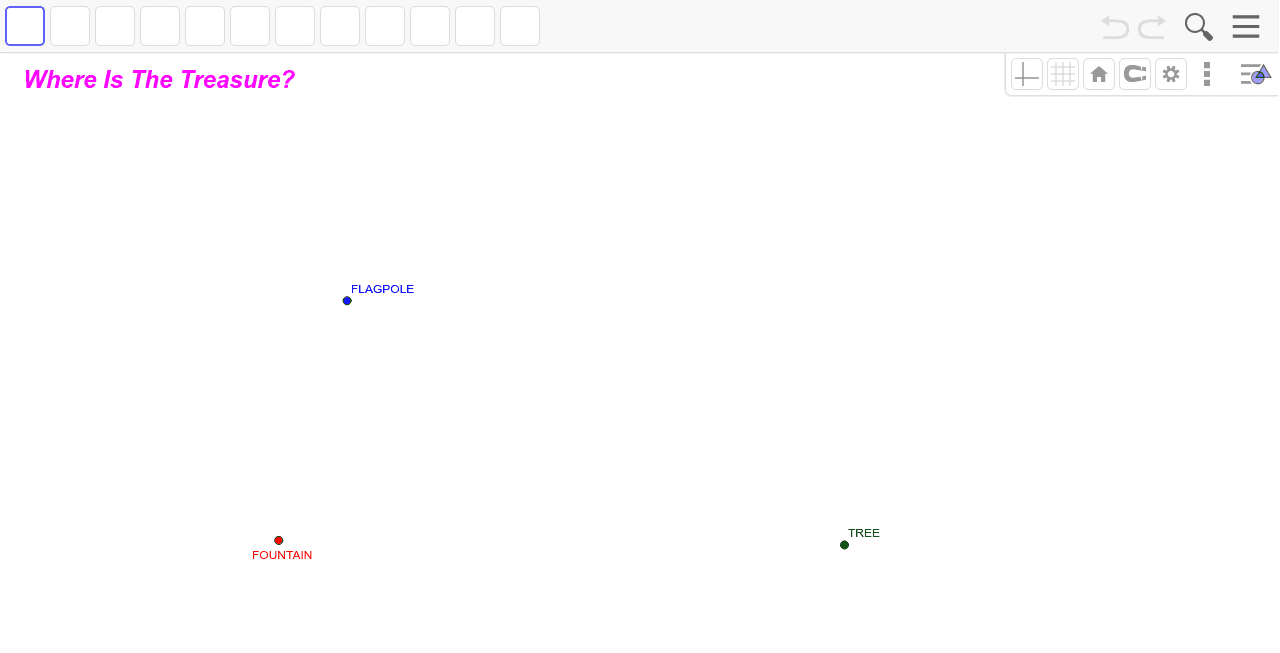
This GeoGebra activity presents a treasure-hunt scenario where students use given clues and various GeoGebra tools to determine the possible location of buried treasure. The core mathematical concepts include similar triangles, similarity transformations, polynomial functions, logarithms, and basic statistics. Students must combine geometric reasoning with algebraic analysis to narrow down the treasure's position. The construction involves creating points A, B, and C as key reference locations, and using a text object (text1) to display clues or instructions. Learners can employ GeoGebra's measurement, transformation, and graphing features to test hypotheses and visualize constraints. This resource is suitable for upper middle school to high school students, supporting exploration of similarity properties, function modeling, and real-world problem solving. It encourages critical thinking, spatial reasoning, and collaborative inquiry.
GeoGebra Commands & Parameters
Point A(-4.530667122439269, -1.1012011485899655)Point B(-2.824482611903437, 4.879819278453232)Point C(9.587540970236352, -1.2136968306033173)
AI Drawing Prompt Reference
Please draw a figure that includes three key points located at coordinates (-4.53, -1.10), (-2.82, 4.88), and (9.59, -1.21). These points will serve as reference locations for a treasure-hunt activity where students use various tools to determine the possible location of buried treasure. The figure should also include a text object to display clues or instructions. Students can employ measurement, transformation, and graphing features to test hypotheses and visualize constraints.
The prompt above was compiled from the original drawing commands and is for reference only.