
What Would a Giraffe See in a Mirror?
Loading the math board and drawing, please wait…
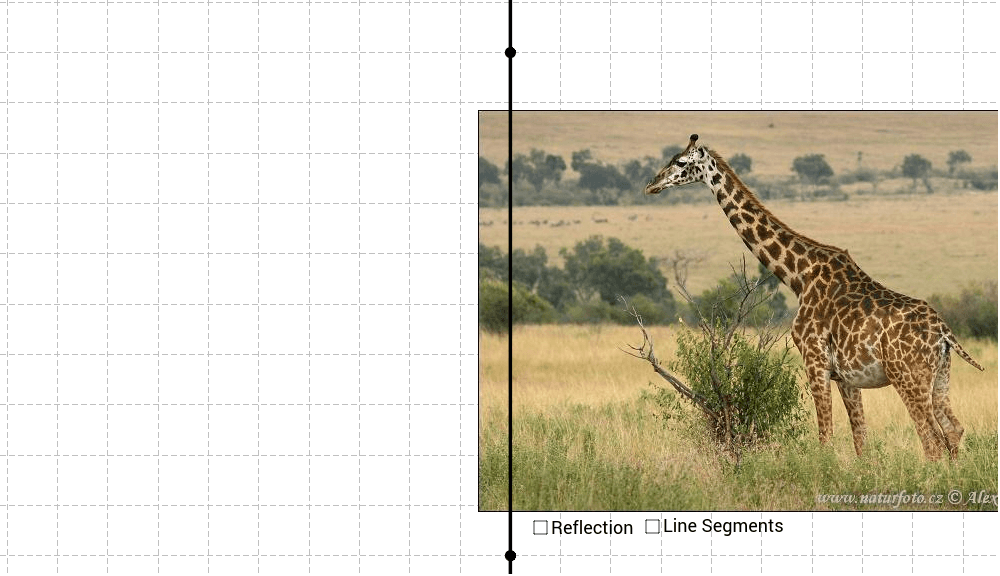
This example uses GeoGebra to demonstrate what a giraffe would see in a mirror, introducing the properties of reflections. By drawing the giraffe's outline and using the Mirror command, students can visually understand the geometric principles of reflection. The construction involves commands such as Line, Polygon, Mirror, and Segment. Suitable for middle school and above students to learn about reflection geometry.
GeoGebra Commands & Parameters
Line(A, B) → aPolygon(C, D, O, P, Q, R, S, T, U, V, W, Z, E, A_1, B_1, C_1, E_1, D_1, F_1, G_1, H_1, I_1, J_1, F, K_1, L_1, M_1, N_1, O_1, P_1, Q_1, R_1, S_1, T_1, G, U_1, V_1, B_2, H, I, K, M, N) → poly1, c, n, o, p, q, r, s, t, u, v, w, d, z, a_1, b_1, c_1, e_1, d_1, f_1, g_1, h_1, i_1, e, j_1, k_1, l_1, m_1, n_1, o_1, p_1, q_1, r_1, s_1, f, t_1, u_1, v_1, b_2, g, h, i, k, mMirror(C, a) → C'Mirror(D, a) → D'Mirror(E, a) → E'Mirror(F, a) → F'Mirror(G, a) → G'Mirror(H, a) → H'Mirror(I, a) → I'Mirror(K, a) → K'Mirror(M, a) → M'Mirror(N, a) → N'Mirror(O, a) → O'Mirror(P, a) → P'Mirror(Q, a) → Q'Mirror(R, a) → R'Mirror(S, a) → S'Mirror(T, a) → T'Mirror(U, a) → U'Mirror(V, a) → V'Mirror(W, a) → W'Mirror(Z, a) → Z'Mirror(A_1, a) → JMirror(B_1, a) → LMirror(C_1, a) → W_1Mirror(E_1, a) → Z_1Mirror(D_1, a) → A_2Mirror(F_1, a) → C_2Mirror(G_1, a) → D_2Mirror(H_1, a) → E_2Mirror(I_1, a) → F_2Mirror(J_1, a) → G_2Mirror(K_1, a) → H_2Mirror(L_1, a) → I_2Mirror(M_1, a) → J_2Mirror(N_1, a) → K_2Mirror(O_1, a) → L_2Mirror(P_1, a) → M_2Mirror(Q_1, a) → N_2Mirror(R_1, a) → O_2Mirror(S_1, a) → P_2Mirror(T_1, a) → Q_2Mirror(U_1, a) → R_2Mirror(V_1, a) → S_2Mirror(B_2, a) → T_2Polygon(C', D', O', P', Q', R', S', T', U', V', W', Z', E', J, L, W_1, Z_1, A_2, C_2, D_2, E_2, F_2, G_2, F', H_2, I_2, J_2, K_2, L_2, M_2, N_2, O_2, P_2, Q_2, G', R_2, S_2, T_2, H', I', K', M', N') → poly1', c', n', o', p', q', r', s', t', u', v', w', d', z', j, l, w_1, z_1, a_2, c_2, d_2, e_2, f_2, e', g_2, h_2, i_2, j_2, k_2, l_2, m_2, n_2, o_2, p_2, f', q_2, r_2, s_2, t_2, g', h', i', k', m'Segment(C', C) → a_3Segment(R_2, U_1) → b_3Segment(I_2, L_1) → c_3Segment(M_2, P_1) → d_3
AI Drawing Prompt Reference
Draw a vertical mirror line. On one side, sketch a giraffe outline as a closed polygon with many vertices forming body, legs, neck, and head. Then reflect every vertex of the giraffe across the mirror line to create corresponding points on the other side, and connect these reflected points in the same order to form the mirror image. Finally, draw two segments connecting a pair of corresponding points across the mirror line to indicate the reflection path. The result shows the original and its mirror image symmetric about the line.
The prompt above was compiled from the original drawing commands and is for reference only.