
What is the Sentry Theorem? A Dynamic Geometry Illustration
Loading the math board and drawing, please wait…
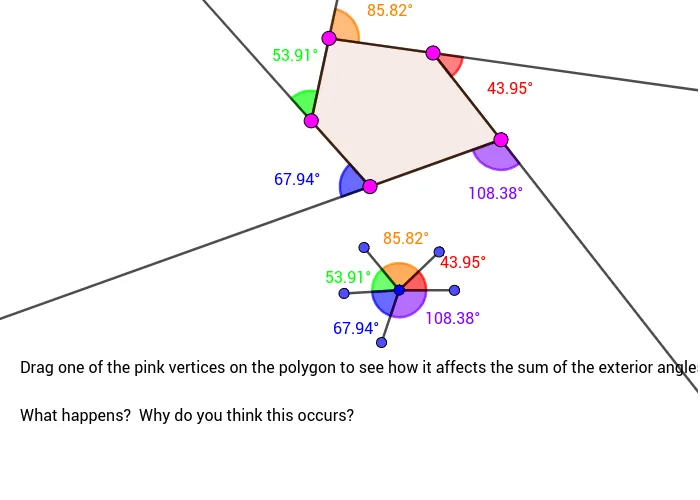
①This GeoGebra example dynamically illustrates the Sentry Theorem, a geometric result often involving polygons, angles, and rotational symmetry. ②Core mathematical concepts include polygon interior angles, rotation, symmetry, and relationships among rays and segments; the original tags also mention parabola, conditional probability, median line, and parametric curves, suggesting a rich multi-topic context. ③Construction details: the commands Polygon, Ray, Angle, Segment, and Rotate are used to create points A, B, C, D, E, polygon poly1, multiple segments and rays (a–j), angle variables (α–κ), and a text label text1, with rotations generating symmetric configurations. ④Suitable for high school or undergraduate geometry courses, this example helps students visualize and explore the theorem's statement and proof, and can serve as a teacher demonstration or a student inquiry tool.
GeoGebra Commands & Parameters
Polygon(A, B, C, D, E) → poly1, a, b, c, d, eRay(B, C) → fRay(C, D) → gRay(D, E) → hRay(E, A) → iRay(A, B) → jAngle(b, j) → αAngle(a, i) → βAngle(e, h) → γAngle(d, g) → δAngle(g, f) → εSegment(G, F) → kRotate(G, γ, F) → G'Segment(G', F) → lRotate(G', δ, F) → G''Segment(F, G'') → mAngle(G, F, G') → ζAngle(G', F, G'') → ηRotate(G'', ε, F) → G'''_1Segment(F, G'''_1) → qAngle(G'', F, G'''_1) → θRotate(G'''_1, α, F) → HSegment(F, H) → nAngle(G'''_1, F, H) → ιAngle(H, F, G) → κ
AI Drawing Prompt Reference
Draw a pentagon with vertices labeled. From each side, extend a ray outward to form exterior angles. Choose a point near the pentagon and draw segments from this point to certain vertices or points on the sides. Rotate these segments around the point by various angles (such as the exterior angles) to create a symmetric pattern of triangles or sectors. Label the angles formed by the rotations and the segments. The final figure should illustrate rotational symmetry and relationships among polygon angles and rotation angles.
The prompt above was compiled from the original drawing commands and is for reference only.