
What Is Congruence (SAS)?
Loading the math board and drawing, please wait…
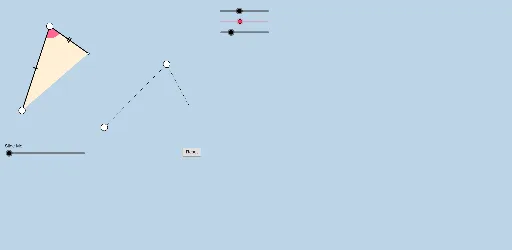
This example demonstrates how to prove triangle congruence using the SAS (Side-Angle-Side) criterion. It involves core mathematical concepts such as triangle congruence, geometric construction, and transformations. Construction highlights include commands like Circle, Point, Segment, Rotate, Angle, Ray, Intersect, Min, Polygon, CircleSector, Mirror, Line, Dilate, Vector, Translate; and objects like a, b, α, A, c, B, f, d, B', β, g, C, h, i, e, k, D, E, poly1, c_1, a_1, b_1, p, F, A', B'_1, C', poly1', c', a', b'_1, p', A'_1, B'_2, f', A'_2, C'_1, i', j, G. Suitable for middle school and above students to learn and understand geometric proofs.
GeoGebra Commands & Parameters
Circle(A, a) → cPoint(c) → BSegment(A, B) → fCircle(A, b) → dRotate(B, α, A) → B'Angle(B, A, B') → βRay(A, B') → gIntersect(d, g, 1) → CSegment(B, C) → hSegment(A, C) → iMin(f, i) → eCircle(A, (0.25 * e)) → kIntersect(k, f) → D,Intersect(k, i) → E,Polygon(A, B, C) → poly1, c_1, a_1, b_1CircleSector(A, D, E) → pMirror(A, h) → A'Mirror(B, h) → B'_1Mirror(C, h) → C'Polygon(A', B'_1, C') → poly1', c', a', b'_1Mirror(p, h) → p'Mirror(A, h) → A'_1Mirror(B, h) → B'_2Segment(A'_1, B'_2) → f'Mirror(A, h) → A'_2Mirror(C, h) → C'_1Segment(A'_2, C'_1) → i'Line(C, B) → jPoint(j) → GPoint(j) → HRay(B, H) → lRay(C, G) → mCircle(F, a) → qPoint(q) → ISegment(F, I) → nRotate(I, α, F) → I'Angle(I, F, I') → γCircle(F, b) → rRay(F, I') → sIntersect(r, s, 1) → JSegment(I, J) → tSegment(F, J) → f_1Dilate(B, If[0 < u ≤ 1, 1 - u, 0], I) → B'_3Vector(B, B'_3) → vTranslate(A, v) → A'_3Translate(B, v) → B'_4Segment(A'_3, B'_4) → f'_1Line(B, n) → g_1Point(g_1) → KAngle(K, B, A) → δRotate(A'_3, If[1 < u ≤ 2, ((-(u - 1)) * δ), (-δ)], I) → LRotate(B'_4, If[1 < u ≤ 2, ((-(u - 1)) * δ), (-δ)], I) → MSegment(L, M) → h_1Dilate(A, If[2 < u ≤ 3, 3 - u, 0], F) → A'_4Vector(A, A'_4) → wTranslate(A, w) → A'_5Translate(C, w) → C'_2Segment(A'_5, C'_2) → i'_1Line(A, f_1) → i_1Point(i_1) → NAngle(N, A, C) → εRotate(A'_5, If[3 < u ≤ 4, ((-(u - 3)) * ε), (-ε)], F) → ORotate(C'_2, If[3 < u ≤ 4, ((-(u - 3)) * ε), (-ε)], F) → PSegment(O, P) → j_1Translate(p, w) → p'_1Rotate(p'_1, If[3 < u ≤ 4, ((-(u - 3)) * ε), (-ε)], F) → d_1Dilate(B, If[4 < u ≤ 5, 5 - u, 0], I) → B'_5Vector(B, B'_5) → u_1Translate(A, u_1) → A'_6Translate(B, u_1) → B'_6Translate(C, u_1) → C'_3Polygon(A'_6, B'_6, C'_3) → poly1'_1, c'_3, a'_6, b'_6Line(B, t) → k_1Point(k_1) → QAngle(Q, B, C) → ζRotate(A'_6, If[5 < u ≤ 6, ((-(u - 5)) * ε), (-ε)], I) → RRotate(B'_6, If[5 < u ≤ 6, ((-(u - 5)) * ε), (-ε)], I) → SRotate(C'_3, If[5 < u ≤ 6, ((-(u - 5)) * ε), (-ε)], I) → TPolygon(R, S, T) → poly2, t_1, r_1, s_1Segment(B, A) → l_1Segment(A, C) → m_1Segment(C, B) → n_1CircleSector(A, D, E) → e_1