
Congruence of Triangles (SSS)
Loading the math board and drawing, please wait…
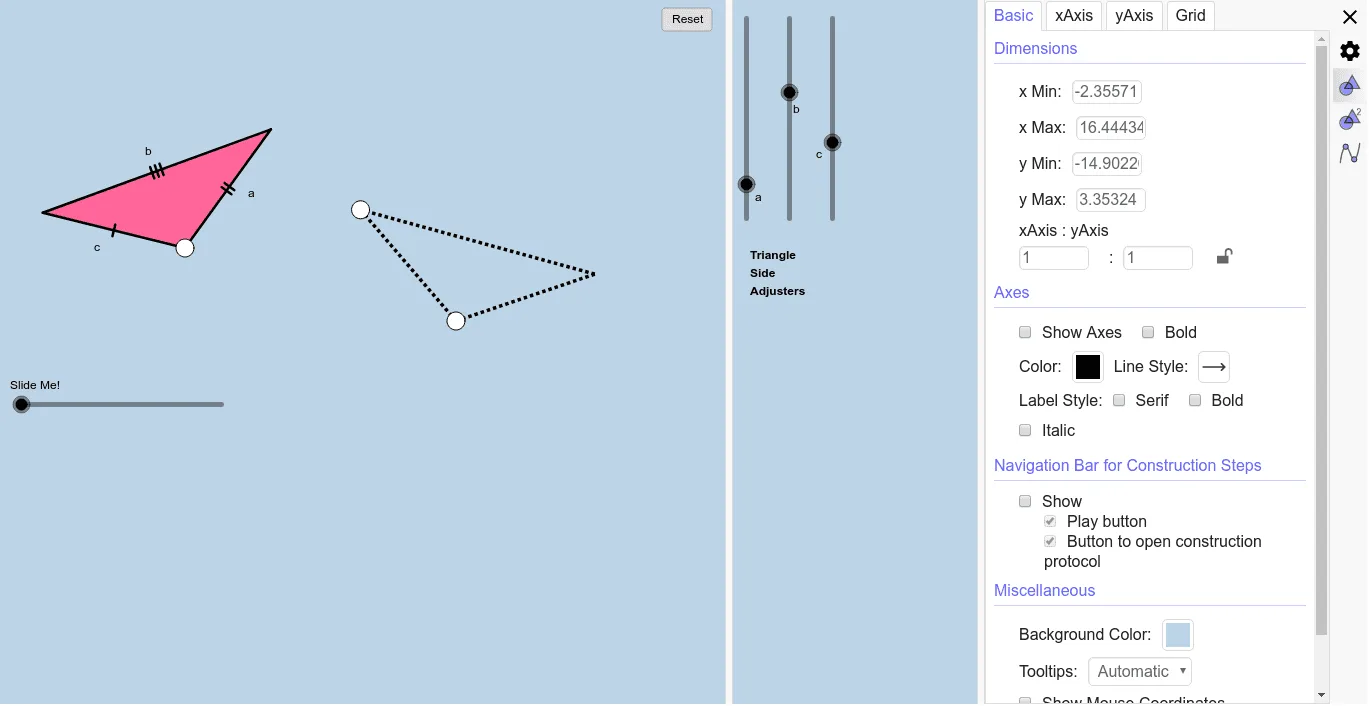
This example illustrates the concept of congruent triangles, particularly the SSS (Side-Side-Side) condition. Key mathematical concepts include the conditions for triangle congruence. Using GeoGebra commands such as Circle, Intersect, Segment, and Polygon, the construction of triangles satisfying the SSS condition is demonstrated. Suitable for middle school and above students to learn about geometric construction and properties of congruent triangles.
GeoGebra Commands & Parameters
Circle(A, a) → d_1Intersect(d_1, e) → B, CCircle(C, b) → fSegment(A, C) → gCircle(A, c) → kIntersect(k, f) → F, G, ,Segment(C, F) → hSegment(F, A) → iPolygon(A, C, F) → poly1, f_1, a_1, c_1Circle(D, i) → pPoint(p) → ESegment(D, E) → nCircle(D, g) → qCircle(E, h) → rIntersect(q, r, 2) → HSegment(D, H) → sSegment(H, E) → tLine(A, n) → g_1Point(g_1) → IAngle(I, A, F) → αDilate(A, If[0 < o ≤ 1, 1 - o, 0], D) → A'Vector(A, A') → uTranslate(F, u) → F'Translate(A, u) → A'_1Segment(F', A'_1) → i'Rotate(F', If[1 < o ≤ 2, ((-(o - 1)) * α), (-α)], D) → F''Rotate(A'_1, If[1 < o ≤ 2, ((-(o - 1)) * α), (-α)], D) → JSegment(F'', J) → i''Dilate(A, If[2 < o ≤ 3, 3 - o, 0], D) → A'_2Vector(A, A'_2) → vTranslate(A, v) → A'_3Translate(C, v) → C'Segment(A'_3, C') → g'Line(D, g) → h_1Point(h_1) → KAngle(H, D, K) → βRotate(A'_3, If[3 < o ≤ 4, ((-(o - 3)) * β), (-β)], D) → LRotate(C', If[3 < o ≤ 4, ((-(o - 3)) * β), (-β)], D) → C''Segment(L, C'') → g''Line(C, t) → i_1Point(i_1) → MAngle(M, C, F) → γDilate(C, If[4 < o ≤ 5, 5 - o, 0], C'') → C'_1Vector(C, C'_1) → wTranslate(C, w) → C'_2Translate(F, w) → F'_1Segment(C'_2, F'_1) → h'Rotate(C'_2, If[5 < o ≤ 6, ((-(o - 5)) * γ), (-γ)], C'') → NRotate(F'_1, If[5 < o ≤ 6, ((-(o - 5)) * γ), (-γ)], C'') → OSegment(N, O) → h''Line(F, C) → j_1Mirror(A, j_1) → A'_6Mirror(C, j_1) → C'_4Mirror(F, j_1) → F'_3Polygon(A'_6, C'_4, F'_3) → poly1'_1, f'_3, a'_6, c'_4Point(j_1) → SPoint(j_1) → TRay(C'_4, T) → k_1Ray(F'_3, S) → l_1Segment(A'_6, F'_3) → m_1Segment(A'_6, C'_4) → n_1Dilate(F, If[0 < d ≤ 1, 1 - d, 0], E) → F'_2Vector(F, F'_2) → u_1Translate(A'_6, u_1) → PTranslate(C'_4, u_1) → QTranslate(F'_3, u_1) → RPolygon(P, Q, R) → poly2, r_1, p_1, q_1Translate(A'_6, u_1) → UTranslate(C'_4, u_1) → VSegment(U, V) → s_1Translate(A'_6, u_1) → WTranslate(F'_3, u_1) → ZSegment(W, Z) → t_1Translate(C, u_1) → C'_3Translate(F, u_1) → F'_4Segment(C'_3, F'_4) → h'_1Translate(A'_6, u_1) → A_1Translate(F'_3, u_1) → B_1Segment(A_1, B_1) → e_1Line(E, k_1) → f_2Point(f_2) → C_1Angle(C'', E, C_1) → δRotate(P, If[1 < d ≤ 2, ((-(d - 1)) * δ), (-δ)], E) → P'Rotate(Q, If[1 < d ≤ 2, ((-(d - 1)) * δ), (-δ)], E) → Q'Rotate(R, If[1 < d ≤ 2, ((-(d - 1)) * δ), (-δ)], E) → R'Polygon(P', Q', R') → poly2', r', p', q'Rotate(A_1, If[1 < d ≤ 2, ((-(d - 1)) * δ), (-δ)], E) → D_1Rotate(B_1, If[1 < d ≤ 2, ((-(d - 1)) * δ), (-δ)], E) → E_1Segment(D_1, E_1) → g_2Rotate(U, If[1 < d ≤ 2, ((-(d - 1)) * δ), (-δ)], E) → U'Rotate(V, If[1 < d ≤ 2, ((-(d - 1)) * δ), (-δ)], E) → V'Segment(U', V') → h_2Rotate(C'_3, If[1 < d ≤ 2, ((-(d - 1)) * δ), (-δ)], E) → F_1Rotate(F'_4, If[1 < d ≤ 2, ((-(d - 1)) * δ), (-δ)], E) → G_1Segment(F_1, G_1) → i_2Polygon(D, C'', E) → poly3, e_2, d_2, c''Dilate(D, If[2.5 < d ≤ 3.5, 3.5 - d, 0], D_1) → D'Segment(D, D') → j_2Segment(E, C'') → k_2Min(c, k_2 / 2) → o_1Circle(D, (0.3 * o_1)) → c_2Intersect(c_2, i'') → H_1,Intersect(c_2, j_2) → I_1,CircleSector(D, I_1, H_1) → p_2Intersect(j_2, k_2) → J_1Polygon(D, D_1, E) → poly4, e_3, d_3, d_4Dilate(D, If[3.5 < d ≤ 4.5, 4.5 - d, 0], D_1) → D'_1Vector(D, D'_1) → v_1Translate(p_2, v_1) → q_2Angle(E, D_1, D) → εRotate(q_2, If[4.5 < d ≤ 5.5, ((d - 4.5) * (π - ε)), π - ε], D_1) → r_2Intersect(c_2, g'') → K_1, L_1CircleSector(D, K_1, I_1) → s_2Polygon(D, C'', D_1) → poly5, d_5, d_6, c''_1Dilate(D, If[6 < d ≤ 7, 7 - d, 0], D_1) → D'_2Vector(D, D'_2) → w_1Translate(s_2, w_1) → t_2Angle(D, D_1, C'') → ζRotate(t_2, If[7 < d ≤ 8, ((-(d - 7)) * (π - ζ)), (-(π - ζ))], D_1) → c_3Dilate(E, If[8.5 < d ≤ 9.5, 9.5 - d, 0], C'') → E'Segment(E, E') → l_2Segment(E, C'') → m_2Polygon(A, C, F) → poly6, f_3, a_2, c_4Polygon(D, C'', E) → poly7, e_4, d_7, c''_2