
Volumes of Mouhefanggais and Spheres
Loading the math board and drawing, please wait…
In collections
Volumes and Surface Areas of Pyramids, Cones and Spheres
Volumes in Ancient Chinese Mathematics 中國古算中的體積
Volumes of Pyramid and Sphere in Ancient Chinese Mathematics
Volume of Spheres in Ancient Chinese Mathematics
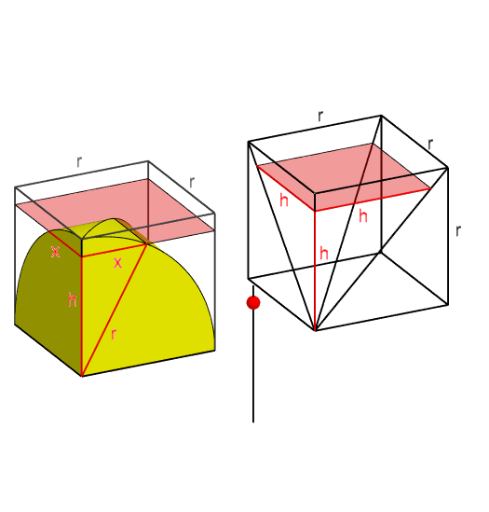
This example demonstrates the geometric relationship and volume calculation between Mouhefanggais and spheres. It involves core mathematical concepts such as solid geometry, volume computation, and geometric construction. The construction utilizes GeoGebra commands and objects like Point, Sequence, CircleSector, Polygon, CircleArc, Segment, Prism, OrthogonalPlane, If, Intersect, Surface, CurveCartesian, and Translate. It is suitable for high school and above, aiding in exploring solid geometry volume problems.
GeoGebra Commands & Parameters
Point(Segment[I, I + (0, 0, 1)]) → PSequence(Polygon[((-sin(θ)), (-sin(θ)), 1 - cos(θ)), (sin(θ), (-sin(θ)), 1 - cos(θ)), (sin(θ), sin(θ), 1 - cos(θ)), ((-sin(θ)), sin(θ), 1 - cos(θ))], θ, 0, π, π / n) → list4CircleSector((0, 0, 0), (0, 0, 1), (-1, 0, 0)) → dCircleSector((0, 0, 0), (0, 1, 0), (0, 0, 1)) → gPolygon((0, 0), (-1, 0), (-1, 1), (0, 1)) → poly1, i, j, k, lCircleArc((0, 0, 0), (0, 1, 0), (0, 0, 1)) → hSegment((0, 0, 0), (0, 0, 1)) → mPrism(Polygon[A, B, C, D], F) → a, G, edgeBI, edgeCJ, edgeDK, edgeFI, edgeIJ, edgeJK, edgeFK, H, E, faceABIF, faceBCJI, faceCDKJ, faceADKF, faceFIJK, edgeAFSegment(B, F) → pSegment(B, E) → qSegment(B, H) → sSegment(I, I + (0, 0, 1)) → tOrthogonalPlane(P, t) → uPrism(Polygon[(0, 0, 0), (-1, 0, 0), (-1, 1, 0), (0, 1, 0)], -1) → v, M, edge1, edge2, edge3, edge4, edge5, edge6, edge7, edge8, N, O, Q, face1, face2, face3, face4, face5If(z(P) ≠ 1, (0, sqrt(1 - z(P)^(2)), z(P)), (0, 0, 1)) → KIf(z(P) ≠ 1, ((-sqrt(1 - z(P)^(2))), 0, z(P)), (0, 0, 1)) → LIntersect(q, u) → UIntersect(p, u) → VIntersect(edgeBI, u) → WIntersect(s, u) → ZSurface((s * sqrt(1 - t^(2))), sqrt(1 - t^(2)), t, s, -1, 0, t, 0, 1) → cSurface((-sqrt(1 - t^(2))), (s * sqrt(1 - t^(2))), t, s, 0, 1, t, 0, 1) → bCircleArc((0, 0, 0), (0, 0, 1), (-1, 0, 0)) → eCurveCartesian((-sqrt(1 - t^(2))), sqrt(1 - t^(2)), t, t, 0, 1) → fIntersect(edge4, u) → RIntersect(edge3, u) → SIf(z(P) ≠ 1, ((-sqrt(1 - z(P)^(2))), sqrt(1 - z(P)^(2)), z(P)), (0, 0, 1)) → JIntersect(edge2, u) → TTranslate(Polygon[K, R, S, T, L, J], Vector[(0, 0)]) → poly2Segment((0, 0, 0), K) → f_1Segment(A_1, K) → g_1Segment((0, 0, 0), A_1) → h_1Segment(B, W) → j_1Translate(Polygon[W, Z, U, V], Vector[(0, 0)]) → poly3Segment(W, Z) → i_1Translate(Polygon[K, R, S, T, L, J], Vector[(0, 0)]) → poly4Translate(Polygon[W, Z, U, V], Vector[(0, 0)]) → poly5Segment(G, W) → k_1Segment(A_1, (0, 0, 1)) → l_1Segment(L, A_1) → m_1Segment(V, W) → n_1Segment(A, B) → p_1Segment(B, C) → q_1Segment(C, D) → r_1Segment(D, A) → s_1Segment((0, 0), (0, 1)) → t_1Segment((0, 0), (-1, 0)) → b_1Segment((-1, 1), (0, 1)) → c_1Segment((-1, 0), (-1, 1)) → d_1