
Volume of Solids of Revolution by Ravinder Kumar
Loading the math board and drawing, please wait…
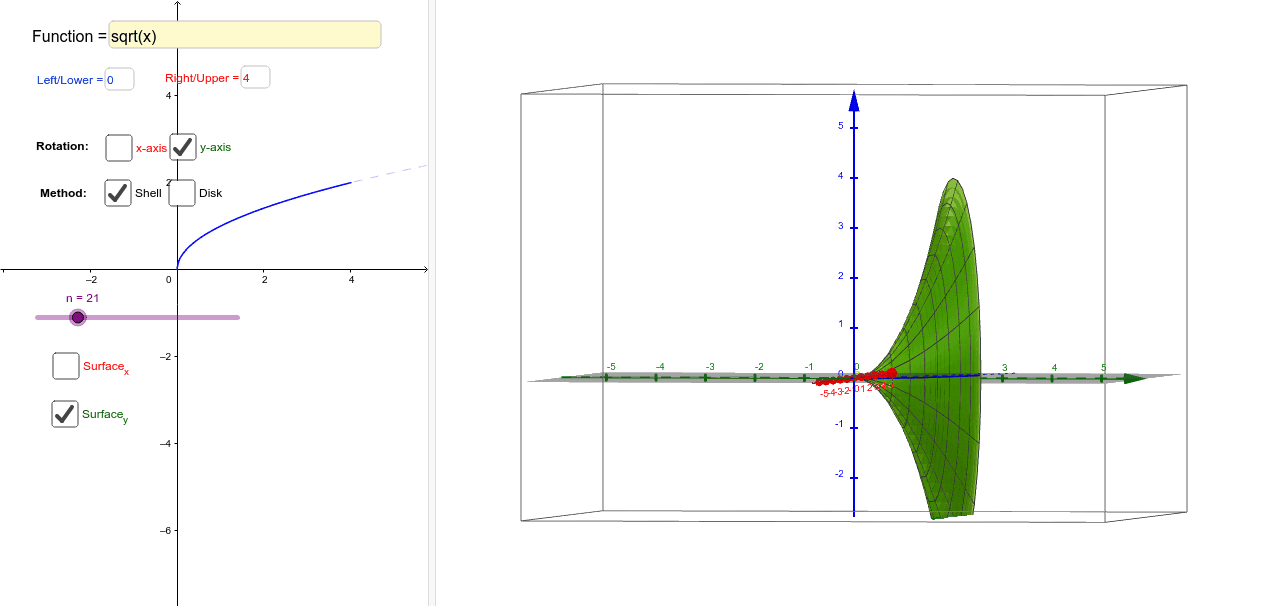
This GeoGebra applet demonstrates the disk and shell methods to find the volume of solids of revolution about the x-axis and y-axis. Users can input a function and observe the volume changes under different methods. The core mathematical concepts involved include functions, integration in calculus, and the calculation of volumes of solids of revolution. Using commands like Textfield, Sequence, and Surface, users can dynamically adjust the function and axis of rotation to better understand these concepts. Suitable for high school mathematics education and learning.
GeoGebra Commands & Parameters
Textfield(g) → InputBox1Textfield(ll) → InputBox2Textfield(ru) → InputBox3Sequence(ll + (i * ht), i, 0, n) → list1Surface(f, (2 * π)) → eSequence(Cylinder[(list1(i), 0, 0), (list1(i + 1), 0, 0), f(list1(i))], i, 0, n - 1) → listd00Surface((u * cos(v)), f(u), (u * sin(v)), u, (i * i), ru, v, 0, (2 * π)) → hSequence(QuadricSide[Cylinder[(0, f(list1(i)), 0), (0, f(ru), 0), list1(i)]], i, 1, n + 1) → listsySequence(QuadricSide[Cylinder[(list1(i), 0, 0), (ru, 0, 0), f(list1(i))]], i, 1, n + 1) → listsxSequence({QuadricSide[Cylinder[(0, f(list1(i)), 0), (0, f(list1(i + 1)), 0), list1(i)]], Bottom[Cylinder[(0, f(list1(i)), 0), (0, f(list1(i + 1)), 0), list1(i)]], Top[Cylinder[(0, f(list1(i)), 0), (0, f(list1(i + 1)), 0), list1(i)]]}, i, 1, n + 1) → listdySequence({QuadricSide[Cylinder[(list1(i), 0, 0), (list1(i + 1), 0, 0), f(list1(i))]], Top[Cylinder[(list1(i), 0, 0), (list1(i + 1), 0, 0), f(list1(i))]], Bottom[Cylinder[(list1(i), 0, 0), (list1(i + 1), 0, 0), f(list1(i))]]}, i, 1, n + 1) → listdx