
Volume of Revolution: Washer Method
Loading the math board and drawing, please wait…
In collections
Calculus - Applications of Integrals - Areas and Volumes
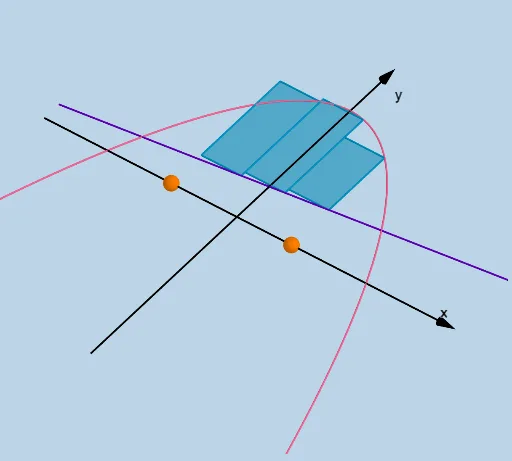
This example demonstrates the Washer Method for calculating the volume of revolution. Key mathematical concepts include integration and solid geometry. Using GeoGebra commands such as Polygon, Surface, Sequence, and Rotate, the formation of the solid of revolution is dynamically illustrated. Suitable for high school mathematics education and learning.
GeoGebra Commands & Parameters
Polygon(A, B, D, C) → q1, a_1, b_1, d, cSurface(x(B), ((u * y(D)) * cos(v)), ((u * y(D)) * sin(v)), u, 0, 1, v, 0, α) → fSurface(x(A), ((u * y(D)) * cos(v)), ((u * y(D)) * sin(v)), u, 0, 1, v, 0, α) → gSequence(Surface[a + (i * deltax) + (deltax * u), (h(a + ((i + 1) * deltax)) * cos(v)), (h(a + ((i + 1) * deltax)) * sin(v)), u, 0, 1, v, 0, α], i, 0, n - 1, 1) → L_4Sequence(Polygon[(a + (i * deltax), p(a + ((i + 1) * deltax))), (a + ((i + 1) * deltax), p(a + ((i + 1) * deltax))), (a + ((i + 1) * deltax), h(a + ((i + 1) * deltax))), (a + (i * deltax), h(a + ((i + 1) * deltax)))], i, 0, n - 1) → diffrectanglesSequence(Surface[a + (i * deltax) + (deltax * u), (p(a + ((i + 1) * deltax)) * cos(v)), (p(a + ((i + 1) * deltax)) * sin(v)), u, 0, 1, v, 0, α], i, 0, n - 1, 1) → l1Rotate(diffrectangles, α, xAxis) → diffrectangles'Textfield(h) → InputBox1Textfield(p) → InputBox2Textfield(a) → InputBox3Textfield(b) → InputBox4Textfield(n) → InputBox5Sequence(Surface[a + (i * deltax), (cos(v) * ((h(a + (i * deltax)) * u) + (p(a + (i * deltax)) * (1 - u)))), (sin(v) * ((h(a + (i * deltax)) * u) + (p(a + (i * deltax)) * (1 - u)))), u, 0, 1, v, 0, α], i, 1, n, 1) → L_2Sequence(Surface[a + ((i - 1) * deltax), (cos(v) * ((h(a + (i * deltax)) * u) + (p(a + (i * deltax)) * (1 - u)))), (sin(v) * ((h(a + (i * deltax)) * u) + (p(a + (i * deltax)) * (1 - u)))), u, 0, 1, v, 0, α], i, 1, n, 1) → L_3