
Volume of Revolution Using Cylindrical Shells Method
Loading the math board and drawing, please wait…
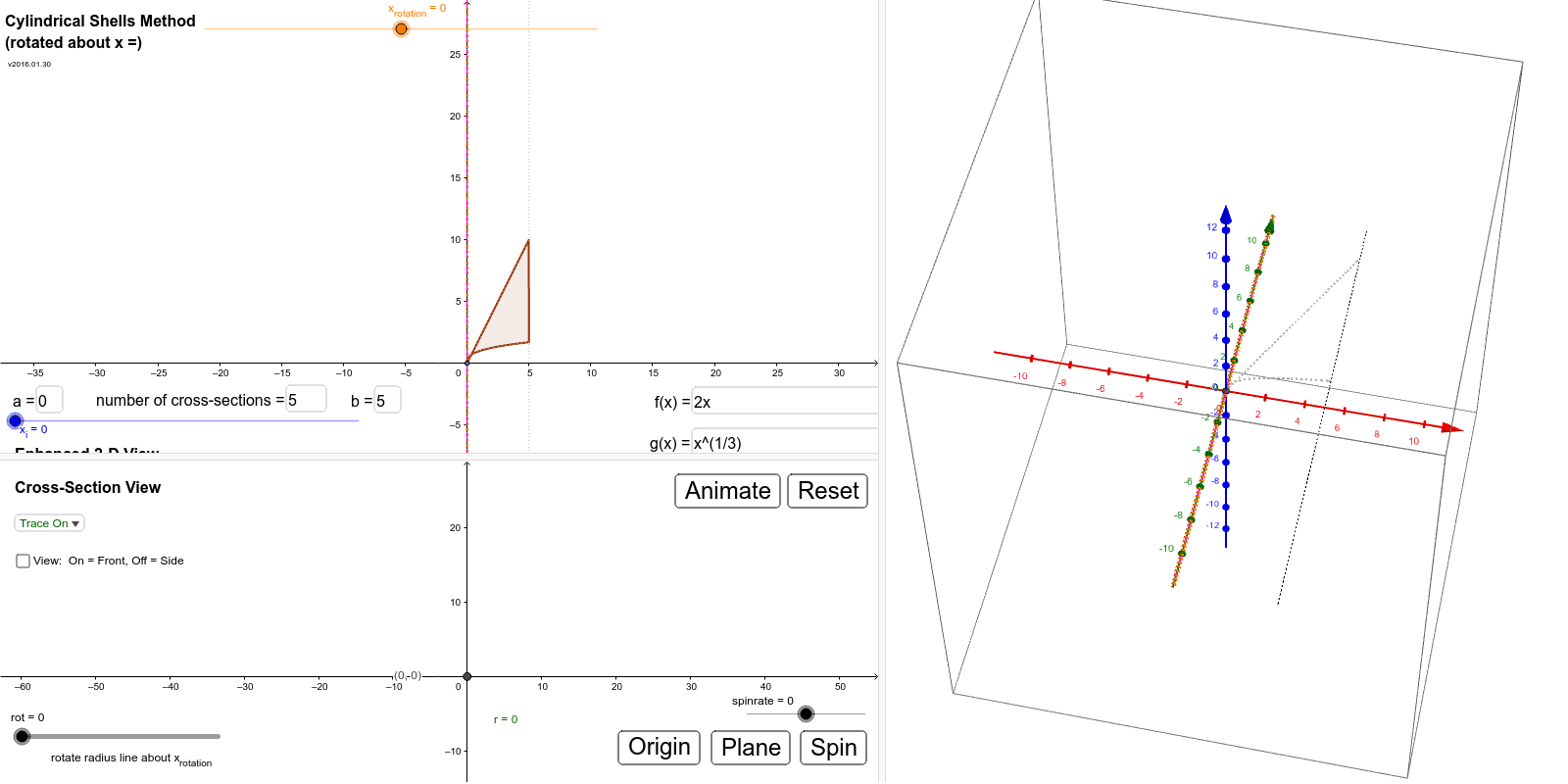
This example demonstrates the process of calculating the volume of a solid of revolution using the cylindrical shells method. Users can set two functions, integration limits, axis of rotation, and the number of cross-sections. By adjusting parameters, one can observe the formation of the solid of revolution. Key mathematical concepts include integration in calculus and the calculation of the volume of a solid of revolution. GeoGebra commands used include Intersect, Textfield, IntegralBetween, etc. Suitable for high school and above students for learning and teachers for teaching.
GeoGebra Commands & Parameters
Intersect(g, l_c, (0, 0)) → P_{gc}Intersect(f, l_c, (0, 0)) → P_{fc}Textfield(a) → inputBox_aTextfield(b) → inputBox_bIntersect(f, l_b, (5, 10)) → P_{fb}Intersect(g, l_b, (5, 1.7099759466766968)) → P_{gb}Intersect(f, l_a, (0, 0)) → P_{fa}Intersect(g, l_a, (0, 0)) → P_{ga}IntegralBetween(f, g, Min[x(P_{fa}), x(P_{ga})], Max[x(P_{fb}), x(P_{gb})]) → RTextfield(x_{rotation}) → inputBox_{yr}Segment(P_{fc}, P_{gc}) → h_1Segment(P_{fh2}, P_{gh2}) → h_2Segment((x_{rotation}, y(P_{fc})), (x_{rotation} + radi, y(P_{fc}))) → rIntersect(cs1_f, l_r) → P_{yr1}, P_{yr2}Segment(P_{yr1}, P_{yr2}) → x_{rotation2}Segment(P_{fc}, P_{gc}) → h_{1a}Sequence(Segment[Rotate[P_{fc}, i°, l_r], Rotate[P_{gc}, i°, l_r]], i, 0, 360, 1) → cylsegCircle((x_{rotation}, y(P_{fc})), radi, yAxis) → cs3_fCircle((x_{rotation}, y(P_{gc})), radi, yAxis) → cs3_gTextfield(n) → InputBox_nPlane((x_i, x_{rotation}, radi), x = x_i) → pln3dLine(Rotate[P_{fc}, rot°, l_r], Rotate[P_{gc}, rot°, l_r]) → l_{cr}SelectedIndex(lstTraceOpt) → lstTOIndexTextfield(tg) → InputBox_gTextfield(tf) → InputBox_f
AI Drawing Prompt Reference
Draw a solid of revolution formed by rotating two functions f and g around the y-axis, and observe the process of calculating its volume using the cylindrical shells method by adjusting the functions, integration limits, and rotation axis. First, plot the graphs of the two functions, then set the integration limits, draw the rotation axis and the intersection points of the functions with the axis, use these points to calculate the volume, and finally show the formation of the solid of revolution.
The prompt above was compiled from the original drawing commands and is for reference only.