
Volume of Revolution by tenkosky
Loading the math board and drawing, please wait…
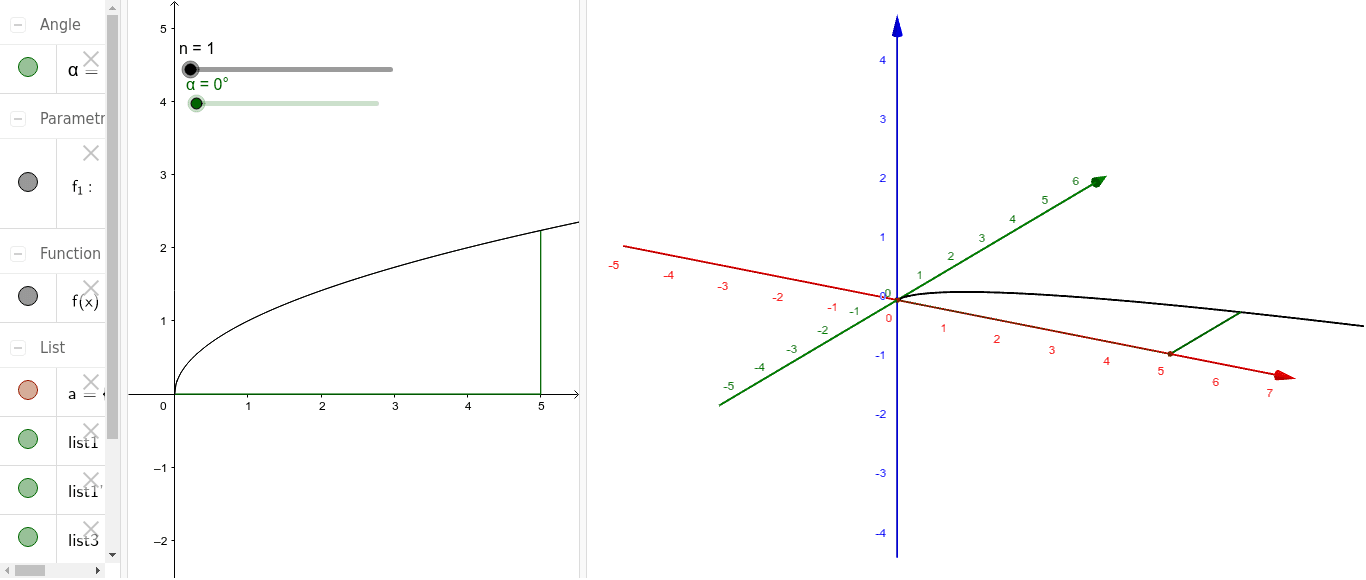
This example demonstrates the calculation of the volume of a solid of revolution. Key mathematical concepts include functions, rotation, and solid geometry. Using GeoGebra commands such as Sequence and Rotate, the example constructs the rotated function graph and calculates the volume of the solid. Suitable for high school mathematics education and learning.
GeoGebra Commands & Parameters
Sequence(Segment[((i * 5 / n), 0), ((i * 5 / n), f((i * 5 / n)))], i, 0, n, 1) → list3Rotate(f, α, xAxis) → f_1Sequence(Cylinder[((i * 5 / n), 0), (((i + 1) * 5 / n), 0), f((i * 5 / n))], i, 0, n - 1, 1) → aSequence(Segment[((i * 5 / n), f((i * 5 / n))), (((i + 1) * 5 / n), f((i * 5 / n)))], i, 0, n - 1, 1) → list1Rotate(list3, α, xAxis) → list3'Rotate(list1, α, xAxis) → list1'
AI Drawing Prompt Reference
Draw a graph of a solid of revolution. The graph consists of vertical line segments and cylinders. These segments and cylinders rotate around an axis to form a volume. The height of the segments is determined by function values, and the cylinders' bases and heights are related to the segments. The construction order is to first draw the segments and cylinders, then rotate them around the axis to form the solid.
The prompt above was compiled from the original drawing commands and is for reference only.