
Volume by Shells by tenkosky
Loading the math board and drawing, please wait…
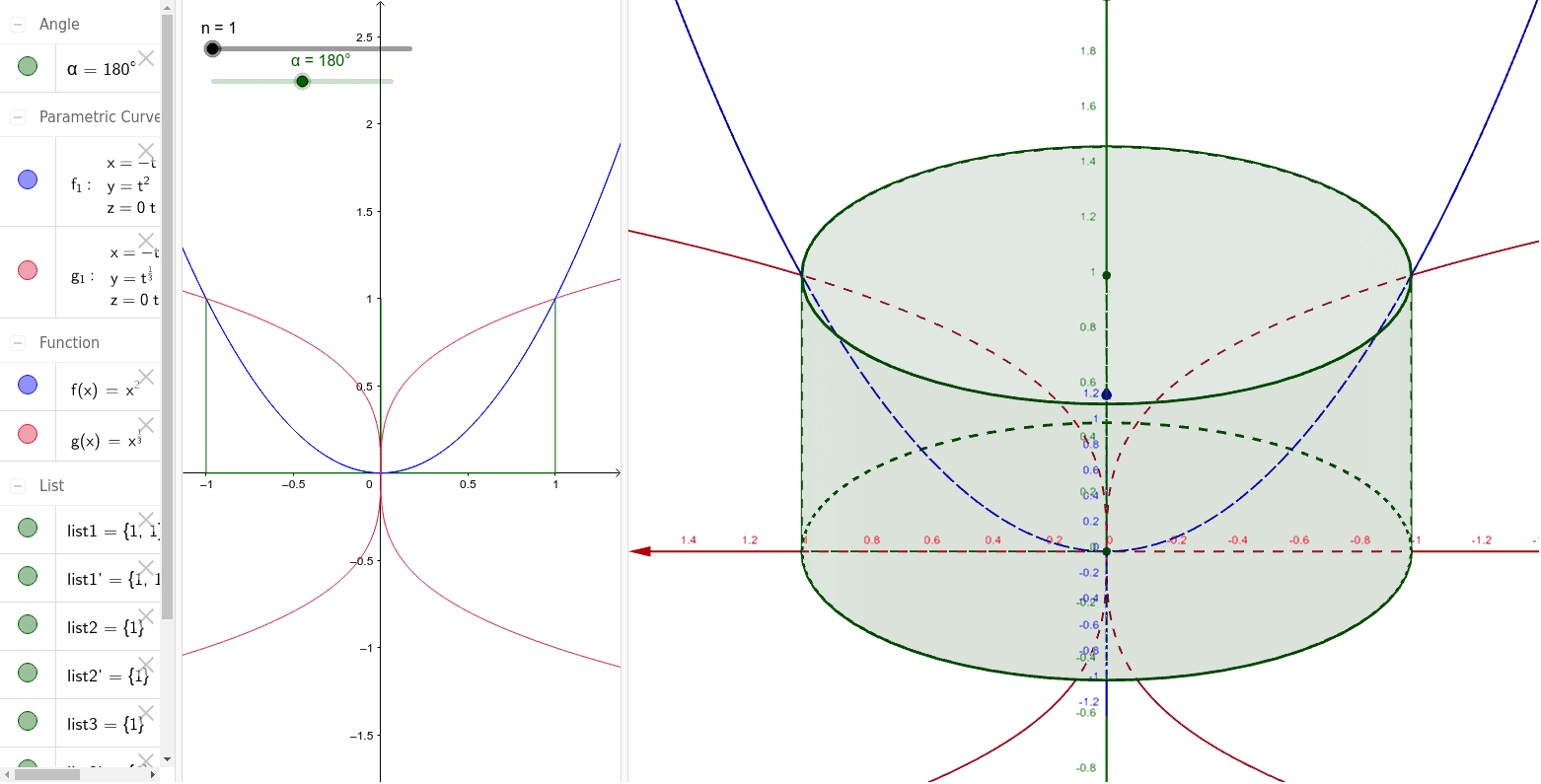
This example demonstrates the calculation of the volume of a solid of revolution using the shell method, visually illustrating the concept of integration. Key mathematical concepts include integration, the shell method in differential calculus, and the calculation of volumes of rotated solids. It utilizes GeoGebra commands such as Sequence and Rotate, involving objects like functions f, g, rotation count n, lists list1, list2, list3, and rotation angle α. Suitable for high school students and learners needing to understand the method for calculating volumes of rotated solids.
GeoGebra Commands & Parameters
Sequence(Segment[(i / n, f(i / n)), ((i + 1) / n, f(i / n))], i, 0, n - 1, 1) → list2Sequence(Segment[(i / n, g(i / n)), ((i + 1) / n, g(i / n))], i, 0, n - 1, 1) → list3Sequence(Segment[(i / n, f((i - 1) / n)), (i / n, g(i / n))], i, 0, n, 1) → list1Rotate(f, α, yAxis) → f_1Rotate(g, α, yAxis) → g_1Rotate(list1, α, yAxis) → list1'Rotate(list2, α, yAxis) → list2'Rotate(list3, α, yAxis) → list3'Sequence(Cylinder[(0, f((i - 1) / n)), (0, g(i / n)), i / n], i, 0, n, 1) → list4
AI Drawing Prompt Reference
Visualize the volume calculation of a solid of revolution using the shell method, illustrating the concept of integration. Include two function curves and their rotated images, with cylindrical elements representing volume elements. Start by drawing the function curves and line segments connecting them, then rotate these elements around an axis to form the rotated curves and cylinders, finally combining all parts to show the solid and its shell structure.
The prompt above was compiled from the original drawing commands and is for reference only.